




Micro Vickers Hardness Test: Principles, Applications and Benefits

Introduction to the Micro Vickers Hardness Test
Stránka micro Vickers hardness test is a highly precise hardness testing method used to evaluate very small areas, thin materials, coatings, and microstructural features. Unlike conventional hardness tests that apply relatively large forces, the micro Vickers method uses extremely light loads to create tiny indentations that can be accurately measured under a microscope.
This testing technique is widely used in metallurgy, aerospace, electronics, automotive manufacturing, and research laboratories where detailed hardness analysis is required. It allows engineers and researchers to assess hardness variations within microscopic regions of a material, making it an essential tool for quality control and material development.
As materials become more advanced and manufacturing tolerances become tighter, the importance of micro Vickers hardness testing continues to grow.
What Is a Micro Vickers Hardness Test?
Vymedzenie pojmu a účel
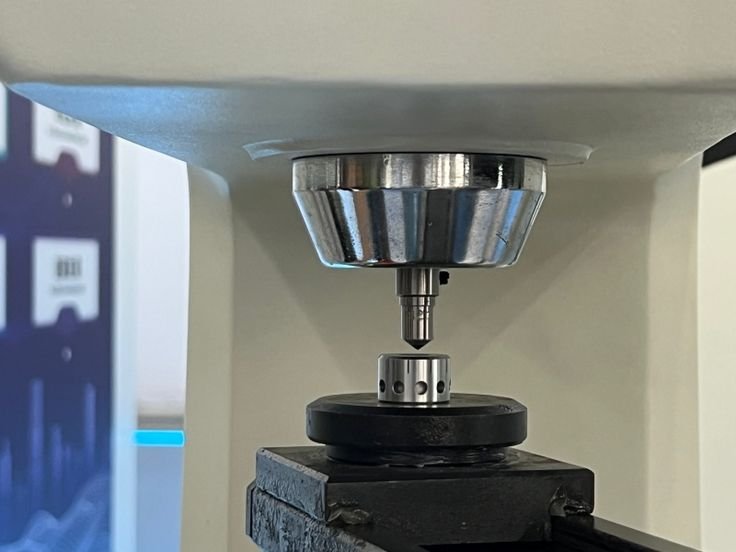
Stránka micro Vickers hardness test is a microhardness testing method that uses a diamond pyramid indenter and low test loads to measure a material’s resistance to indentation.
The test is commonly used to:
- Measure thin coatings
- Evaluate surface treatments
- Analýza mikroštruktúr
- Inspect weld zones
- Test small precision components
- Support metallurgical investigations
Differences Between Vickers and Micro Vickers Testing
Although both methods use the same diamond pyramid indenter, the primary difference lies in the applied force.
| Funkcia | Standard Vickers | Mikro-Vickers |
|---|---|---|
| Test Load | Higher Loads | Very Low Loads |
| Aplikácia | Bulk Materials | Small Features |
| Indentation Size | Larger | Microscopic |
| Precision Analysis | Dobré | Vynikajúce |
Micro Vickers testing is specifically designed for highly localized hardness measurements.
How the Micro Vickers Hardness Test Works
Testing Principle
The test involves pressing a diamond pyramid indenter into the material surface using a very small load.
After the load is removed, the indentation is measured under high magnification.
Diamantový pyramídový vtlačovač
The indenter features:
This standardized geometry ensures accurate and repeatable hardness measurements.
Low Test Loads and Precision Measurement
Typical micro Vickers loads range from:
- 10 gf
- 25 gf
- 50 gf
- 100 gf
- 200 gf
- 500 gf
- 1000 gf
These low forces produce extremely small indentations suitable for microscopic analysis.
Micro Vickers Hardness Values Explained
Understanding HV Results
Results are reported using the Vickers hardness scale (HV).
Examples include:
- 250 HV0.1
- 450 HV0.2
- 700 HV0.5
The number after HV indicates the test load used.
Factors Influencing Measurement Accuracy
Several factors affect testing accuracy:
- Surface preparation quality
- Optical calibration
- Test load selection
- Material homogeneity
- Operator skill
Proper specimen preparation is particularly important in microhardness testing.
Micro Vickers Hardness Test Procedure
Požiadavky na prípravu vzoriek
Microhardness testing requires careful sample preparation.
The surface should be:
- Flat
- Clean
- Polished
- Free from contamination
Improper preparation can significantly affect results.
Applying the Test Load
The selected load is applied through the diamond indenter for a specified dwell time.
Measuring Indentation Diagonals
After testing, the two diagonals of the indentation are measured using:
- Optické mikroskopy
- Digital imaging systems
- Automated analysis software
Calculating Hardness Values
Modern systems automatically calculate hardness values based on:
- Test load
- Indentation dimensions
This improves efficiency and reduces human error.
Equipment Used for Micro Vickers Hardness Testing
Micro Vickers Hardness Testers
Common equipment types include:
- Manual microhardness testers
- Digital microhardness testers
- Fully automated systems
Optické meracie systémy
Väčšina systémov obsahuje:
- High-magnification microscopes
- Precision optics
- Measurement reticles
Digital Imaging and Analysis Software
Advanced software enables:
- Automatická detekcia odsadenia
- Výpočty tvrdosti
- Štatistická analýza
- Vytváranie správ
Automatizované testovacie systémy
Automated solutions offer:
- Motorizované stolíky
- Auto-focus functions
- Batch testing capabilities
- Data management integration
These features improve productivity and repeatability.
Advantages of the Micro Vickers Hardness Test
The micro Vickers method offers numerous benefits:
- Exceptional measurement precision
- Vhodné pre tenké materiály
- Ideal for coatings and surface layers
- Ability to test microscopic regions
- Vynikajúca opakovateľnosť
- Wide range of material applications
- Detailed hardness mapping capability
These advantages make it one of the most powerful tools for advanced material characterization.
![长得好看就是有特权不一样[闭嘴]](https://hardnesstests.com/wp-content/uploads/2026/01/55.jpg)
Limitations of the Micro Vickers Hardness Test
Despite its strengths, some limitations exist:
- Requires meticulous sample preparation
- More time-consuming than Rockwell testing
- Sensitive to vibration
- Higher equipment costs
- Requires optical measurement expertise
However, these challenges are generally outweighed by the method’s precision.
Common Materials and Applications
Thin Coatings and Surface Treatments
Micro Vickers testing is commonly used for:
- PVD povlaky
- Povlaky nanášané metódou CVD
- Nitrided surfaces
- Hardened layers
Heat-Affected Zones
Engineers frequently use the test to analyze hardness variations near welded joints.
Weld Inspection
The method helps evaluate:
- Zvarový kov
- Fusion zones
- Zóny ovplyvnené teplotou
Semiconductor and Electronic Materials
Microhardness testing supports quality control in electronics manufacturing.
Hutnícky výskum
Researchers use the technique to study:
- Grain structures
- Phase transformations
- Vývoj materiálov
Micro Vickers vs Standard Vickers Hardness Test
| Funkcia | Mikro-Vickers | Standard Vickers |
|---|---|---|
| Test Load | Low | Vyššie |
| Coating Evaluation | Vynikajúce | Dobré |
| Microstructure Analysis | Vynikajúce | Obmedzené |
| Indentation Size | Very Small | Larger |
| Precision | Very High | Vysoká |
Micro Vickers testing is preferred when localized hardness information is required.
Priemyselné normy a dodržiavanie predpisov
The micro Vickers hardness test is governed by internationally recognized standards, including:
- ASTM E384
- ISO 6507
For official standards information:
Compliance ensures reliable, repeatable, and globally accepted results.
Často kladené otázky
1. What is the micro Vickers hardness test used for?
It is used to measure hardness in very small areas, thin coatings, microstructures, and precision components.
2. What is the difference between Vickers and micro Vickers testing?
Micro Vickers testing uses significantly lower loads and measures much smaller indentations.
3. Can micro Vickers testing measure coatings?
Yes. It is one of the most widely used methods for evaluating coating hardness.
4. What does HV0.1 mean?
It indicates a Vickers hardness value measured using a 0.1 kgf test load.
5. Is the micro Vickers hardness test destructive?
The indentation is extremely small, making the test minimally destructive.
6. Which industries commonly use micro Vickers testing?
Aerospace, automotive, electronics, metallurgy, research laboratories, and advanced manufacturing industries.
Záver
Stránka micro Vickers hardness test is a highly accurate and versatile method for evaluating hardness in small features, thin coatings, and complex microstructures. Its ability to provide detailed hardness information at the microscopic level makes it indispensable for modern materials research, quality control, and advanced manufacturing.
By understanding the principles, procedures, applications, and advantages of the micro Vickers hardness test, manufacturers and researchers can achieve more reliable material evaluations and ensure superior product performance.

