Metal Hardness Testing: Essential Methods, Standards and Applications

Introduction to Metal Hardness Testing
Metal hardness testing is one of the most important procedures in material evaluation and quality control. It measures a metal’s resistance to indentation, penetration, scratching, or deformation under a specified load. Because hardness often correlates with strength, wear resistance, and durability, hardness testing provides valuable insight into a material’s overall performance.
Manufacturers, laboratories, and engineers rely on metal hardness testing to verify material quality, monitor heat treatment processes, inspect incoming materials, and ensure compliance with industry standards. Whether testing steel, aluminum, copper alloys, titanium, or specialty metals, hardness measurements help maintain product reliability and consistency.
Today, metal hardness testing is a standard practice across industries such as aerospace, automotive, energy, construction, manufacturing, and metallurgy.
What Is Metal Hardness Testing?
Definition und Zweck
Metal hardness testing is the process of determining how resistant a metal is to permanent deformation when subjected to a controlled force.
The primary goals of hardness testing include:
- Evaluating material quality
- Verifying heat treatment effectiveness
- Comparing different metal grades
- Monitoring manufacturing processes
- Supporting failure analysis
- Ensuring compliance with specifications
Why Hardness Matters in Metals
Hardness affects many critical material properties, including:
- Abriebfestigkeit
- Stärke
- Machinability
- Fatigue performance
- Service life
As a result, hardness testing is often used as a quick indicator of overall material performance.
Principles of Metal Hardness Testing
Resistance to Deformation
Hardness testing measures a metal’s ability to resist localized plastic deformation caused by an indenter or impact force.
Generally:
- Harder metals produce smaller indentations.
- Softer metals produce larger indentations.
Zusammenhang zwischen Härte und Festigkeit
In many metals, hardness values correlate closely with:
- Zugfestigkeit
- Streckgrenze
- Abriebfestigkeit
This relationship allows engineers to estimate mechanical properties without destructive testing.
Factors Influencing Hardness Results
Several factors can affect measurements:
- Surface condition
- Material thickness
- Prüfverfahren
- Applied force
- Operator technique
Proper testing procedures are essential for accurate results.
Main Methods of Metal Hardness Testing
Brinell-Härteprüfung
The Brinell method uses a tungsten carbide ball pressed into the material under a specified load.
Vorteile:
- Suitable for large metal components
- Effective for castings and forgings
- Excellent for coarse-grained materials
Results are reported as HBW.
Rockwell-Härteprüfung
Rockwell testing measures indentation depth directly.
Zu den Vorteilen gehören:
- Schnelles Testen
- Direct digital readings
- Ideal for production environments
Zu den gängigen Skalen zählen:
- HRC
- HRB
- HRA
Vickers-Härteprüfung
The Vickers method uses a diamond pyramid indenter.
Key features:
- Hohe Präzision
- Großer Lastbereich
- Suitable for nearly all metals
Results are reported as HV.
Knoop-Härteprüfung
The Knoop method uses an elongated diamond indenter.
Die Anwendungen umfassen:
- Dünne Schichten
- Surface layers
- Brittle materials
Results are reported as HK.
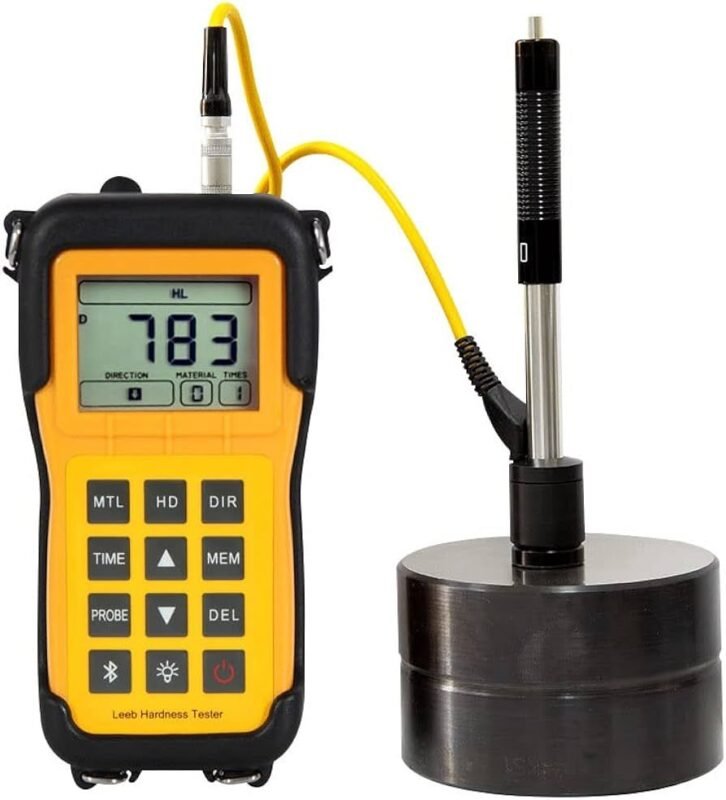
Leeb-Härteprüfung
Leeb testing measures rebound velocity after impact.
Vorteile:
Results are commonly reported as HL values.
Ultrasonic Contact Impedance (UCI) Testing
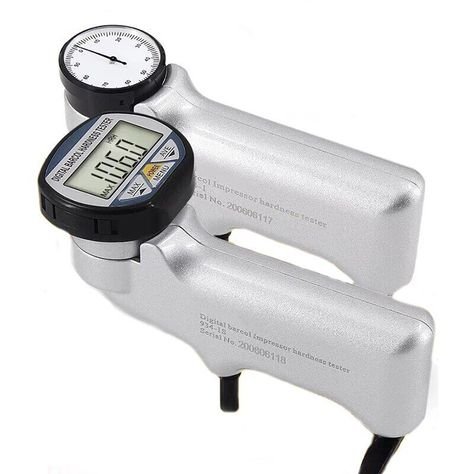
UCI technology uses ultrasonic vibration to determine hardness.
Zu den Vorteilen gehören:
- Portable testing
- Small indentation size
- Suitable for finished parts
Metal Hardness Testing Equipment
Benchtop Hardness Testers
Common laboratory systems include:
- Brinell-Härteprüfgeräte
- Rockwell-Härteprüfgeräte
- Vickers-Härteprüfgeräte
- Universal hardness testers
Tragbare Härteprüfgeräte
Portable systems are ideal for:
- Field inspections
- Large structures
- Heavy machinery
Digital Hardness Testing Systems
Modern systems provide:
- Automatic calculations
- Touchscreen controls
- Statistische Analyse
- Datenspeicherung
Calibration Blocks and Accessories
Calibration equipment ensures:
- Measurement accuracy
- Einhaltung von Normen
- Traceable results
Metal Hardness Testing Procedure
Vorbereitung der Probe
The specimen surface should be:
- Sauber
- Flat
- Free of scale
- Properly polished if required
Selecting the Appropriate Test Method
The testing method depends on:
- Material Typ
- Größe der Komponente
- Required accuracy
- Applicable standards
Conducting the Test
The indenter or impact device applies force according to the selected procedure.
Recording and Analyzing Results
Results are documented and compared against material specifications and acceptance criteria.
Factors Affecting Test Accuracy
Surface Finish
Rough or contaminated surfaces can distort hardness readings.
Material Thickness
Insufficient thickness may affect indentation geometry and measurement accuracy.
Calibration and Verification
Regular calibration is essential for reliable results.
Environmental Conditions
Temperature, vibration, and improper handling can influence testing performance.
Advantages of Metal Hardness Testing
Metal hardness testing offers numerous advantages:
- Fast and efficient
- Cost-effective
- Minimal specimen damage
- Applicable to many metals
- Widely standardized
- Suitable for quality control
- Starker Zusammenhang mit den mechanischen Eigenschaften
These benefits make hardness testing a fundamental engineering tool.
Limitations of Metal Hardness Testing
Despite its usefulness, limitations include:
- Localized measurement only
- Different methods produce different scales
- Surface preparation may be required
- Small permanent indentation remains
- Conversion between scales may introduce uncertainty
Proper method selection minimizes these challenges.
Industrielle Anwendungen
Steel Manufacturing
Hardness testing verifies:
- Material grades
- Heat treatment results
- Production consistency
Autoindustrie
Die Anwendungen umfassen:
- Zahnräder
- Wellen
- Lager
- Motorkomponenten

Aerospace Components
Critical aerospace parts require strict hardness verification for safety and performance.
Oil and Gas Equipment
Hardness testing is commonly used for:
- Pipelines
- Valves
- Druckbehälter
- Drilling components
Construction and Heavy Machinery
Manufacturers use hardness testing to ensure durability and wear resistance.
Industriestandards und Compliance
Common standards for metal hardness testing include:
- ASTM E10 (Brinell)
- ASTM E18 (Rockwell)
- ASTM E92 (Vickers)
- ASTM E384 (Microhardness)
- ISO 6506 (Brinell)
- ISO 6507 (Vickers)
- ISO 6508 (Rockwell)
Offizielle Quellen:
Compliance ensures globally recognized and repeatable test results.
Häufig gestellte Fragen
1. What is metal hardness testing?
It is the process of measuring a metal’s resistance to indentation or deformation under a controlled force.
2. Which hardness testing method is most common for metals?
Rockwell, Brinell, and Vickers are the most widely used methods.
3. Can hardness testing estimate material strength?
Yes. Hardness values often correlate with tensile strength and other mechanical properties.
4. Is metal hardness testing destructive?
It is generally considered minimally destructive because it leaves only a small indentation.
5. What industries use metal hardness testing?
Aerospace, automotive, manufacturing, energy, construction, metallurgy, and research sectors.
6. Why is calibration important in hardness testing?
Calibration ensures accuracy, repeatability, and compliance with industry standards.
Fazit
Metal hardness testing is a vital quality control and material evaluation technique used across nearly every engineering industry. By measuring a metal’s resistance to deformation, manufacturers and engineers can assess material performance, verify heat treatment processes, and ensure compliance with technical specifications.
Whether using Brinell, Rockwell, Vickers, Leeb, or UCI methods, metal hardness testing provides fast, reliable, and valuable information that supports product quality, operational safety, and long-term durability.