Brinell Sertlik Testi: İlkeler, Yöntem ve Uygulamalar


Introduction to the Brinell Hardness Test
Bu Brinell sertlik testi is one of the oldest and most widely recognized methods for measuring the hardness of metals and engineering materials. Known for its reliability and ability to test large or coarse-grained materials, the Brinell method remains a preferred choice in many industrial sectors.
Unlike hardness tests that measure indentation depth, the Brinell hardness test determines hardness by measuring the diameter of an indentation created by a hard ball under a specified load. This approach provides a representative measurement of material hardness, particularly for castings, forgings, and structural metals.
Today, the Brinell hardness test is widely used in manufacturing, metallurgy, heavy industry, and quality control laboratories around the world.
Brinell Sertlik Testi Nedir?
Tanım ve Amaç
Bu Brinell sertlik testi is an indentation hardness testing method that measures a material’s resistance to deformation by pressing a hard tungsten carbide ball into its surface under a controlled load.
Bu test genellikle şu amaçlarla kullanılır:
- Verify material quality
- Evaluate mechanical properties
- Monitor production consistency
- Inspect castings and forgings
- Support material certification
Malzeme Testlerinde Önemi
Hardness is often related to important material properties such as strength, wear resistance, and durability. The Brinell method provides a practical and reliable way to assess these characteristics.
Its large indentation area makes it especially useful for materials with non-uniform microstructures.
Brinell Sertlik Testinin Tarihçesi
The Brinell hardness test was developed in 1900 by Johan August Brinell, a Swedish engineer who sought a simple and reliable method for evaluating metal hardness.
The test quickly gained acceptance due to its accuracy and ease of use. More than a century later, it remains one of the most trusted hardness testing methods in industrial applications.
How the Brinell Hardness Test Works
Temel Test Prensibi
The Brinell method involves pressing a hard ball indenter into the surface of a material under a specified load.
After removing the load, the diameter of the resulting indentation is measured and used to calculate the hardness value.
Indenter and Test Force
Modern Brinell testing typically uses:
- Tungsten carbide ball indenter
- Ball diameters ranging from 1 mm to 10 mm
- Test loads ranging from 1 kgf to 3000 kgf
The combination of ball size and load depends on the material being tested.
Girintinin Ölçülmesi
The indentation diameter is measured using:
- Optik mikroskoplar
- Dijital görüntüleme sistemleri
- Automatic measurement software
The average diameter is then used to determine the hardness value.
Brinell Hardness Number (HBW) Explained
Understanding HBW Values
Brinell hardness results are expressed as HBW (Hardness Brinell Tungsten Carbide).
Örnekler şunları içerir:
- 120 HBW
- 220 HBW
- 350 HBW
Higher HBW values indicate greater resistance to indentation and generally higher hardness.
Factors Affecting Results
Several factors can influence Brinell hardness values:
- Yüzey durumu
- Test yükü seçimi
- Girinti durumu
- Material thickness
- Operatör tekniği
Proper testing procedures help ensure accurate results.
Brinell Sertlik Test Prosedürü
Örnek Hazırlama
Before testing:
- Clean the surface
- Remove scale or contaminants
- Ensure sufficient specimen thickness
- Provide stable support
Proper preparation improves repeatability.
Test Yükünün Uygulanması
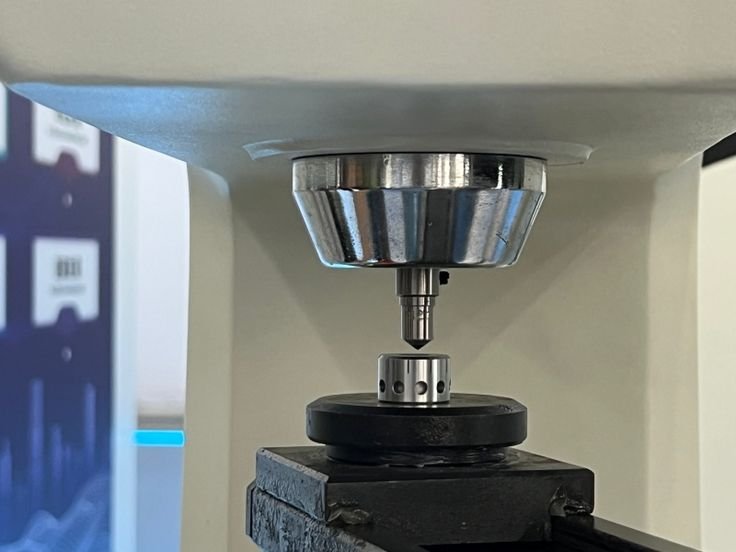
The machine applies a specified force through the carbide ball indenter for a defined dwell time.
Measuring the Indentation Diameter
After the load is removed, the indentation diameter is measured in multiple directions.
The average value is used for hardness calculations.
Calculating Hardness Values
Modern digital systems automatically calculate HBW values based on:
- Ball diameter
- Test kuvveti
- Measured indentation diameter
This eliminates manual calculation errors.
Equipment Used in Brinell Hardness Testing
Brinell Sertlik Ölçerler
Common types include:
- Manuel test uzmanları
- Dijital test cihazları
- Automatic testers
- Integrated production systems
Carbide Ball Indenters
Tungsten carbide balls are used because of their excellent wear resistance and dimensional stability.
Optik Ölçüm Sistemleri
Measurement devices may include:
- Optik mikroskoplar
- Digital cameras
- Automated image analysis systems
Digital Brinell Testing Technology
Modern testers often feature:
- Dokunmatik ekran arayüzleri
- Otomatik girinti ölçümü
- İstatistiksel raporlama
- Data storage and export
These capabilities improve efficiency and traceability.
Brinell Sertlik Testinin Avantajları
The Brinell method offers several advantages:
- Suitable for large components
- Excellent for coarse-grained materials
- Reliable average hardness values
- Well-established international standard
- Good correlation with tensile strength
- Effective for castings and forgings
These benefits make it highly valuable in heavy industry.
Brinell Sertlik Testinin Sınırlamaları
Despite its strengths, the Brinell method has some limitations:
- Larger indentation size
- Slower than Rockwell testing
- Not ideal for thin materials
- Limited use on finished surfaces
- Optik ölçüm gerektirir
For small or thin specimens, Vickers testing may be more suitable.
Endüstriyel Uygulamalar
Steel Production
Brinell testing is widely used to evaluate structural steels and heavy-duty metal products.
Cast Iron Components
The method provides reliable results for cast iron due to its large indentation area.
Forgings and Castings
Brinell testing is commonly used during production and final inspection.
Heavy Machinery Manufacturing
Uygulamalar şunları içerir:
- Industrial equipment
- Construction machinery
- Mining equipment
- Large mechanical components
Kalite Kontrol Laboratuvarları
Laboratories use Brinell testing to verify compliance with material specifications and standards.
Brinell vs Rockwell Hardness Test
| Özellik | Brinell | Rockwell |
|---|---|---|
| Ölçüm Yöntemi | Indentation Diameter | Indentation Depth |
| Test Hızı | Orta düzeyde | Hızlı |
| Large Components | Mükemmel | Good |
| Optical Measurement | Required | Not Required |
| Production Testing | Orta düzeyde | Mükemmel |
Rockwell testing is generally preferred for high-volume production environments.
Brinell vs Vickers Hardness Test
| Özellik | Brinell | Vickers |
|---|---|---|
| Girinti | Karbür Top | Elmas Piramit |
| İnce Malzemeler | Sınırlı | Mükemmel |
| Büyük Dökümler | Mükemmel | Good |
| Hassasiyet | Yüksek | Çok Yüksek |
| Mikrosertlik Testi | Hayır | Evet |
Vickers testing offers greater flexibility for small and thin specimens.
Endüstri Standartları ve Uyumluluk
The Brinell hardness test is governed by internationally recognized standards including:
- ASTM E10
- ISO 6506
Resmi standartlar hakkında bilgi için:
Compliance ensures reliable and globally accepted test results.
Sıkça Sorulan Sorular
1. What is the Brinell hardness test used for?
It is used to measure the hardness of metals by evaluating the size of an indentation created by a carbide ball under load.
2. What does HBW mean?
HBW stands for Brinell Hardness measured using a tungsten carbide ball indenter.
3. Which materials are suitable for Brinell testing?
Steel, cast iron, forgings, castings, and other large metal components.
4. Is the Brinell hardness test destructive?
The test leaves a visible indentation, making it minimally destructive.
5. Why is Brinell testing preferred for castings?
Its large indentation averages material variations and provides representative results.
6. What is the difference between Brinell and Rockwell testing?
Brinell measures indentation diameter, while Rockwell measures indentation depth.
Sonuç
Bu Brinell sertlik testi remains one of the most reliable and widely used methods for evaluating the hardness of metals and industrial materials. Its ability to provide representative hardness values for large components, castings, and forgings makes it especially valuable in heavy manufacturing and metallurgical applications.
By understanding the principles, procedures, advantages, and limitations of the Brinell hardness test, manufacturers and quality professionals can select the most appropriate testing method and ensure consistent material performance and product quality.