Prenosný tvrdomer: 21 užitočných tipov na zvýšenie presnosti, efektívnosti a testovania priamo na mieste


Úvod do prenosného tvrdomeru
What is a Portable Hardness Tester?
A portable hardness tester is a compact and lightweight device used to measure the hardness of materials directly on-site. Unlike traditional bench-mounted testers, this device allows technicians to perform hardness testing without removing or transporting the material.
A portable hardness tester is commonly used for metals, alloys, and industrial components. It provides quick and reliable results, making it an essential tool in quality control and maintenance.
Why Portability Matters in Material Testing
In many industries, large or fixed components cannot be moved easily. A portable hardness tester solves this problem by enabling:
- On-site inspection
- Skrátenie času odstávky
- Faster decision-making
This flexibility makes it invaluable in industries like construction, oil and gas, and manufacturing.
Pracovný princíp prenosného tvrdomeru
Rebound Method Explained
The rebound method, often used in Leeb hardness testers, measures hardness based on the rebound velocity of an impact body. The harder the material, the higher the rebound.
Ultrasonic Contact Impedance (UCI) Method
The UCI method uses ultrasonic vibrations to measure hardness. A vibrating rod contacts the material, and the frequency change is used to determine hardness.
Measurement and Data Interpretation
The results are displayed digitally and can be converted into different hardness scales such as:
- Rockwell (HRC)
- Brinell (HB)
- Vickers (HV)
Types of Portable Hardness Tester
Leeb Hardness Tester
This is the most common type of portable hardness tester. It uses the rebound method and is suitable for large and heavy components.
Ultrazvukový tester tvrdosti
Ideal for thin materials and small parts, this tester provides highly accurate results.
Portable Rockwell Tester
This type offers direct Rockwell hardness readings and is often used in field applications.
Comparison of Testing Methods
| Method | Presnosť | Aplikácia | Portability |
|---|---|---|---|
| Leeb | Moderate | Large Parts | Vysoká |
| UCI | Vysoká | Tenké materiály | Vysoká |
| Rockwell | Very High | Všeobecné použitie | Moderate |
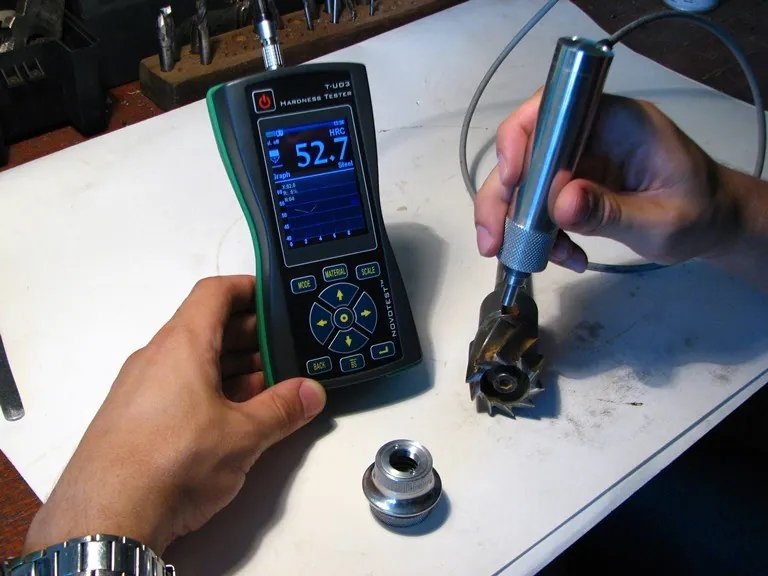
Kľúčové komponenty prenosného testera tvrdosti
Impact Device or Probe
This is the main component that interacts with the material surface.
Display Unit
Shows test results and allows users to select settings.
Data Storage System
Stores test results for later analysis.
Software and Connectivity Features
Modern devices include USB, Bluetooth, and cloud connectivity for data management.
Advantages of Portable Hardness Tester
On-Site Testing Capability
A portable hardness tester eliminates the need to move large components to a lab.
Ease of Use
Most devices are user-friendly and require minimal training.
Cost Efficiency
Reducing transportation and downtime leads to cost savings.
Applications of Portable Hardness Tester
Spracovateľský priemysel
Used for quality control during production.
Oil and Gas Sector
Ensures pipeline and equipment integrity.
Letecký a kozmický priemysel
Used for testing aircraft components.
Maintenance and Inspection
Helps detect wear and material degradation.
Materials Tested with Portable Hardness Tester
Metals and Alloys
Commonly used for steel, aluminum, and other metals.
Welded Structures
Useful for checking weld quality.
Heat-Treated Components
Ensures proper hardness after heat treatment.
Calibration and Standards
Medzinárodné normy
Portable hardness tester devices must comply with ASTM and ISO standards.
Viac informácií nájdete tu: https://www.astm.org
Metódy kalibrácie
Regular calibration ensures accurate measurements.
Ensuring Accuracy
Using reference blocks helps verify results.
How to Use a Portable Hardness Tester
Proces testovania krok za krokom
- Prepare the surface
- Select the testing method
- Position the probe
- Take the measurement
- Record the result
Best Practices for Accurate Results
- Ensure a clean surface
- Use proper calibration
- Maintain consistent positioning
Common User Errors
- Incorrect probe angle
- Poor surface preparation
- Ignoring calibration

Factors to Consider When Choosing a Portable Hardness Tester
Measurement Range
Ensure the device covers the required hardness range.
Accuracy and Resolution
Higher accuracy is essential for critical applications.
Battery Life and Portability
Long battery life ensures uninterrupted testing.
Údržba a riešenie problémov
Tipy na bežnú údržbu
Pravidelné čistenie a kalibrácia sú nevyhnutné.
Bežné problémy a riešenia
Issues like inconsistent readings can often be resolved through recalibration.
Extending Device Lifespan
Proper handling and storage extend the tester’s life.
Portable Hardness Tester vs Bench Hardness Tester
Portability vs Precision
Portable testers offer flexibility, while bench testers provide higher precision.
Cost and Application Differences
Portable devices are more cost-effective for field use.
When to Use Each Type
Use portable testers for on-site work and bench testers for lab analysis.
Future Trends in Portable Hardness Tester Technology
Smart Testing Devices
Future portable hardness tester systems will include smart features for automated analysis.
AI and Data Analytics
Artificial intelligence will improve accuracy and data interpretation.
Wireless and Cloud Integration
Cloud connectivity will enable real-time data sharing.
Často kladené otázky (FAQ)
1. What is a portable hardness tester used for?
It is used to measure material hardness directly on-site.
2. How does a portable hardness tester work?
It uses methods like rebound or ultrasonic testing to measure hardness.
3. What are the types of portable hardness tester?
Leeb, UCI, and portable Rockwell testers are the main types.
4. Which industries use portable hardness tester devices?
Industries include manufacturing, oil and gas, aerospace, and maintenance.
5. How accurate is a portable hardness tester?
Accuracy depends on the method, with UCI providing higher precision.
6. Ako často by sa mala vykonávať kalibrácia?
Calibration should be performed regularly based on usage.
Záver
A portable hardness tester is an essential tool for modern material testing. Its ability to provide quick, reliable, and on-site measurements makes it invaluable across various industries.
As technology advances, portable hardness tester devices will become smarter, more accurate, and better integrated into digital systems. Choosing the right device and maintaining it properly ensures long-term performance and reliability.