




Tvrdomery pre letecký priemysel: Presné testovanie pre bezpečnosť, výkon a certifikáciu


In the aerospace industry, where safety margins are razor-thin and material performance is mission-critical, hardness testing is far more than a routine quality check—it is a vital process that determines the structural integrity, fatigue resistance, and longevity of aircraft components. From turbine blades and landing gear to fuselage frames and fasteners, every part must meet exacting hardness specifications to endure extreme stress, temperature fluctuations, and environmental exposure.
Hardness machines for aerospace are specialized instruments designed to measure the resistance of metals, alloys, and composites to deformation, providing data that directly impacts design validation, manufacturing consistency, and regulatory compliance. In this comprehensive, SEO-optimized article, we’ll explore the importance of hardness testing in aerospace, the types of machines used, their working principles, key applications, selection criteria, and future trends.
Why Hardness Testing Is Critical in Aerospace
Aerospace components operate under some of the most demanding conditions on Earth—and beyond. Hardness testing ensures:
- Structural Safety – Landing gear, wing spars, and engine mounts must resist deformation under heavy loads.
- Fatigue Resistance – Turbine blades and fasteners require hardness levels that prevent crack initiation.
- Wear Resistance – Gears, bearings, and hinge mechanisms must maintain dimensional stability over thousands of cycles.
- Heat Treatment Validation – Confirms the effectiveness of processes like carburizing, nitriding, and precipitation hardening.
- Material Consistency – Ensures that alloys from different suppliers or batches meet identical performance standards.
- Regulatory Compliance – Meets stringent certification requirements from agencies like FAA, EASA, and NASA.
- Lightweight Optimization – Balances hardness with weight reduction in advanced materials like titanium and aluminum-lithium alloys.
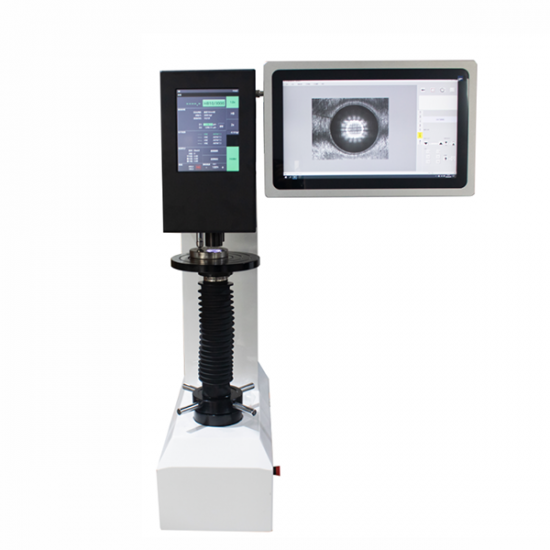
Types of Hardness Machines for Aerospace Applications
1. Tester tvrdosti podľa Rockwella
- Princíp: Meria hĺbku penetrácie pri veľkom zaťažení po malom predbežnom zaťažení.
- Váhy: HRA (hard alloys), HRC (steels), HRB (soft metals).
- Výhody: Fast, direct reading, minimal surface preparation.
- Aerospace Use: Quick QC of landing gear components, fasteners, and heat-treated steel parts.
2. Tester tvrdosti podľa Brinella
- Princíp: Používa guľôčkový indentor s priemerom 10 mm pri vysokom zaťažení (500-3000 kgf).
- Vzorec: HB=πD(D-D2-d2)2P
- Výhody: Averages out material inhomogeneity; ideal for large grain structures.
- Aerospace Use: Engine casings, forged aluminum alloys, and large structural castings.
3. Tester tvrdosti podľa Vickersa
- Princíp: Používa diamantový pyramídový hrot (uhol 136°) pri zaťažení od 1 do 120 kgf.
- Vzorec: HV=1,854×d2P
- Výhody: Presné, všestranné, vhodné na meranie tenkých rezov a hĺbky puzdra.
- Aerospace Use: Surface-hardened turbine blades, case depth verification, and R&D.
4. Knoopov tester tvrdosti
- Princíp: Používa podlhovastú kosoštvorcovú pyramídu pre veľmi nízke zaťaženie (1-1000 gf).
- Výhody: Minimálna penetrácia; ideálne pre krehké materiály a tenké nátery.
- Aerospace Use: Carburized case depth, anodized coatings, and ceramic matrix composites.
5. Microhardness Tester
- Princíp: A specialized Vickers or Knoop tester for loads < 1 kgf.
- Výhody: Tests microscopic areas, grain boundaries, and diffusion layers.
- Aerospace Use: Failure analysis of microcracks, welds, and heat-affected zones.
6. Portable & Leeb Hardness Testers
- Princíp: Rázová metóda s použitím pružinového kladiva; meria rýchlosť odrazu.
- Výhody: Nedeštruktívne testovanie na mieste bez prípravy vzorky.
- Aerospace Use: Field inspection of landing gear, wing structures, and in-service components.
Key Aerospace Applications of Hardness Testing
| Komponent | Material | Požiadavka na tvrdosť | Testovacia metóda |
|---|---|---|---|
| Turbine Blades | Superzliatiny niklu | 400–600 HV (surface hardened) | Vickers, Microhardness |
| Landing Gear Struts | High-strength steel | 50-60 HRC | Rockwell C |
| Fuselage Frames | Aluminum alloys (7075, 2024) | 120–180 HB | Brinell, Rockwell B |
| Engine Bolts | Titanium alloy (Ti-6Al-4V) | 35–45 HRC | Rockwell C |
| Bearing Races | Case-hardened steel | 58–64 HRC | Rockwell C, Vickers |
| Composite Laminates | Carbon fiber/epoxy | N/A (uses nanoindentation) | Specialized testers |
| Welds & HAZ | Various | Variable | Microhardness, Vickers |
| Fasteners (Rivets) | Aluminum/cadmium-plated | 50–80 HB | Brinell, Rockwell B |
How to Choose the Right Hardness Machine for Aerospace
- Typ materiálu a rozsah tvrdosti
- Superalloys: Vickers, microhardness.
- Kalené ocele: Rockwell C, Vickers.
- Aluminum alloys: Brinell, Rockwell B.
- Coatings: Knoop, micro-Vickers.
- Sample Size & Geometry
- Large forgings/castings: Brinell.
- Small precision parts: Vickers, microhardness.
- Complex curved surfaces: Portable Leeb tester.
- Testing Location
- Lab-based R&D: Bench-top Vickers or Rockwell.
- Production line QC: Automated Rockwell or Brinell.
- Field maintenance: Portable hardness testers.
- Automatizácia a integrácia údajov Choose machines with software for SPC, batch reporting, and traceability to AS9100 standards.
- Dodržiavanie noriem Ensure adherence to ASTM E10 (Brinell), E18 (Rockwell), E92 (Vickers), E384 (microhardness), and OEM specs.
Advantages of Hardness Testing in Aerospace Manufacturing
- Včasné odhalenie defektu – Identifies improper heat treatment before parts enter assembly.
- Enhanced Fatigue Life – Optimizes hardness to resist crack propagation.
- Regulatory Confidence – Provides documented proof for FAA/EASA audits.
- Supplier Qualification – Validates raw material and semi-finished part quality.
- Cost Avoidance – Prevents in-flight failures that lead to grounding or catastrophic accidents.
Maintenance & Calibration of Aerospace Hardness Machines
- Pravidelná kalibrácia – Use certified test blocks traceable to NIST or equivalent national standards.
- Kontrola hĺbky hĺbky- Skontrolujte, či nedošlo k odštiepeniu alebo opotrebovaniu; ak sa zmení geometria, vymeňte ju.
- Overenie zaťaženia- Zabezpečte, aby použité sily zodpovedali požiadavkám testu.
- Čistá optika- V prípade optických systémov udržujte objektívy bez prachu a škrabancov.
- Kontrola životného prostredia- Testy vykonávajte pri stabilných teplotných a vlhkostných podmienkach.
- Traceability Records – Maintain logs for audit trails and quality management systems.
Future Trends in Hardness Testing for Aerospace
- Automatizácia a robotika – Robotic arms performing high-volume, consistent tests in production cells.
- AI a strojové učenie – Predictive analytics for hardness trends and process optimization.
- Prenosné a bezdrôtové systémy – Bluetooth-enabled testers sending data to cloud databases for fleet monitoring.
- Nanoindentácia – Linking macro hardness with nanoscale mechanical properties for advanced materials.
- Ekologické testovanie- Zníženie spotreby energie a eliminácia nebezpečných materiálov.
- Integration with Digital Twin – Real-time hardness data feeding into digital twin models for predictive maintenance.
- Additive Manufacturing QA – Hardness mapping of 3D-printed aerospace parts for density and grain structure validation.
Záver
Hardness machines for aerospace are essential tools for ensuring that every component—from microscopic turbine blade coatings to massive landing gear struts—meets the uncompromising standards of safety, performance, and reliability demanded by the industry. By selecting the appropriate testing method, integrating automation, and adhering to rigorous calibration protocols, aerospace manufacturers can guarantee the integrity of their products throughout the entire lifecycle.
As the industry advances toward next-generation materials, smart manufacturing, and digital certification, hardness testing will evolve from a quality control step into a strategic enabler of innovation, safety, and mission success.