




Knoop Diamond Indenter: 7 Essential Benefits for Accurate Microhardness Testing


Introduction to Knoop Diamond Indenters
A Knoop diamond indenter is a precision tool used to create very small, elongated indentations during Knoop microhardness testing. It is especially useful when conventional hardness testing would create an indentation that is too large for the application.
Knoop testing is commonly associated with:
- Dunne materialen
- Small components
- Brittle materials
- Coatings
- Surface layers
- Metallographic specimens
- Individual microstructural regions
The key feature of the Knoop method is its elongated diamond-pyramid indentation. This geometry allows the operator to obtain useful hardness information while producing a relatively small impression.
That can be a big advantage when the available test area is limited.
However, small indentations also create demanding measurement requirements. Surface quality, optical resolution, indenter geometry, test force, and operator technique can all influence the result.
A high-quality Knoop indenter is therefore essential for reliable microhardness testing.
What Is a Knoop Diamond Indenter?
Basic Structure
A Knoop diamond indenter is a carefully manufactured diamond pyramid designed to create an elongated indentation.
Unlike the four-sided pyramidal geometry used in Vickers testing, the Knoop indenter has a different geometry that produces a long, narrow impression.
After applying and removing the test force, the long diagonal of the indentation is measured using the hardness tester’s optical system.
The measurement is then used to determine the Knoop hardness value according to the applicable method.
The basic process is:
Apply force → Create indentation → Measure long diagonal → Calculate hardness
Because the indentation can be very small, accurate optical measurement is particularly important.
Why Diamond Is Used
Diamond is exceptionally hard and resistant to wear.
This allows the indenter to maintain its intended geometry under repeated testing conditions.
Maintaining geometry is critical because the shape of the indentation is directly related to the measurement.
If the tip becomes damaged or excessively worn, the resulting indentation may no longer represent the intended Knoop geometry.
How a Knoop Diamond Indenter Works
The Knoop method uses a controlled test force to press the elongated diamond pyramid into the specimen.
After the specified loading conditions are completed, the force is removed.
The resulting indentation has a characteristic elongated shape.
The long diagonal is measured, and the hardness value is determined according to the applicable Knoop testing procedure.
A typical workflow includes:
- Prepare the specimen surface.
- Mount and support the sample securely.
- Select the appropriate test force.
- Position the Knoop indenter.
- Apply the specified force.
- Maintain the required dwell period.
- Remove the force.
- Locate the indentation.
- Measure the long diagonal.
- Calculate or automatically determine the hardness value.
- Record the result.
The method is particularly useful when the test area is too small for conventional indentation techniques.
Knoop Diamond Indenter Geometry
Elongated Pyramid Design
The defining feature of a Knoop diamond indenter is its elongated pyramidal geometry.
This creates a long, narrow indentation rather than the approximately square indentation associated with Vickers testing.
The geometry allows the test to be performed with relatively small indentation dimensions.
This is useful for:
- Thin layers
- Small samples
- Narrow regions
- Brittle materials
- Microstructural areas
The exact geometric requirements should be evaluated according to the applicable standard and manufacturer specifications.
Importance of Tip Quality
The tip of the indenter must be carefully manufactured and maintained.
Potential problems include:
- Chipping
- Cracking
- Wear
- Surface damage
- Contamination
- Geometric deviation
Because Knoop testing often involves very small indentations, even a relatively small indenter defect can become significant.
For critical applications, appropriate inspection and verification procedures should therefore be followed.
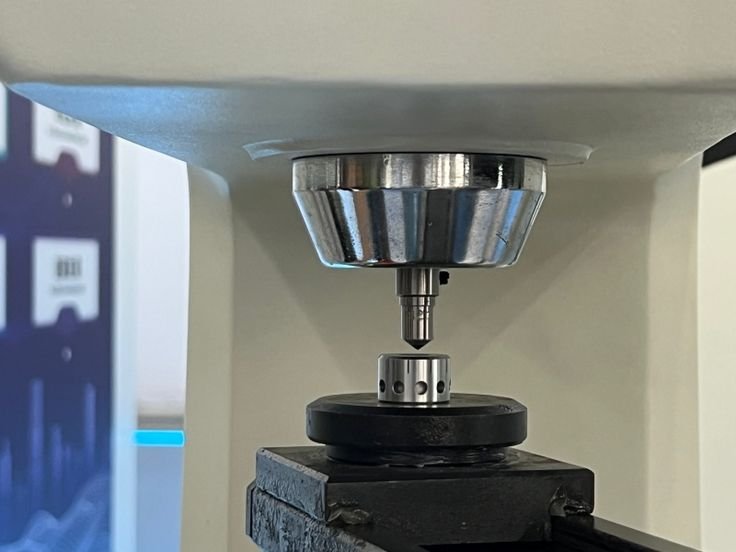
7 Key Benefits of Knoop Diamond Indenters
1. Small Indentation Size
One of the biggest advantages of Knoop testing is its ability to create a small indentation.
This makes the method useful when the available test area is limited.
For example, a researcher may need to measure hardness on a thin surface layer without significantly damaging the component.
2. Excellent Diamond Hardness
Diamond provides the exceptional hardness required for precision indentation.
A suitable diamond indenter can withstand repeated testing of many engineering materials while maintaining its intended shape.
3. Suitable for Thin Materials
Knoop testing can be particularly useful for thin sections and surface layers.
Because the indentation is relatively small and elongated, it can provide useful information where a larger indentation would be impractical.
However, test force and indentation depth still need to be appropriately controlled to reduce substrate effects.
4. Useful for Brittle Materials
Knoop testing is commonly associated with applications involving brittle materials.
These may include:
- Glass
- Keramiek
- Certain minerals
- Hard coatings
- Brittle phases
The elongated indentation geometry can be useful when evaluating materials where conventional indentation methods may be less suitable.
5. Precise Surface Testing
Knoop testing allows localized hardness measurements.
This can be valuable when hardness varies significantly across a material.
For example, researchers may measure hardness from the surface toward the core of a treated material.
6. Good Repeatability
A high-quality Knoop diamond indenter can support repeatable measurements when used with a properly maintained tester.
Repeatability also depends on:
- Surface preparation
- Testkracht
- Dwell time
- Indenter condition
- Optical measurement
- Operator technique
- Specimen support
The indenter is important, but accurate testing requires control of the entire measurement system.
7. Wide Research Applications
Knoop testing is valuable in research and advanced material characterization.
It can help investigate:
- Oppervlaktebehandelingen
- Coatings
- Material gradients
- Brittle materials
- Thin films
- Microstructural regions
- Material-processing effects
Knoop Diamond Indenter Applications
Thin Coatings and Surface Layers
When a coating is thin, a large indentation may extend into the substrate and distort the apparent hardness.
Knoop testing can provide a smaller indentation, making it useful for certain coating investigations.
The test conditions still need to be selected carefully.
Glass and Ceramics
Knoop hardness testing can be used for suitable brittle materials such as glass and ceramics.
The method provides localized hardness information while limiting indentation size.
Metallographic Testing
Researchers can use Knoop indentations to investigate individual regions of a metallographic sample.
Potential applications include:
- Weld analysis
- Heat-affected zones
- Material phases
- Oppervlaktebehandelingen
- Diffusion layers
Electronics and Advanced Materials
Microhardness techniques can be useful when working with small components and specialized materials.
The ability to make localized measurements is valuable in research and development.
Knoop vs. Vickers Diamond Indenters
Both Knoop and Vickers use diamond indenters, but their geometries and applications differ.
| Functie | Knoop | Vickers |
|---|---|---|
| Indenter shape | Elongated pyramid | Four-sided pyramid |
| Indentation shape | Long and narrow | Approximately square |
| Typical use | Microhardness, thin/brittle materials | Macro and microhardness |
| Small-area testing | Uitstekend | Uitstekend |
| Optical measurement | Required | Commonly required |
| Typical applications | Coatings, glass, ceramics, thin layers | Metals, heat-treated materials, microhardness |
| Main advantage | Small, elongated indentation | Versatile hardness testing |
Neither method is universally better. The correct choice depends on the material, geometry, test force, and purpose of the measurement.
How to Choose a Knoop Diamond Indenter
1. Check Tester Compatibility
Before purchasing, confirm:
- Hardness tester manufacturer
- Machine model
- Indenter mounting system
- Knoop testing capability
- Required specifications
A mechanically compatible indenter must also satisfy the technical requirements of the testing system.
2. Consider the Test Force
Knoop testing is commonly used at relatively low forces.
The selected indenter and tester should be appropriate for the intended force range.
The test force should also be suitable for the material thickness and application.
3. Verify Indenter Geometry
Geometry is one of the most important purchasing criteria.
A quality Knoop diamond indenter should be manufactured to the required geometric specifications.
For laboratory applications, documentation of inspection or conformity can be valuable.
4. Check Certification and Traceability
For controlled testing environments, consider documentation such as:
- Indenter identification
- Manufacturer
- Geometry information
- Inspection records
- Traceerbaarheid
- Applicable standard
This is particularly important for accredited laboratories and research programs requiring documented measurement control.
Knoop Indenter Verification and Calibration
A Knoop hardness tester should be treated as a complete measurement system.
The diamond indenter is only one component.
Other factors include:
- Testkracht
- Loading mechanism
- Optisch systeem
- Sample preparation
- Specimen support
- Measurement software
Reference materials can help monitor system performance.
If measurements on an appropriate reference block begin to drift, the laboratory can investigate possible causes, including the indenter, test force, optical system, or specimen preparation.
ASTM E384 covers microindentation hardness testing, including Knoop and Vickers methods.

Common Knoop Diamond Indenter Problems
Chipping
A diamond tip can be damaged by impact.
Effect: The indentation may have an abnormal shape.
Action: Stop using a visibly damaged indenter and follow the applicable inspection procedure.
Wear
Repeated testing can eventually affect the indenter geometry.
Effect: Measurements may gradually change.
Action: Monitor performance and replace the indenter when required.
Contamination
Dust, oil, or particles may interfere with the test.
Action: Clean the component using an approved procedure.
Misalignment
Incorrect installation can affect indentation geometry.
Action: Confirm proper mounting and alignment.
Maintenance and Handling
Although diamond is extremely hard, it must still be handled carefully.
Good practices include:
- Protect the tip from impact.
- Never drop the indenter.
- Keep the mounting area clean.
- Follow the manufacturer’s cleaning instructions.
- Inspect the tip if unusual results appear.
- Store replacement indenters in protective packaging.
- Maintain appropriate verification records.
Don’t use abrasive cleaning methods unless they are specifically approved for the indenter.
Veelgestelde vragen
1. What is a Knoop diamond indenter?
It is a precision diamond pyramid designed to create an elongated indentation for Knoop microhardness testing.
2. Why is Knoop testing useful for thin materials?
The Knoop method produces a relatively small indentation, making it suitable for certain thin layers and localized surface measurements when the test conditions are properly selected.
3. Can a Knoop diamond indenter be used for Vickers testing?
No. Knoop and Vickers use different indenter geometries. The appropriate indenter should be selected for the intended hardness method.
4. What materials can be tested using Knoop hardness?
Suitable applications can include metals, glass, ceramics, coatings, brittle materials, thin layers, and specialized engineering materials.
5. Is the Knoop indenter made entirely of diamond?
The working indenter is made using diamond, while the complete assembly may also contain a mounting or holder made from another material.
6. How important is Knoop indenter geometry?
It is extremely important because the indentation geometry directly affects the measurement. A damaged or improperly manufactured indenter can produce unreliable results.
7. How often should a Knoop diamond indenter be replaced?
There is no universal replacement interval. Service life depends on usage, material, test conditions, handling, inspection results, and manufacturer recommendations.
8. How can Knoop hardness testing accuracy be improved?
Use a suitable high-quality indenter, prepare the surface properly, control the test force and dwell time, maintain the optical system, verify the tester with suitable reference materials, and follow the applicable standard.
Conclusie
De Knoop diamond indenter is a specialized precision component designed for small-scale hardness measurement. Its elongated pyramidal geometry makes Knoop testing particularly useful for thin materials, brittle specimens, coatings, surface layers, and localized microhardness analysis.
Diamond provides the high hardness and wear resistance required for precision indentation, but reliable results depend on much more than the material of the indenter. Geometry, tip condition, alignment, test force, surface preparation, optical measurement, and equipment verification all play important roles.
When selecting a Knoop indenter, confirm the tester compatibility, geometry, test-force range, documentation, and applicable testing requirements. Regular inspection and careful handling can also extend service life and reduce the risk of measurement errors.
For laboratories, research institutions, and manufacturers working with small or delicate specimens, a properly selected Knoop diamond indenter can provide an effective solution for accurate and repeatable microhardness testing.