

- Appareil d'essai de dureté Micro Vickers
- Appareil d'essai de dureté Vickers
- Capteur de dureté Vickers
- Appareil d'essai de dureté Rockwell
- Appareil d'essai de dureté Brinell
- Appareil de dureté Leeb
- Appareil de mesure de la dureté Shore
- Testeur de dureté Webster
- Appareil de mesure de la dureté Barcol
- Barre d'essai de dureté



Brinell Hardness Tester: 11 Powerful Insights for Accurate Material Testingbrinell hardness tester

Plan de l'article
| Niveau de titre | Sujet |
|---|---|
| H1 | Testeur de dureté Brinell |
| H2 | Introduction to Brinell Hardness Testing |
| H3 | What Is a Brinell Hardness Tester |
| H3 | History and Development |
| H2 | Working Principle of Brinell Hardness Tester |
| H3 | Indentation Method |
| H3 | Calculation of Hardness Value |
| H2 | Key Components of Brinell Hardness Tester |
| H3 | Bille de pénétration |
| H3 | Système d'application des charges |
| H3 | Système de mesure optique |
| H2 | Types d'appareils d'essai de dureté Brinell |
| H3 | Manual Brinell Testers |
| H3 | Digital Brinell Testers |
| H3 | Automatic Brinell Testers |
| H2 | Advantages of Brinell Hardness Tester |
| H3 | High Accuracy for Soft Materials |
| H3 | Large Indentation Area |
| H3 | Reliable Results |
| H2 | Applications of Brinell Hardness Tester |
| H3 | Metal Casting Industry |
| H3 | Forging and Heavy Machinery |
| H3 | Laboratoires de contrôle de la qualité |
| H2 | Comparaison avec d'autres essais de dureté |
| H3 | Rockwell vs Brinell |
| H3 | Vickers vs Brinell |
| H2 | How to Choose a Brinell Hardness Tester |
| H3 | Key Specifications |
| H3 | Exigences du secteur |
| H2 | Maintenance et étalonnage |
| H2 | Tendances futures en matière d'essais de dureté |
| H2 | Questions fréquemment posées |
| H2 | Conclusion |
Brinell Hardness Tester: Complete Guide to Reliable Material Hardness Measurement
A brinell hardness tester is one of the most widely used instruments for measuring the hardness of metals and alloys, particularly those with coarse or uneven grain structures. Known for its reliability and simplicity, this testing method is essential in industries such as casting, forging, and heavy manufacturing.
The test is based on the Brinell Hardness Test, which determines hardness by measuring the size of an indentation made by a hardened steel or carbide ball under a specified load.
Introduction to Brinell Hardness Testing
Brinell hardness testing is a fundamental method in material science for evaluating the mechanical properties of materials.
What Is a Brinell Hardness Tester
A brinell hardness tester is a machine that measures hardness by pressing a spherical indenter into the surface of a material and measuring the diameter of the indentation.
Key characteristics include:
- Large indentation size
- Convient aux surfaces rugueuses ou irrégulières
- Mesure précise des matériaux tendres et moyennement durs
History and Development
The Brinell hardness test was developed by Swedish engineer Johan August Brinell in the early 1900s. It was one of the first standardized hardness testing methods and remains widely used today.
Working Principle of Brinell Hardness Tester ⚙️
The Brinell hardness tester operates using an indentation-based measurement method.
Indentation Method
The test involves pressing a hardened steel or tungsten carbide ball into the material surface under a specified load.
Parmi les paramètres courants, on peut citer :
- Diamètre du pénétrateur : de 1 mm à 10 mm
- Charge : de 500 kgf à 3 000 kgf
After applying the load for a specific duration, the indenter is removed, leaving a permanent indentation.
Calculation of Hardness Value
The hardness value is calculated based on the diameter of the indentation.
The result is expressed as HB (indice de dureté Brinell), which represents the material’s resistance to deformation.
Key Components of Brinell Hardness Tester
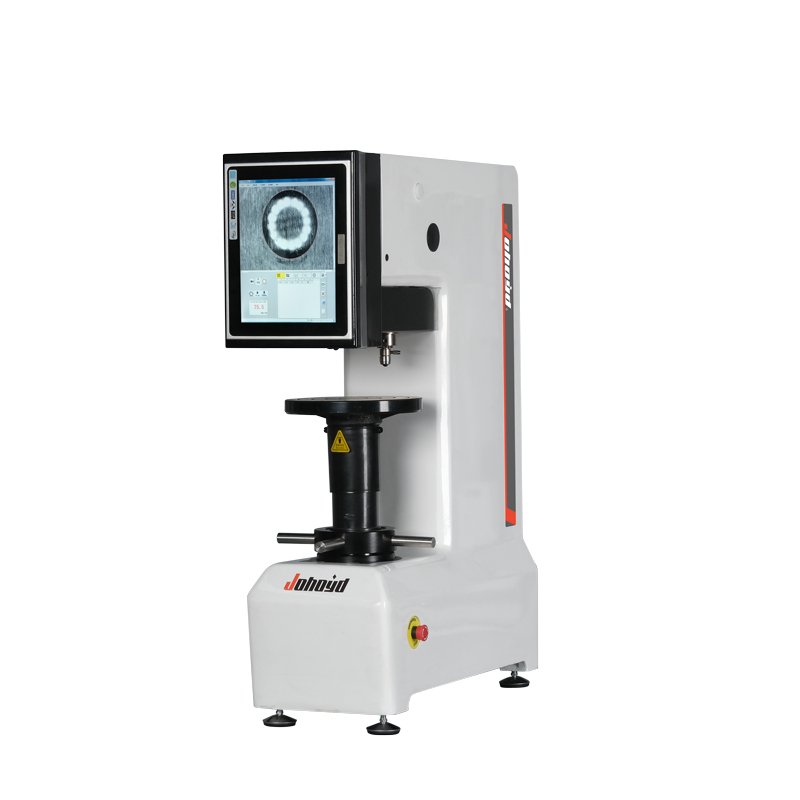
A brinell hardness tester consists of several essential components.
Bille de pénétration
The indenter is a hardened steel or tungsten carbide ball that creates the indentation.
Système d'application des charges
This system applies the required force to press the indenter into the material.
It can be:
- Hydraulic
- Mechanical
- Electronic
Système de mesure optique
After indentation, the diameter is measured using:
- Microscope
- Optical measuring device
- Digital imaging system
Types d'appareils d'essai de dureté Brinell
Different types of testers are available depending on automation and usage requirements.
Manual Brinell Testers
These machines require manual operation for load application and measurement.
Digital Brinell Testers
Digital testers use electronic systems to measure indentation and calculate hardness values automatically.
Automatic Brinell Testers
Fully automated systems perform testing, measurement, and result calculation with minimal operator input.
Advantages of Brinell Hardness Tester 🌟
Brinell hardness testers offer several important benefits.
High Accuracy for Soft Materials
They are particularly effective for testing softer metals and materials with coarse grain structures.
Large Indentation Area
The large indentation averages out surface irregularities, providing reliable results.
Reliable Results
Brinell testing is less sensitive to surface imperfections compared to other methods.
Applications of Brinell Hardness Tester 🏭
Brinell hardness testers are widely used in various industries.
Metal Casting Industry
Used to test cast iron and non-ferrous metals.
Forging and Heavy Machinery
Ensures the hardness of large components such as shafts and gears.
Laboratoires de contrôle de la qualité
Used for routine testing and material certification.
Comparaison avec d'autres essais de dureté
Brinell testing is often compared with other hardness testing methods.
Rockwell vs Brinell
The Rockwell Hardness Test measures depth of indentation, while Brinell measures indentation diameter.
Vickers vs Brinell
L'essai de dureté Vickers utilise un pénétrateur en diamant et convient à un large éventail de matériaux.
How to Choose a Brinell Hardness Tester 🔍
Selecting the right tester depends on several factors.
Key Specifications
Envisager :
- Capacité de charge
- Taille du pénétrateur
- Méthode de mesure
- Niveau d'automatisation
Exigences du secteur
Choose a machine that meets the specific needs of your application and industry standards.
Maintenance et étalonnage
Proper maintenance ensures accurate and reliable results.
Entretien courant
- Clean the indenter and specimen surface
- Vérifiez régulièrement les composants
- Veillez à ce que l'alignement soit correct
Calibrage
Calibration should be performed using certified reference blocks to maintain accuracy.

Future Trends in Hardness Testing 🚀
Advancements in technology are improving hardness testing equipment.
Digital Integration
Modern testers include software for data analysis and reporting.
Automatisation
Automated systems reduce human error and improve efficiency.
Advanced Imaging
High-resolution cameras enhance measurement accuracy.
Questions fréquemment posées
What materials are suitable for Brinell hardness testing?
Soft metals, cast iron, aluminum, and copper alloys are ideal for Brinell testing.
What is the unit of Brinell hardness?
L'unité est HB (indice de dureté Brinell).
Why is Brinell testing used for large components?
The large indentation area provides more representative results for coarse materials.
How is Brinell hardness calculated?
It is calculated based on the indentation diameter and applied load.
What is the difference between Brinell and Rockwell testing?
Brinell measures indentation size, while Rockwell measures indentation depth.
Is Brinell testing suitable for very hard materials?
It is less suitable for very hard materials compared to Vickers testing.
Conclusion
A brinell hardness tester is an essential tool for measuring material hardness, especially for soft and coarse-grained materials. Based on the proven Brinell Hardness Test, it provides reliable and accurate results for a wide range of industrial applications.
With advancements in digital technology and automation, modern Brinell hardness testers continue to evolve, offering improved precision and efficiency for quality control and material testing processes. 🔍