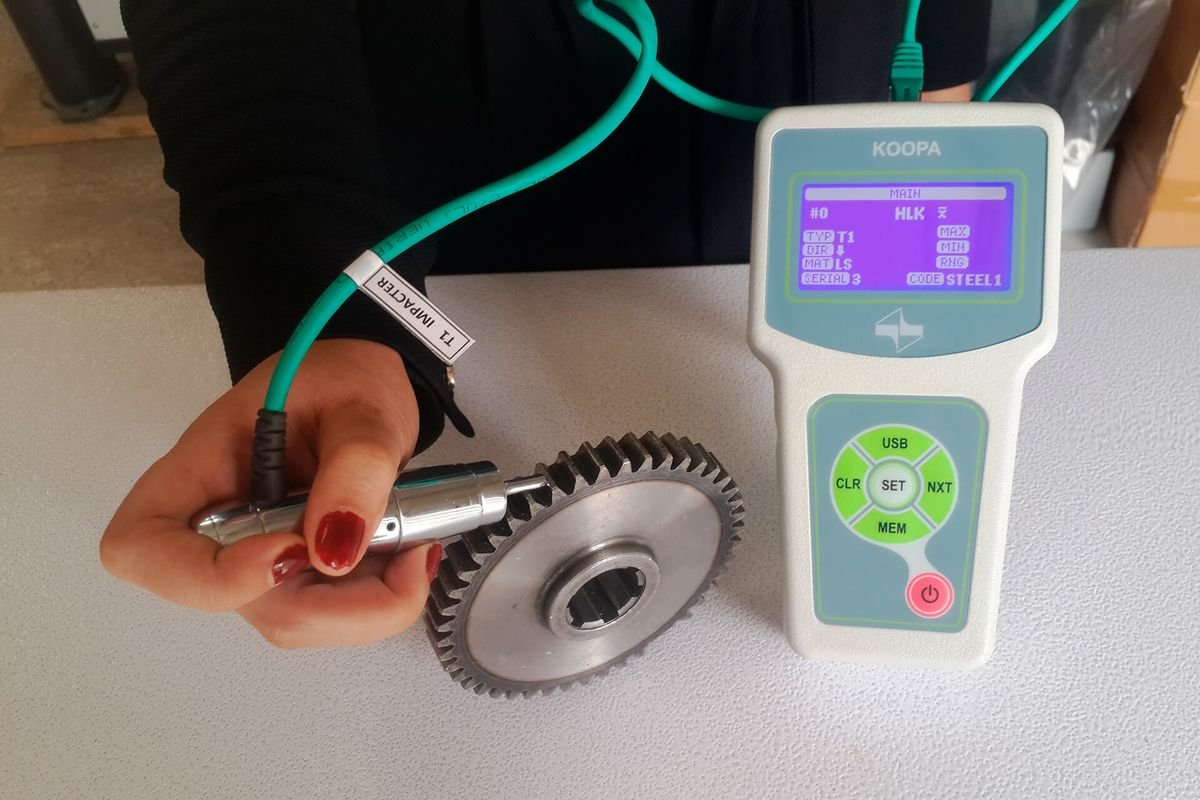
The Definitive Guide to Macro Vickers Hardness Testers


When it comes to verifying the quality of a heat-treated gear, a forged aircraft component, or a thick steel plate, the Makro-Vickers-Härteprüfer is the undisputed workhorse of the materials testing lab. Unlike its delicate cousin, the Micro Vickers, the Macro Vickers is built for power and versatility, capable of applying significant force to large, heavy, and hard specimens.
This guide breaks down everything you need to know about this essential piece of industrial equipment.
🔨 What Is a Macro Vickers Hardness Tester?
A Macro Vickers Hardness Tester is an instrument that measures the hardness of a material by pressing a diamond pyramid indenter into its surface under a high test force (typically 1 kgf to 120 kgf). The result is a Vickers Hardness Number (HV), which is calculated based on the size of the indentation left behind.
Think of it this way:
- Micro Vickers is for surgeons (thin films, electronics).
- Makro Vickers is for blacksmiths (large metal parts, heavy industry).
⚙️ How It Works: The Principle of Action
The process follows the universal law of indentation hardness testing:
- Surface Contact: The prepared sample is placed on the anvil. A 10x microscope brings the surface into focus.
- Indenter Engagement: The diamond indenter is positioned directly over the test spot.
- Force Application: A specific load (e.g., 30 kgf, 50 kgf, or 100 kgf) is applied for a set dwell time (usually 10-15 seconds).
- Optische Messung: The machine automatically removes the load. The operator (or an automated system) then switches to a high-magnification objective lens to view the indentation.
- Berechnung: The diagonals of the resulting square impression are measured. The Vickers Hardness Number (HV) is calculated using the formula: HV=1.854×d2FWhere Fis the force in kgf and dis the mean diagonal length in mm.
🆚 Macro vs. Micro: The Critical Distinction
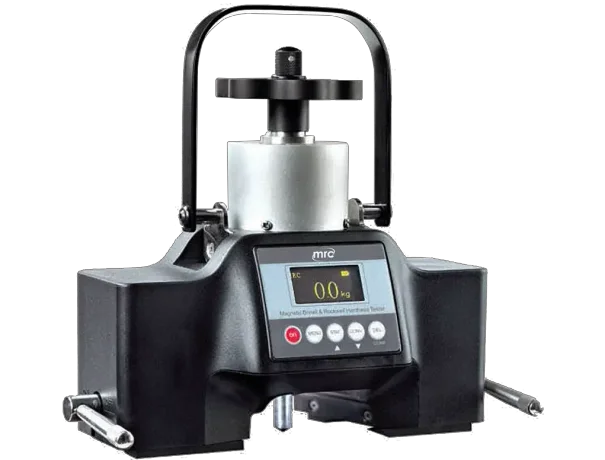
While they use the samediamond indenter, the difference lies entirely in the scale of forceund application.
| Merkmal | Makro Vickers | Micro Vickers |
|---|---|---|
| Force Range | 1 kgf – 120 kgf (Heavy Duty) | 1 gf – 1 kgf (Light Touch) |
| Primary Use | Bulk metals, forgings, castings | Thin films, coatings, microstructures |
| Magnification | Low Power (100x – 200x) | High Power (400x – 1000x) |
| Probe Vorbereitung | Standard grinding/polishing | Mirror finish required |
| Indent Size | Visible to the naked eye | Microscopic |
| Standard | ASTM E92, ISO 6507 | ASTM E384, ISO 6507 |
🏭 Where Is It Used? (Industrial Applications)
The Macro Vickers tester is a cornerstone of quality control in heavy industry:
- Überprüfung der Wärmebehandlung: Checking the hardness of carburized or nitrided steel parts (like gears and shafts) to ensure the case depth meets specifications.
- Metallurgical Analysis: Measuring the hardness of specific micro-constituents (like martensite or bainite) within a metal’s grain structure.
- Weld Inspection: Testing the Heat-Affected Zone (HAZ) of a weld to ensure the metal hasn’t been weakened by the welding process.
- Failure Analysis: Determining if a broken part failed because it was too soft (under-hardened) or too brittle (over-hardened).
- General Forgings & Castings: Providing a reliable hardness value for large, raw metal stock.
🛠️ Step-by-Step: Running a Test
Executing a proper Macro Vickers test requires precision:
- Vorbereitung der Probe: Grind and polish the surface to remove scale, oxides, or decarburization. The surface must be flat and reflective.
- Machine Setup: Place the sample on the anvil. Using the 10x objective, focus on the surface.
- Apply Load: Select the desired test force (e.g., 30 kgf for a hardened steel). The machine automatically applies the load and dwells.
- Measure the Indent: Switch to the 40x or 100x objective. Use the filar eyepiece to measure the two diagonals of the square indentation.
- Record Data: The machine’s software will calculate and display the HV number. For critical applications, multiple indents are taken and averaged.
🌟 Leading Brands in the Industry
Investing in a Macro Vickers tester means investing in accuracy and durability. The top names are:
- Wilson (Instron): The pioneer of the Vickers test in the US, known for legendary robustness.
- Mitutoyo: Japanese precision at its finest, offering seamless integration with digital readouts.
- INNOVATEST (Formerly EMCO-TEST): European engineering excellence, famous for their automated testing systems.
- Buehler: A dominant force in metallography sample preparation and analysis.
- ZwickRoell: German-engineered systems known for high-end automation and testing capabilities.
💡 Pro Tips for Perfect Results
- Mind the Edge Effect: Never place an indentation closer than 2.5 times the diagonal length to an edge. The metal will bulge, giving you a falsely high hardness reading.
- Right Load for the Job: Don’t use a 100 kgf load on a thin sheet metal part—you’ll punch right through it! Match the load to the material thickness.
- Calibrate Religiously: Always verify your machine’s accuracy daily using a NIST-traceable Vickers Standard Hardness Block.
- Look for “Pincushion”: If your indentation looks like a pincushion (bowed sides) instead of a perfect square, your machine’s loading mechanism may be out of alignment.
Schlussfolgerung
Die Makro-Vickers-Härteprüfer remains the universal translator for material hardness. Its ability to bridge the gap between heavy industrial parts and precise metallurgical analysis makes it an irreplaceable tool in any serious materials science laboratory.