




Gummihärteprüfer: Der ultimative Leitfaden für präzise Gummihärteprüfungen und Qualitätskontrolle

Introduction to Rubber Hardness Testers
A rubber hardness tester is a precision instrument used to measure the resistance of rubber and elastomeric materials to indentation under a specified force. Hardness is one of the most important quality indicators for rubber products because it directly affects flexibility, sealing performance, wear resistance, compression set, and overall product durability.
Rubber hardness testing is widely used in automotive manufacturing, medical devices, aerospace, construction, industrial sealing, consumer products, and research laboratories. Whether evaluating O-rings, tires, hoses, seals, gaskets, footwear, or silicone components, accurate hardness measurement helps ensure product consistency and compliance with customer specifications.
Modern rubber hardness testers combine precision mechanical systems, digital sensors, automatic data recording, and intelligent software to provide highly repeatable and standards-compliant measurements.
What Is a Rubber Hardness Tester?
Begriffsbestimmung und Zweck
A rubber hardness tester is a device designed to determine how resistant a rubber material is to penetration by a standardized indenter. The measured hardness value indicates the material’s stiffness and helps manufacturers maintain consistent production quality.
Typical applications include:
- Rohstoffprüfung
- Qualitätskontrolle in der Produktion
- Produktentwicklung
- Materialvergleich
- Lieferantenqualifizierung
- Fehleranalyse
- Process optimization
- Zertifizierung des Endprodukts
Why Rubber Hardness Testing Matters
Rubber hardness testing helps manufacturers verify:
- Elasticity
- Materialkonsistenz
- Verschleißfestigkeit
- Compression characteristics
- Product durability
- Einhaltung der Spezifikationen
Because hardness often correlates with performance in sealing and vibration isolation applications, regular testing is an essential part of quality assurance.
Types of Rubber Materials
Natural Rubber (NR)
Natural rubber provides excellent elasticity, resilience, and abrasion resistance, making it suitable for tires, belts, and vibration-isolation products.
Silicone Rubber
Silicone rubber offers exceptional temperature resistance, flexibility, and biocompatibility for medical devices, food processing, and electronics.
EPDM Rubber
EPDM rubber is widely used for outdoor applications because of its excellent resistance to weather, ozone, and UV exposure.
Nitrile Rubber (NBR)
Nitrile rubber is highly resistant to oils, fuels, and chemicals, making it ideal for automotive seals, hoses, and industrial gaskets.
Polyurethane and Specialty Elastomers
Polyurethane elastomers combine high wear resistance with excellent mechanical strength and are commonly used in industrial rollers, wheels, and heavy-duty components.
Rubber Hardness Testing Methods
Shore A Hardness Testing
Shore A is the most commonly used hardness scale for rubber and flexible elastomers. It measures indentation depth using a spring-loaded blunt indenter.
Typical applications include:
- O-rings
- Gaskets
- Hoses
- Tires
- Rubber sheets
Shore D Hardness Testing
Shore D is designed for harder rubber compounds and rigid elastomers.
Common applications include:
- Hard polyurethane
- Dense rubber components
- Rigid elastomer products
Shore OO Hardness Testing
Shore OO is intended for very soft materials such as:
- Foam rubber
- Gel materials
- Sponge rubber
- Soft silicone products
IRHD (International Rubber Hardness Degree) Testing
IRHD testing uses a highly controlled indentation method and is widely adopted for laboratory testing and international quality standards.
It is particularly suitable for:
- Precision rubber testing
- Thin rubber samples
- Research laboratories
Microhardness Testing for Rubber
Microhardness techniques are occasionally used for specialized rubber composites, multilayer materials, and research applications where localized measurements are required.
Types of Rubber Hardness Testers
Analog Shore Durometers
Analog durometers provide a simple, cost-effective solution for routine hardness measurements in manufacturing and inspection environments.
Digital Rubber Hardness Testers
Digital models offer:
- Electronic displays
- Higher reading accuracy
- Automatic data storage
- USB connectivity
- Statistische Analyse
Bench-Mounted Hardness Testers
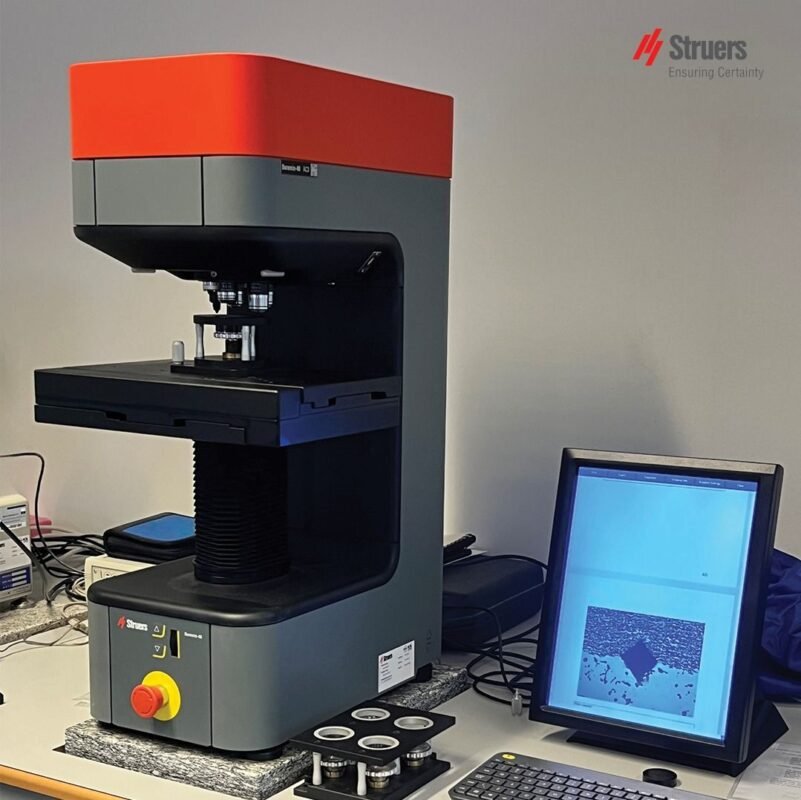
Bench-mounted systems reduce operator influence by applying consistent contact pressure and dwell time, improving repeatability for laboratory testing.
Automatische Härteprüfsysteme
Zu den vollautomatischen Systemen gehören:
- Motorized loading
- Automatic measurement
- Digital reporting
- SPC analysis
- Network connectivity
Main Components of a Rubber Hardness Tester
Indenter and Spring Mechanism
The indenter geometry and calibrated spring determine the hardness scale and measurement range.
Präzisions-Beladesystem
Modern systems ensure consistent application force, reducing operator variability and improving repeatability.
Digital Display and Electronics
Advanced electronics provide:
- Real-time hardness readings
- Peak value hold
- Average calculations
- Statistical functions
Data Management Software
Modern software supports:
- SPC-Berichterstattung
- Export als PDF und Excel
- Batch analysis
- Datenbankverwaltung
- Cloud integration
Key Features of Modern Rubber Hardness Testers
Hohe Messgenauigkeit
Precision mechanical design and electronic sensing improve measurement consistency.
Automatic Data Recording
Digital instruments eliminate manual recording errors and simplify documentation.
Statistical Analysis
Built-in software supports:
- Mean values
- Standard deviation
- Process capability analysis
- Trendbeobachtung
Quality Control Integration
Modern testers integrate easily with manufacturing quality systems and laboratory information management systems (LIMS).
Industrielle Anwendungen
Autoindustrie
Überprüfen:
- Tires
- Seals
- O-rings
- Suspension bushings
- Weatherstrips
Medizinische Geräte
Measure silicone and rubber components used in:
- Katheter
- Medical tubing
- Seals
- Respiratory equipment
Luft- und Raumfahrt
Evaluate high-performance elastomers used in fuel systems, hydraulic seals, and vibration isolation components.
Consumer Products
Test rubber used in:
- Footwear
- Sporting goods
- Household products
- Electronics accessories
Industrial Seals and Gaskets
Verify hardness for products used in hydraulic, pneumatic, and chemical processing systems.
How to Choose the Best Rubber Hardness Tester
Rubber Type
Select the tester based on whether the material is soft silicone, natural rubber, polyurethane, EPDM, or another elastomer.
Hardness Scale
Choose the appropriate scale:
- Shore A for most rubber products
- Shore D for harder elastomers
- Shore OO for soft foams and gels
- IRHD for laboratory precision
Testing Environment
Consider whether testing will be performed:
- In the laboratory
- On the production floor
- In the field
- For research applications
Applicable Standards
Ensure the tester complies with ASTM and ISO standards relevant to rubber hardness measurement.
Kalibrierung und Wartung
Die routinemäßige Wartung sollte Folgendes umfassen:
- Prüfung unter Verwendung zertifizierter Härte-Referenzblöcke
- Inspection of the indenter
- Cleaning contact surfaces
- Geplante Kalibrierung
- Software-Updates
Proper calibration ensures accurate and repeatable hardness measurements.
Vorteile und Einschränkungen
Vorteile
A rubber hardness tester offers:
- Schnelle Prüfung
- Non-destructive measurement
- Hohe Wiederholgenauigkeit
- Portable operation
- Digital reporting
- International standards compliance
Beschränkungen
Zu den möglichen Einschränkungen zählen:
- Temperature significantly affects rubber hardness.
- Dwell time influences measurement results.
- Surface condition may affect readings.
- Different rubber formulations require different hardness scales.
Internationale Normen
Gemeinsame Standards in Bezug auf rubber hardness tester Zu den Anwendungsbereichen gehören:
- ASTM D2240 – Standard-Prüfverfahren für die Bestimmung der Eigenschaften von Kautschuk – Durometer-Härte
- ASTM D1415 – Standard Test Method for Rubber Property—International Hardness (IRHD)
- ISO 48-4 – Rubber, Vulcanized or Thermoplastic—Determination of Hardness (IRHD Method)
- ISO 7619-1 – Rubber, Vulcanized or Thermoplastic—Determination of Indentation Hardness by Means of a Durometer (Shore Hardness)
- ISO 868 – Plastics and Ebonite—Determination of Indentation Hardness by Means of a Durometer (also applicable to certain elastomeric materials)
Offizielle Quellen:
Häufig gestellte Fragen
1. What is a rubber hardness tester used for?
A rubber hardness tester measures the resistance of rubber and elastomeric materials to indentation, helping manufacturers evaluate material consistency, durability, and product quality.
2. Which hardness scale is best for rubber?
Shore A is the most commonly used scale for general rubber products. Shore D is suitable for harder elastomers, Shore OO is used for very soft materials, and IRHD is widely used for laboratory and precision testing.
3. What is the difference between Shore hardness and IRHD?
Shore hardness uses a spring-loaded indenter and is commonly used for production testing, while IRHD provides a more controlled laboratory method with higher precision for certain rubber materials.
4. Which industries use rubber hardness testers?
Rubber hardness testers are widely used in automotive manufacturing, medical device production, aerospace, industrial sealing, consumer goods, research laboratories, and rubber processing facilities.
5. How often should a rubber hardness tester be calibrated?
Die Kalibrierung sollte regelmäßig unter Verwendung zertifizierter Referenzmaterialien überprüft und gemäß den Empfehlungen des Herstellers sowie den geltenden ASTM- oder ISO-Normen durchgeführt werden.
6. How do I choose the right rubber hardness tester?
Choose a tester based on the rubber type, required hardness scale, testing environment, measurement accuracy, automation needs, and compliance with applicable testing standards.
Schlussfolgerung
A rubber hardness tester is an essential instrument for evaluating the quality and mechanical performance of rubber and elastomeric materials. Whether measuring natural rubber, silicone, EPDM, nitrile, polyurethane, or specialty elastomers, selecting the appropriate hardness testing method ensures accurate, repeatable, and standards-compliant results.
By investing in a modern rubber hardness tester with precision force control, digital measurement capabilities, intelligent software, and reliable calibration, manufacturers can improve quality assurance, optimize production processes, reduce inspection errors, and consistently produce high-performance rubber products for demanding industrial applications.