




Prüfgeräte für die Materialfestigkeit: Der umfassende Leitfaden für moderne Materialprüfung und Qualitätskontrolle

Introduction to Material Strength Testing Equipment
Material strength testing equipment plays a critical role in determining the mechanical performance, reliability, and safety of engineering materials. These advanced testing systems help manufacturers, researchers, and quality control laboratories evaluate how materials respond to different forces, including tension, compression, bending, impact, and repeated loading.
From metals and polymers to ceramics, composites, and advanced materials, every material must meet specific strength requirements before being used in industrial applications. Accurate testing helps engineers understand material behavior, prevent failures, improve product designs, and ensure compliance with international standards.
Modern material testing equipment combines precision mechanical structures, advanced sensors, computer-controlled operation, and intelligent analysis software to provide accurate and repeatable measurement results.
What Is Material Strength Testing Equipment?
Begriffsbestimmung und Zweck
Material strength testing equipment refers to a group of machines and instruments designed to measure the mechanical properties of materials. These systems apply controlled forces to test samples and record how materials respond under different conditions.
Common testing functions include:
- Tensile strength measurement
- Prüfung der Kompression
- Bending and flexural testing
- Hardness measurement
- Fatigue testing
- Impact resistance testing
- Fracture analysis
The collected data helps engineers select suitable materials and improve manufacturing processes.
Importance of Material Strength Evaluation
Material strength testing is essential because it helps determine:
- Product durability
- Strukturelle Zuverlässigkeit
- Safety performance
- Material quality
- Manufacturing consistency
- Service life prediction
Without accurate testing, unexpected material failures can lead to product recalls, safety risks, and increased production costs.
Types of Material Properties Tested
Tensile Strength
Tensile testing measures how a material behaves when pulled apart.
Important parameters include:
- Zugfestigkeit
- Yield strength
- Elongation
- Elastizitätsmodul
- Breaking point
Tensile testing is commonly used for metals, plastics, rubber, composites, and textiles.
Compression Strength
Compression testing evaluates how materials perform under squeezing forces.
Die Anwendungen umfassen:
- Prüfung des Betons
- Foam materials
- Plastic components
- Ceramic products
Härte
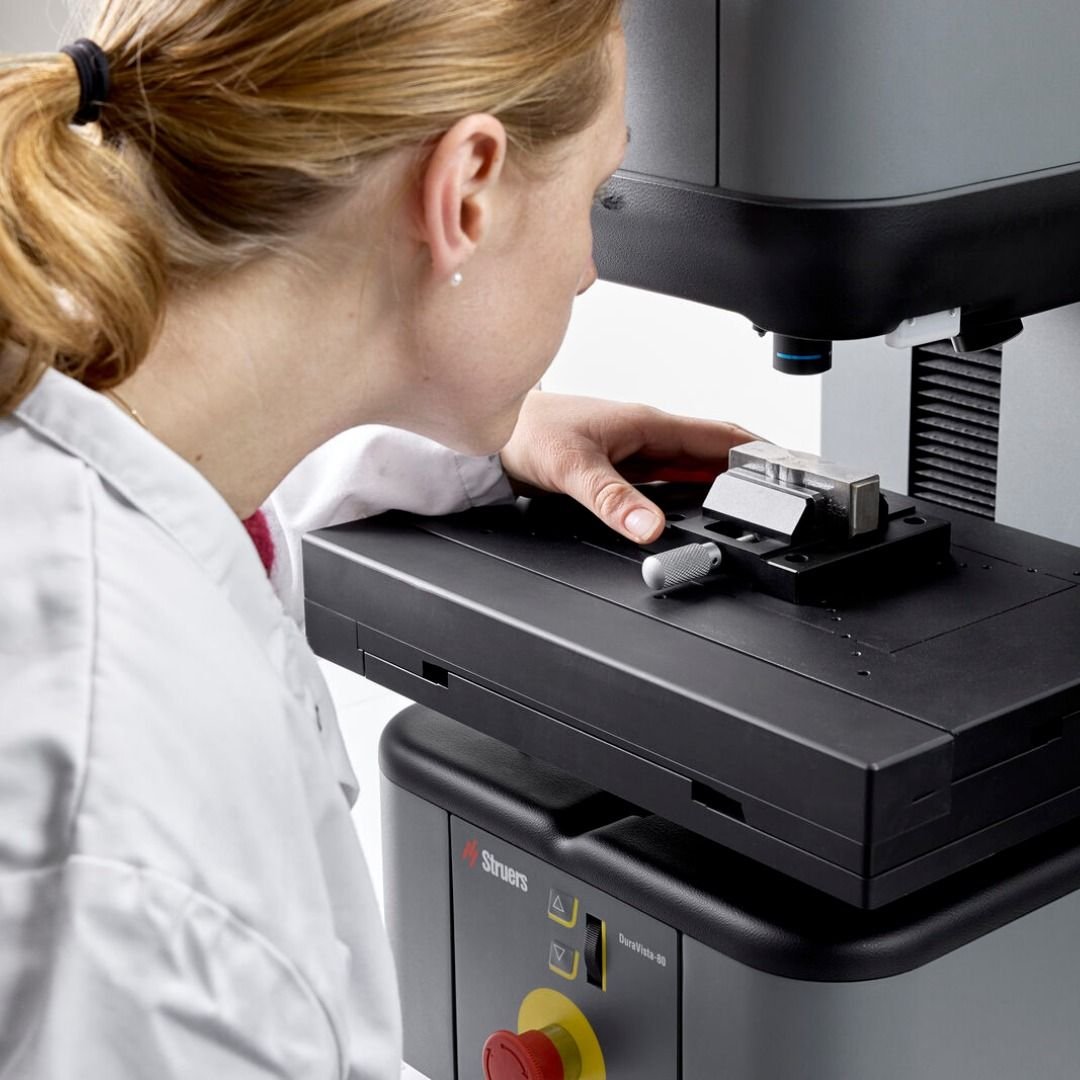
Hardness testing measures resistance to indentation or surface deformation.
Common methods include:
- Rockwell-Härteprüfung
- Brinell-Härteprüfung
- Vickers-Härteprüfung
- Microhardness testing
- Nanoindentation testing
Impact Resistance
Impact testing evaluates how materials absorb sudden forces.
Common methods include:
- Charpy impact testing
- Izod impact testing
This is especially important for metals, plastics, and structural materials.
Fatigue Strength
Fatigue testing evaluates material performance under repeated loading cycles.
It helps predict:
- Component lifespan
- Crack formation
- Long-term reliability
Fracture Toughness
Fracture toughness testing measures a material’s resistance to crack growth.
It is critical for:
- Aerospace materials
- Structural metals
- Advanced ceramics
- Verbundwerkstoffe
Major Types of Material Strength Testing Equipment
Universal Testing Machines
Universal Testing Machines (UTMs) are among the most versatile types of material testing systems.
They can perform:
- Zugfestigkeitsprüfung
- Prüfung der Kompression
- Flexural testing
- Peel testing
UTMs are widely used in laboratories and manufacturing industries.
Tensile Testing Machines
Tensile testing machines are designed specifically to measure how materials respond to pulling forces.
Sie werden in der Regel verwendet für:
- Metal sheets
- Wires
- Plastics
- Gummiprodukte
- Verbundwerkstoffe
Compression Testing Equipment
Compression testing systems measure how materials withstand compressive forces.
Common applications include:
- Concrete blocks
- Foam products
- Verpackungsmaterialien
- Ceramic components
Hardness Testing Machines
Hardness testing equipment measures surface resistance and mechanical strength.
Popular systems include:
- Rockwell-Härteprüfgeräte
- Brinell-Härteprüfgeräte
- Vickers-Härteprüfgeräte
- Mikrohärteprüfgeräte
Fatigue Testing Systems
Fatigue testing machines simulate repeated stress conditions to evaluate long-term durability.
Die Anwendungen umfassen:
- Aircraft components
- Automotive parts
- Industrial machinery
Impact Testing Machines
Impact testers measure material behavior under sudden loading conditions.
They are widely used for:
- Metals
- Plastics
- Verbundwerkstoffe
Testing Methods for Different Materials
Metal Testing
Metals require comprehensive testing to evaluate:
- Strength
- Härte
- Ductility
- Fatigue resistance
Common equipment includes tensile testers, hardness testers, and fatigue testing systems.
Plastic and Polymer Testing
Plastic materials are tested for:
- Zugfestigkeit
- Flexibility
- Härte
- Stoßfestigkeit
- Creep behavior
Testing systems include universal testing machines and polymer hardness testers.
Ceramic Testing
Ceramics require specialized equipment because they are hard and brittle.
Common tests include:
- Hardness testing
- Prüfung der Kompression
- Fracture toughness testing
Composite Material Testing
Composite materials require evaluation of:
- Fiber strength
- Matrix performance
- Layer adhesion
- Fatigue resistance
Rubber and Elastomer Testing
Rubber testing focuses on:
- Elasticity
- Härte
- Zugfestigkeit
- Compression properties
Key Components of Material Strength Testing Equipment
Loading Frame and Mechanical Structure
The loading frame provides stability and ensures accurate force application.
High-quality frames minimize vibration and deformation during testing.
Force Measurement System
Modern equipment uses:
- Load cells
- Force sensors
- Digital measurement systems
These components provide accurate force readings.
Displacement Measurement System
Displacement sensors measure:
- Extension
- Compression distance
- Deformation behavior
Common technologies include:
- Linear encoders
- Dehnungsmessstreifen
- Digitale Sensoren
Control Software
Advanced software enables:
- Automated test procedures
- Real-time graphs
- Data storage
- Berichterstellung
- Statistische Analyse
Advanced Features of Modern Testing Equipment
Digital Data Acquisition
Modern systems collect testing data automatically, improving accuracy and reducing manual errors.
Automated Testing Procedures
Automation provides:
- Schnellere Prüfzyklen
- Improved repeatability
- Geringerer Einfluss des Bedieners
Real-Time Analysis
Advanced systems display:
- Stress-strain curves
- Force-displacement graphs
- Failure points
- Material behavior data
AI-Assisted Measurement
Artificial intelligence technology improves:
- Image analysis
- Crack detection
- Test automation
- Data interpretation
Industrielle Anwendungen
Automobilherstellung
Material testing equipment evaluates:
- Motorkomponenten
- Body structures
- Plastic parts
- Verbundwerkstoffe
Luft- und Raumfahrtindustrie
Aircraft manufacturers use testing equipment for:
- Lightweight alloys
- Composite structures
- High-strength materials
Construction Materials
Testing systems evaluate:
- Beton
- Steel
- Building materials
- Structural components
Electronics Manufacturing
Material testing supports:
- Semiconductor materials
- Protective coatings
- Elektronische Komponenten
Medical Device Production
Testing ensures reliability of:
- Implants
- Surgical tools
- Medical polymers
How to Choose the Best Material Strength Testing Equipment
Material Typ
Select equipment based on whether you test:
- Metals
- Plastics
- Rubber
- Keramik
- Composites
Required Testing Standard
Ensure equipment complies with relevant standards such as ASTM and ISO requirements.
Load Capacity
Choose a system with suitable force capacity for your samples.
Examples:
- Small materials: low-force systems
- Structural components: high-capacity machines
Testgenauigkeit
Important factors include:
- Sensor accuracy
- Calibration quality
- Control precision
- Software capability
Automation Requirements
Automated systems are beneficial for:
- High-volume production
- Research laboratories
- Quality control departments
Kalibrierung und Wartung
Regular maintenance includes:
- Load cell calibration
- Sensor inspection
- Mechanical checks
- Software-Updates
- Reference sample verification
Proper maintenance ensures accurate and reliable test results.
Vorteile und Einschränkungen
Vorteile
Material strength testing equipment provides:
- Accurate mechanical property measurement
- Improved product reliability
- Better material selection
- Reduced failure risks
- International standards compliance
- Data-driven engineering decisions
Beschränkungen
Zu den möglichen Einschränkungen zählen:
- High initial investment
- Need for trained operators
- Regular calibration requirements
- Sample preparation requirements
International Testing Standards
Zu den gemeinsamen Standards gehören:
- ASTM E8/E8M – Standard Test Methods for Tension Testing of Metallic Materials
- ASTM D638 – Tensile Properties of Plastics
- ASTM D695 – Compressive Properties of Rigid Plastics
- ASTM E18 – Rockwell Hardness Testing
- ASTM E384 – Microindentation Hardness Testing
- ISO 6892 – Tensile Testing of Metallic Materials
- ISO 527 – Tensile Testing of Plastics
Official references:
Häufig gestellte Fragen
1. What is material strength testing equipment used for?
Material strength testing equipment measures mechanical properties such as tensile strength, hardness, compression strength, fatigue resistance, and impact performance.
2. Which industries use material testing equipment?
Industries including automotive, aerospace, construction, electronics, medical devices, plastics, and manufacturing rely on material testing equipment.
3. What is the most common material strength test?
Tensile testing is one of the most widely used methods because it provides essential information about strength, elasticity, and deformation behavior.
4. How often should testing equipment be calibrated?
Calibration frequency depends on usage, manufacturer recommendations, and applicable industry standards. Regular calibration ensures measurement accuracy.
5. Can one machine test different materials?
Yes. Universal testing machines can often test metals, plastics, composites, and other materials by using different fixtures and accessories.
6. How do I select the right material strength testing equipment?
Consider material type, required test methods, load capacity, accuracy requirements, automation level, and applicable testing standards.
Schlussfolgerung
Material strength testing equipment is essential for understanding material performance, improving product reliability, and ensuring industrial quality standards. From tensile testing and compression testing to hardness measurement and fatigue analysis, these advanced systems provide critical information needed for engineering decisions.
By selecting the right testing equipment based on material type, application requirements, testing standards, and accuracy needs, manufacturers and research organizations can improve product safety, optimize manufacturing processes, and develop stronger, more reliable materials for modern industries.