




Hardness Tester Accessories: Essential Upgrades for Accurate Material Testing


Introduction to Hardness Tester Accessories
Hardness tester accessories are the supporting components and tools used with hardness-testing machines to improve testing capability, specimen positioning, measurement, verification, and maintenance.
A hardness tester may be the centerpiece of a testing system, but it doesn’t work alone. The indenter creates the impression, the anvil supports the specimen, the optical system may measure an indentation, and reference blocks help verify system performance.
In practical testing environments, the right accessories can make a significant difference.
Common accessories include:
- Diamond and carbide indenters
- Ball indenters
- Flat and V-shaped anvils
- Hardness test blocks
- Microscope systems
- Specimen fixtures
- Test-force components
- Calibration and verification tools
- Cleaning equipment
- Protective storage cases
The exact accessories required depend on the hardness method.
Rockwell testing, for example, uses different components from Brinell or Vickers testing. Microhardness systems have additional requirements because their indentations are extremely small.
Choosing accessories isn’t simply about adding more equipment. The goal is to create a stable, compatible, and traceable measurement system.
What Are Hardness Tester Accessories?
Why Accessories Matter
Accessories extend the capabilities of a hardness tester and help adapt it to different testing requirements.
Consider two specimens:
- A flat steel plate
- A cylindrical shaft
A flat anvil may work well for the plate, while a V-anvil may provide better support for the shaft.
Likewise, a Brinell test requires a suitable ball indenter, while Vickers testing requires a diamond pyramid.
In other words, the accessory should match the test method and specimen.
Accessories vs. Replacement Parts
Not every component is an accessory in the same sense.
Accessories are generally optional or interchangeable components used to expand or adapt the tester.
Replacement parts, on the other hand, are components needed to restore the machine to its intended operating condition.
Some products can fall into either category depending on the equipment and application.
9 Essential Hardness Tester Accessories
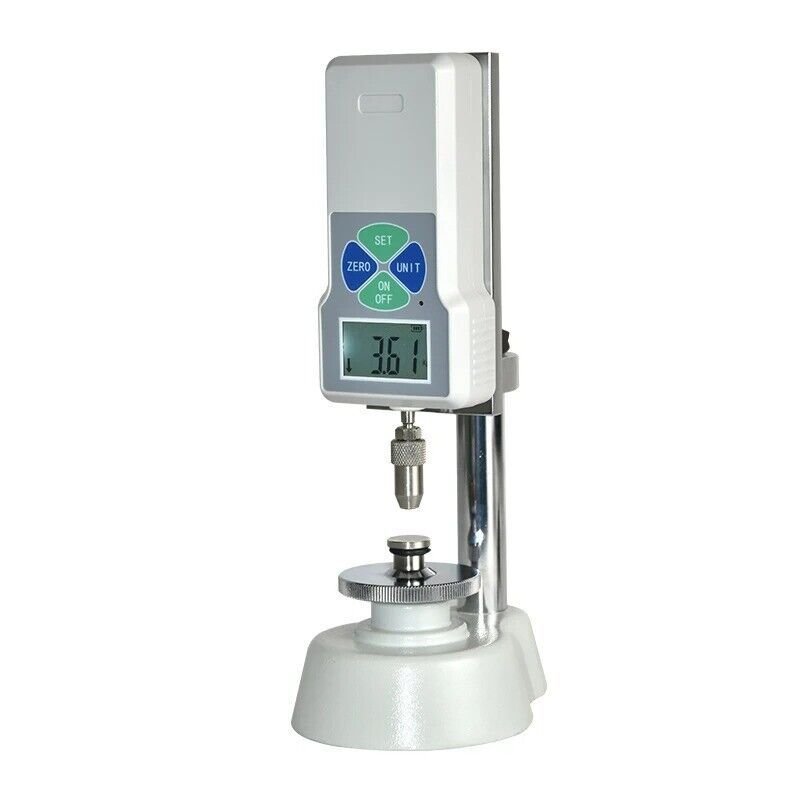
1. Hardness Test Indenters
Indenters are among the most important components in hardness testing.
Depending on the method, they may include:
- Diamond cone indenters
- Vickers diamond indenters
- Knoop diamond indenters
- Tungsten carbide ball indenters
- Stahlkugel-Eindringkörper
The indenter geometry and material must match the applicable testing method.
For example, Vickers uses a diamond pyramid, while Brinell commonly uses a spherical ball.
An indenter is a precision measurement component, not simply a consumable accessory.
2. Hardness Tester Anvils
Anvils support the specimen during testing.
Common designs include:
| Anvil Type | Typical Application |
|---|---|
| Flat anvil | Flat plates and blocks |
| V-anvil | Cylindrical specimens |
| Pointed anvil | Specialized components |
| Small-sample fixture | Small specimens |
| Custom fixture | Irregular components |
Proper support helps reduce specimen movement during loading.
This can be particularly important for Rockwell, Brinell, and other indentation methods.
3. Hardness Reference Blocks
Reference blocks are used to check the performance of a hardness-testing system.
They are manufactured with known or certified hardness values appropriate to the relevant method and range.
Reference blocks can help identify changes caused by:
- Indenter problems
- Test-force issues
- Machine drift
- Measurement errors
- Operator technique
Beispiele hierfür sind:
- Rockwell test blocks
- Brinell test blocks
- Vickers test blocks
- Microhardness reference materials
They are an important part of a controlled verification program.
4. Optical Measurement Systems
Optical systems are particularly important for indentation methods where the indentation dimensions must be measured.
They may include:
- Measuring microscopes
- Digital cameras
- High-resolution objectives
- LED illumination
- Image-analysis software
For Vickers and Knoop testing, accurate measurement of the indentation is critical.
A clear image and appropriate optical resolution can make the measurement process faster and more consistent.
5. Specimen Fixtures
Some components cannot be tested reliably by simply placing them on a flat anvil.
Fixtures can help hold:
- Small parts
- Thin specimens
- Cylindrical samples
- Curved components
- Irregular shapes
The fixture should support the specimen without interfering with the test location.
6. Test Force Accessories
Some hardness testers require specialized components associated with force application.
Depending on the machine, these can include:
- Load weights
- Force mechanisms
- Force calibration devices
- Loading components
- Replacement force-system parts
The correct components should always correspond to the tester’s specifications.
7. Calibration and Verification Tools
Hardness measurement depends on maintaining confidence in the testing system.
Verification equipment can include:
- Certified reference blocks
- Force verification equipment
- Indenter inspection tools
- Dimensional measurement equipment
The exact calibration requirements depend on the test method and quality system.
A reference block can help monitor system performance, but it shouldn’t be treated as a substitute for all required calibration activities.
8. Cleaning and Maintenance Accessories
Clean testing surfaces are essential.
Useful maintenance supplies can include:
- Lens-cleaning materials
- Non-abrasive cleaning tools
- Protective covers
- Approved lubricants where applicable
- Dust-control accessories
The manufacturer’s instructions should always be followed because inappropriate cleaning products can damage optical or precision components.
9. Protective and Storage Accessories
Precision components should be protected when not in use.
Useful accessories include:
- Indenter cases
- Protective covers
- Anvil storage trays
- Reference-block cases
- Equipment covers
Good storage reduces the risk of contamination, impact, and accidental damage.
Rockwell Hardness Tester Accessories
Rockwell testers commonly use:
- Diamond cone indenters
- Ball indenters
- Flat anvils
- V-anvils
- Small-part supports
- Reference blocks
Rockwell testing measures indentation depth under specified conditions, so stable specimen support and correct indenter selection are important.
ASTM E18 is a key reference for Rockwell hardness testing of metallic materials.
For production environments, having several anvil configurations can make one tester suitable for a much wider range of component geometries.
Brinell Hardness Tester Accessories
Brinell testing generally requires a spherical indenter and suitable specimen support.
Common accessories include:
- Kugeln aus Wolframkarbid
- Ball holders
- Flat anvils
- V-anvils
- Brinell reference blocks
- Indentation microscopes
- Digital measurement systems
Because Brinell indentations can be relatively large, proper specimen support is especially important.
ASTM E10 provides requirements related to Brinell hardness testing.
Vickers and Microhardness Accessories
Vickers and microhardness systems often need more specialized accessories.
These can include:
- Vickers diamond indenters
- Knoop diamond indenters
- High-resolution objectives
- Digital cameras
- Precision specimen stages
- Thin-sample fixtures
- Microhardness reference blocks
- Automated indentation software
Microhardness testing involves very small impressions, so optical quality and specimen stability become particularly important.
For research applications, automated image analysis can also reduce manual measurement workload.
How to Choose Hardness Tester Accessories
Machine Compatibility
Always begin with the hardness tester model.
Check:
- Manufacturer
- Model number
- Mounting interface
- Accessory dimensions
- Electrical or software requirements
- Applicable test methods
A seemingly compatible accessory may not work correctly with every machine.
Prüfverfahren
Identify the method first.
| Methode | Typical Accessories |
|---|---|
| Rockwell | Diamond/ball indenters, anvils, reference blocks |
| Brinell | Ball indenters, anvils, microscopes, reference blocks |
| Vickers | Diamond indenters, microscope/camera, fixtures |
| Knoop | Knoop diamond, optical system, reference materials |
| Microhardness | Precision indenters, stages, optics, software |
Specimen Geometry
The specimen often determines the appropriate support accessory.
Consider whether it is:
- Wohnung
- Round
- Thin
- Small
- Curved
- Irregular
- Heavy
A good accessory should make the specimen stable without obstructing the test area.
Genauigkeitsanforderungen
Production screening and accredited laboratory testing may have different requirements.
For high-accuracy applications, consider accessories with appropriate:
- Dimensional tolerances
- Certification
- Traceability
- Inspection documentation
Testing Environment
Environmental conditions can also matter, especially for precision microhardness testing.
Bedenken Sie:
- Vibration
- Dust
- Temperature
- Lighting
- Sauberkeit
Accessories such as equipment covers, stable stages, and appropriate illumination can help create a better testing environment.

The Role of Accessories in Measurement Accuracy
It’s tempting to focus entirely on the hardness tester itself.
But measurement accuracy is influenced by the complete system.
A useful way to think about it is:
Indenter + Force System + Specimen + Anvil + Measurement System + Operator = Hardness Test Result
If one part isn’t suitable, the final measurement can be affected.
For example, a perfect indenter can’t compensate for a specimen that rocks on an unsuitable anvil.
Likewise, a stable specimen doesn’t solve an optical measurement problem in a Vickers test.
That is why accessories should be selected as part of the overall measurement strategy.
Maintenance and Inspection
Hardness tester accessories should be inspected regularly.
Eindringkörper
Check for:
- Chips
- Risse
- Wear
- Deformation
- Verunreinigung
Anvil
Check for:
- Dents
- Burrs
- Korrosion
- Wear
- Verunreinigung
Reference Blocks
Check:
- Identification
- Certification
- Surface condition
- Storage condition
- Verification history
Optical Accessories
Check:
- Lens cleanliness
- Illumination
- Image clarity
- Camera operation
- Measurement software
A simple inspection routine can prevent many avoidable testing problems.
Common Accessory Selection Mistakes
Choosing Only by Price
The cheapest accessory isn’t necessarily the most economical choice.
A poor-quality indenter or fixture can lead to unreliable results and repeated testing.
Ignoring Machine Compatibility
Always check the exact tester model.
Using the Wrong Anvil
Specimen geometry matters.
Ignoring Reference Blocks
Reference materials are useful for monitoring measurement performance.
Poor Storage
Precision indenters and reference blocks should be protected from impact, contamination, and unsuitable environmental conditions.
Häufig gestellte Fragen
1. What are hardness tester accessories?
They are supporting components used with hardness testers, such as indenters, anvils, reference blocks, optical systems, fixtures, and maintenance tools.
2. What is the most important hardness tester accessory?
There isn’t one universal answer. The indenter, specimen support, and measurement system are all important, depending on the testing method.
3. What accessories are used for Rockwell testing?
Common accessories include diamond and ball indenters, flat and V-shaped anvils, specimen supports, and Rockwell reference blocks.
4. What accessories are needed for Brinell testing?
Typical equipment includes tungsten carbide ball indenters, suitable anvils, indentation microscopes or optical systems, and Brinell reference blocks.
5. What accessories are important for Vickers testing?
Vickers testing commonly requires a diamond indenter, suitable specimen support, an optical measurement system, and appropriate reference materials.
6. Do hardness tester accessories need calibration?
Some components require verification or calibration depending on their function and the applicable standard. Reference blocks, force systems, and measurement equipment should be managed according to the relevant requirements.
7. Can accessories improve hardness testing accuracy?
Yes. Proper specimen support, correct indenters, reliable optical measurement, and suitable verification materials can all contribute to better measurement consistency.
8. How do I choose hardness tester accessories?
Start with the tester model and testing method, then consider specimen geometry, test range, accuracy requirements, compatibility, certification, and manufacturer recommendations.
Schlussfolgerung
Hardness tester accessories are essential for turning a basic hardness tester into a complete and adaptable measurement system. Indenters create the indentation, anvils stabilize the specimen, reference blocks help verify performance, and optical systems allow accurate indentation measurement where required.
The best accessory depends on the hardness method, specimen geometry, test range, accuracy requirements, and machine configuration. Rockwell, Brinell, Vickers, and Knoop testing each require different combinations of components.
For manufacturers and laboratories, investing in suitable accessories can improve workflow, expand testing capability, reduce setup problems, and support more consistent results.
Most importantly, accessories shouldn’t be selected in isolation. When the indenter, anvil, specimen fixture, measurement system, and verification materials are properly matched, the entire hardness-testing process becomes more reliable and efficient.

