




Sertlik Test Cihazı: Malzeme Bütünlüğü Doğrulaması için Kapsamlı Bir Kılavuz


1. Introduction: The Critical Role of Hardness in the Material World
In the intricate dance of modern engineering and manufacturing, where performance, safety, and longevity are paramount, understanding a material’s fundamental properties is non-negotiable. Among these properties, sertlik—a material’s resistance to localized plastic deformation—serves as a powerful proxy for strength, wear resistance, ductility, and treatment quality. The instrument dedicated to quantifying this essential characteristic is the Sertlik Test Cihazı. Far more than a simple gauge, these machines are sophisticated systems that translate controlled force and precise measurement into critical data. This article provides a detailed examination of hardness testing machines, exploring their operating principles, diverse configurations, technological components, and indispensable applications across industries.
2. Fundamental Principles of Operation
At its core, a hardness testing machine operates on a straightforward mechanical premise, but its execution demands high precision. The universal process involves:
- Application: A defined force (load) is applied to an indenter—a geometrically shaped tool made of a material harder than the sample (typically diamond or hardened steel).
- Indentation: The indenter penetrates the test specimen’s surface, creating a permanent plastic deformation zone.
- Measurement & Calculation: The machine or operator measures a specific feature of the resulting indentation. The hardness value is then derived via a standardized formula or direct readout, depending on the method.
- Output: The result is presented as a hardness number on an arbitrary, standardized scale (e.g., HRC, HBW, HV).
The critical difference between machine types lies in what is measured (depth or dimension of the indentation) and how the force is applied.
3. Major Types of Hardness Testing Machines
Machines are categorized by the testing method they employ, each suited to specific materials and applications.
3.1. Rockwell Hardness Testing Machines
- Prensip: Depth-sensitive. Measures the additional depth of indentation from a minor (preload) to a major load.
- Process: The indenter first applies a minor load (e.g., 10 kgf) to seat the indenter and establish a zero-reference position. A major load is then applied and removed, while the minor load remains. The permanent depth increase under the minor load is measured.
- Output: Direct readout on a dial or digital display in Rockwell scales (e.g., HRC for hardened steel, HRB for softer alloys).
- Machine Features: Automated load application, direct depth measurement via an encoder system, turret for changing indenters/loads.
- En iyisi: High-speed production and quality control of metals; the fastest and simplest direct-reading method.
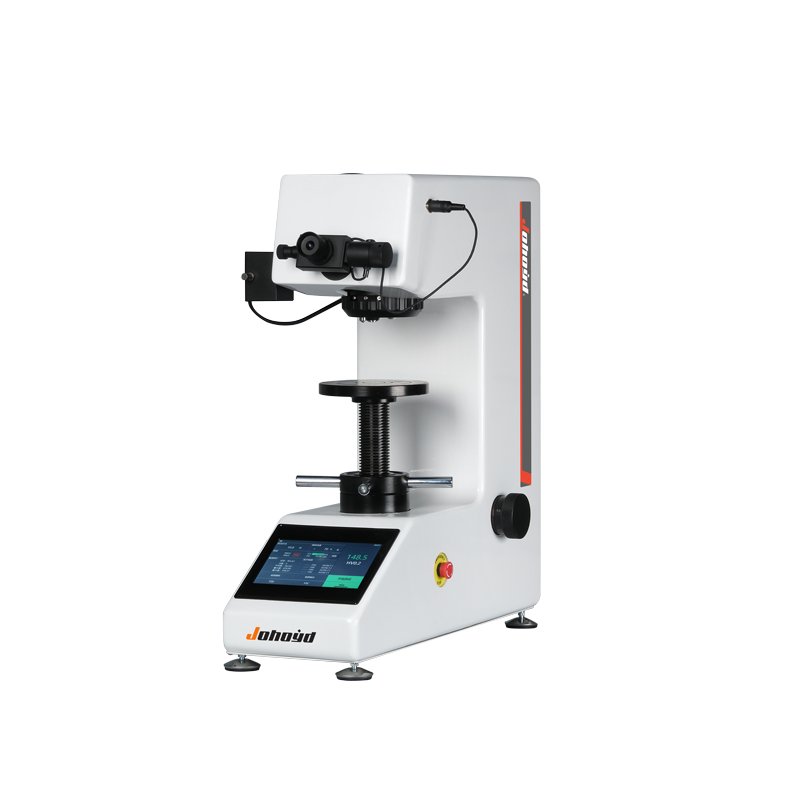
3.2. Brinell Hardness Testing Machines
- Prensip: Optical measurement. Uses a relatively large spherical (tungsten carbide) ball indenter under a high load.
- Process: A single, constant load (e.g., 3000 kgf for iron/steel) is applied for a specified dwell time. The load is removed, and the çap of the residual spherical impression is measured using a portable microscope or integrated optical system.
- Output: Brinell Hardness Number (HBW) calculated from a formula relating load to the surface area of the indentation.
- Machine Features: Robust frame to withstand high loads, hydraulic or servo-electric loading system, integrated or separate measuring microscope.
- En iyisi: Castings, forgings, and materials with coarse or heterogeneous grain structures (e.g., gray cast iron, aluminum alloys) where a large indentation averages material variations.
3.3. Vickers Hardness Testing Machines
- Prensip: Optical measurement. Uses a pyramidal square-based diamond indenter for all scales.
- Process: A precisely controlled load (from 1 gf to 100 kgf) is applied. After load removal, the two diagonals of the square impression are measured under a high-magnification microscope.
- Output: Vickers Hardness Number (HV) calculated from the load divided by the surface area of the indentation.
- Machine Features: A single indenter for all materials and loads, highly accurate optical system with digital camera and image analysis software, often combined with a motorized stage.
- En iyisi: Extremely versatile. Used for everything from soft metals to ultra-hard ceramics. The basis for Microhardness Testing machines when using loads below 1 kgf.
3.4. Microhardness Testing Machines (Vickers & Knoop)
- Prensip: A specialized, highly precise subset of Vickers machines.
- Process: Uses very low loads (typically 10 gf to 1 kgf) to create microscopic indentations. The Knoop indenter, a rhombic-based pyramid, produces an elongated indent for testing brittle materials or thin layers.
- Output: HK (Knoop) or HV values.
- Machine Features: Ultra-stable vibration-isolated tables, high-resolution optics (up to 1000x magnification), piezoelectric or electromagnetic force generation, sophisticated software for automatic measurement and mapping.
- En iyisi: Individual material phases, surface coatings, heat-affected zones, thin foils, electronic components, and glass.
3.5. Portable & Specialized Hardness Testers
- Leeb (Ribaund) Test Cihazları: Handheld devices that measure the rebound velocity of a spring-loaded impact body. The rebound height correlates to hardness. Used for large, in-situ components.
- Ultrasonik Temas Empedansı (UCI) Test Cihazları: Use a vibrating rod with a Vickers diamond tip. The frequency shift upon contact correlates to indentation size. Good for small, thin, or coated parts.
- Durometers: Hand-operated devices with calibrated springs that measure indentation resistance of polymers, elastomers, and rubbers (Shore scales).
4. Key Components of a Modern Machine
A state-of-the-art hardness testing machine is an integration of precision mechanics, electronics, and software:
- Main Frame: A massive, rigid casting to ensure stability and absorb forces without deflection or vibration.
- Load Application System:
- Deadweight (Primary Standard):Most accurate, using calibrated masses.
- Closed-Loop Servo-Electric:Modern standard for precise, programmable, and quiet force control.
- Hydraulic/Pneumatic:Used for very high forces in Brinell testers.
- Indenter Holder & Turret: Precision-machined spindle to hold the indenter. Rockwell machines often have turrets to rotate between different indenters and penetrators.
- Test Force Sensor & Encoder: Monitors and controls the applied force (load cell) and, in Rockwell machines, measures indentation depth with a high-resolution encoder.
- Optical System (for Vickers/Brinell): Comprises a high-quality microscope, LED illumination, digital camera, and motorized objective turret. Software performs automatic edge detection to measure indent diagonals or diameters.
- Motorized XY Stage: Allows precise, programmable positioning of the specimen for multiple tests, line scans, or hardness maps.
- Control Unit & Software: The “brain.” A computer or industrial PC running dedicated software for setting test parameters, controlling the machine cycle, analyzing images, managing databases, and generating reports compliant with standards (ISO, ASTM).
5. Advanced Capabilities and Industry 4.0 Integration
Modern machines have evolved into analytical workstations:
- Fully Automated Testing: Robotic arms load/unload samples. The machine automatically identifies the test location, performs the test, measures, classifies, and sorts the part.
- Hardness Mapping & Profiling: Software creates 2D color-coded hardness distribution maps or line profiles across a section (e.g., across a weld or case-hardened layer).
- Instrumented Indentation Testing (IIT): Also known as nanoindentation on a macro/micro scale. The machine records the entireforce-displacement curve during loading and unloading, allowing calculation of hardness, elastic modulus, creep, and fracture toughness.
- Connectivity: Seamless integration into factory networks and Quality Management Systems (QMS) for real-time SPC (Statistical Process Control) and traceability.
6. Applications Across Industries
- Automotive & Aerospace: Verifying heat treatment of gears, crankshafts, landing gear, and turbine blades.
- Metallurgy & Foundries: Quality control of raw materials, castings, and forgings.
- Heat Treatment Shops: Certifying case depth and hardness after carburizing, nitriding, induction hardening, etc.
- Welding & Fabrication: Assessing hardness in the weld metal, Heat-Affected Zone (HAZ), and base material.
- Medical Devices: Testing the hardness of orthopedic implants, surgical tools, and dental alloys.
- Electronics & Semiconductors: Characterizing thin conductive coatings and brittle substrate materials.
7. Selection Criteria and Best Practices
Choosing the right machine requires analysis of:
- Material Type and Expected Hardness Range
- Sample Size, Shape, and Thickness
- Test Standards to be Followed (ISO, ASTM, etc.)
- Required Precision vs. Testing Speed
- Budget and Future Needs (Automation)
Critical best practices include:
- Proper Sample Preparation: A flat, parallel, and finely prepared surface is essential for accurate results.
- Regular Calibration: Using traceable standard test blocks to calibrate the force, depth, and optical systems.
- Adherence to Standards: Strictly following prescribed procedures for load, dwell time, and environmental conditions.
- Operator Training: Ensuring personnel understand the principles and potential sources of error.
Conclusion: The Unseen Guardian of Quality
The hardness testing machine stands as an unsung guardian of material integrity. From the steel in a skyscraper’s frame to the ceramic in a smartphone’s screen, it provides the quantifiable assurance that materials will perform as designed. Its evolution from mechanical levers and manual microscopes to digitally integrated, automated analytical platforms mirrors the advancement of modern manufacturing. As materials science pushes into new frontiers with composites, amorphous metals, and nano-engineered surfaces, hardness testing machines will continue to adapt, offering ever more precise insights into the fundamental strength of the engineered world. In the relentless pursuit of quality, reliability, and innovation, the hardness test remains a fundamental checkpoint, and the machine that performs it is a cornerstone of industrial progress.