Brinell Test Blokları: Hassas Sertlik Ölçer Doğrulaması İçin Kapsamlı Kılavuz


Introduction to Brinell Test Blocks
Brinell test blocks are precision reference specimens used to verify the performance of Brinell hardness testing machines. Each block is manufactured and calibrated to provide a known hardness reference, allowing laboratories and manufacturers to compare their measured results against an established value.
Brinell hardness testing is widely used for materials such as cast iron, steel, aluminum alloys, copper alloys, and other relatively coarse or heterogeneous metals. Because Brinell testing uses a relatively large indentation, it can provide useful information about the overall hardness of materials with non-uniform structures.
However, reliable results depend on the entire testing system. The test force, ball indenter, machine mechanics, surface condition, and operator technique can all affect the measurement. A properly selected reference block provides a practical way to identify changes in machine performance.
For this reason, Brinell test blocks are an important part of quality control, laboratory verification, and hardness measurement traceability.
What Are Brinell Test Blocks?
Tanım ve Amaç
A Brinell test block is a specially manufactured reference specimen with an assigned Brinell hardness value.
It is designed for use with a particular Brinell testing method and is produced under controlled conditions to provide consistent and traceable reference measurements.
The basic verification process is straightforward:
- Select the appropriate Brinell reference block.
- Prepare and clean its testing surface.
- Place it securely on the hardness tester.
- Apply the specified test force and indenter.
- Measure the resulting indentation.
- Calculate or obtain the Brinell hardness value.
- Compare the result with the block’s certified or assigned value.
- Record the verification result.
ASTM E10 covers Brinell hardness testing of metallic materials and includes requirements related to Brinell hardness test blocks.
Why Are Brinell Test Blocks Important?
A Brinell tester can produce incorrect results even when there is no obvious mechanical failure.
Potential causes include:
- Incorrect test force
- Worn or damaged ball indenter
- Yüzey hazırlığının yetersiz olması
- Machine wear
- Incorrect indentation measurement
- Improper sample support
- Operator error
Regular verification using an appropriate reference block helps detect these problems before they affect production decisions.
How Brinell Test Blocks Work
Brinell testing creates an indentation in the surface of the test material using a spherical indenter under a controlled force.
The indentation is then measured to determine the hardness value.
A reference block works in the same general way as a normal test specimen, but its hardness value has already been established through a controlled calibration process.
If the tester produces a result close to the reference value, the measurement system is behaving as expected.
If the result falls outside the permitted range, further investigation may be necessary.
The problem could involve:
- The indenter
- Test kuvveti
- Machine mechanics
- Measurement system
- Test surface
- Reference block condition
This makes the reference block an important checkpoint in the measurement process.
Types of Brinell Test Blocks
Standard Brinell Test Blocks
Standard Brinell reference blocks are commonly used to verify conventional Brinell hardness machines.
They can be suitable for testing a variety of metallic materials, depending on their certified hardness range.
Typical applications include:
- Çelik
- Dökme demir
- Alüminyum alaşımlar
- Bakır alaşımları
- Brass
- Other non-ferrous metals
The correct block should correspond to the intended Brinell testing conditions.
Brinell Reference Blocks for Different Hardness Ranges
Brinell reference blocks are available across different hardness levels.
A laboratory testing relatively soft aluminum alloys may require a different reference range from a laboratory testing hardened steel.
For quality control, it can be useful to have reference blocks covering the principal hardness ranges used by the laboratory.
Brinell Test Blocks for Portable Testers
Some portable Brinell hardness testing systems can also require appropriate reference specimens for verification.
Portable testing introduces additional considerations, including:
- Machine design
- Indenter configuration
- Test kuvveti
- Yüzey durumu
- Support conditions
The reference block must therefore be suitable for the specific portable system and applicable standard.
Brinell Test Blocks and Hardness Testing Standards
Standards provide important requirements for Brinell testing procedures and verification.
ASTM E10 establishes requirements for Brinell hardness testing and addresses the standardization of Brinell hardness test blocks.
ISO 6506 is another major international reference for Brinell hardness testing. ISO 6506-2 addresses verification of Brinell hardness testing machines, including indirect verification using reference blocks calibrated according to the relevant requirements.
Laboratories should always use the current edition of the standard applicable to their testing program.
ISO International Organization for Standardization
7 Key Benefits of Brinell Test Blocks
1. Improved Measurement Accuracy
Reference blocks provide a known point against which a Brinell tester can be checked.
This gives operators greater confidence in hardness measurements.
2. Early Detection of Machine Problems
Regular testing can identify changes caused by:
- Mechanical wear
- Indenter damage
- Force errors
- Measurement problems
Early detection can prevent unreliable results from spreading through a production batch.
3. Better Quality Control
Manufacturers can include reference block verification in their quality-control procedures.
This is especially useful when hardness values are used to determine whether products meet specifications.
4. Greater Measurement Confidence
A tester that consistently produces acceptable reference-block results gives laboratories greater confidence when measuring production samples.
5. Support for Traceability
Appropriately certified reference blocks can provide documented measurement traceability.
This is important for:
- Quality audits
- Customer requirements
- Laboratory accreditation
- Tedarikçi değerlendirme
- Research
6. Easier Troubleshooting
If a reference block suddenly produces an unexpected value, the laboratory has an early warning that something may require investigation.
7. Improved Documentation
Reference block testing creates useful records showing that the hardness testing system has been checked.
These records can support internal quality systems and external audits.
How to Choose the Right Brinell Test Blocks
Match the Brinell Testing Method
The first step is to confirm the exact testing method used by the machine.
Şunu bir düşünün:
- Ball diameter
- Test kuvveti
- Hardness range
- Malzeme türü
- Uygulanacak standart
A reference block should be suitable for the testing conditions under which it will be used.
Select the Appropriate Hardness Range
The reference value should be relevant to the normal operating range of the tester.
For example, a laboratory primarily testing cast iron may select a different reference range from one primarily testing aluminum alloys.
Where appropriate, multiple reference levels can provide broader verification coverage.
Review Certification
A high-quality reference block should have suitable documentation.
Check for information such as:
- Block identification
- Assigned hardness value
- Testing scale or method
- Calibration information
- Traceability
- Certification details
For critical measurements, documentation is essential.
Surface Preparation of Brinell Test Blocks
Surface condition is especially important in Brinell testing because the indentation must be clearly measured.
Before testing, the surface should be:
- Temiz
- Pürüzsüz
- Dry
- Free of oil
- Free of corrosion
- Free of loose particles
- Free from significant damage
The surface preparation method should be appropriate for the material and the applicable testing standard.
Poor preparation can make indentation measurement difficult and reduce confidence in the result.
Correct Use of Brinell Test Blocks
Use the Correct Ball Indenter
Brinell testing uses a spherical indenter.
The ball diameter and material must be appropriate for the test conditions.
Using the wrong indenter configuration can invalidate the measurement.
Use the Correct Test Force
The force applied during the test must correspond to the selected Brinell procedure.
Operators should carefully verify:
- Test kuvveti
- Loading sequence
- Bekleme süresi
- Indenter diameter
Measure the Indentation Correctly
The indentation diameter is a critical part of Brinell testing.
Depending on the equipment, measurement may be performed using:
- Optik mikroskoplar
- Measuring microscopes
- Dijital görüntüleme sistemleri
- Automated indentation analysis
Modern digital systems can reduce manual measurement work, but the measurement system still needs appropriate verification.
Brinell Test Blocks for Metal Quality Control
Brinell testing is particularly useful for many engineering metals.
Cast Iron
The relatively large indentation can help provide representative hardness information for materials with coarse microstructures.
Alüminyum Alaşımları
Brinell testing can be used for softer non-ferrous alloys and larger components.
Çelik
Brinell testing is commonly used for suitable steel products and components where the hardness range and test conditions are appropriate.
Copper and Copper Alloys
Brass and other copper-based alloys can also be evaluated using suitable Brinell procedures.
Brinell Test Blocks in Manufacturing
Manufacturers can use reference blocks throughout the quality-control process.
Uygulamalar şunları içerir:
- Gelen malzeme kontrolü
- Process control
- Heat-treatment inspection
- Final product inspection
- Supplier verification
- Failure investigation
For example, if a manufacturer heat-treats large steel components, Brinell testing may be used to verify the resulting hardness. A suitable reference block can help confirm that the testing machine is producing reliable measurements.
Brinell Test Blocks for Heat Treatment Verification
Heat treatment can significantly change the hardness and performance of metallic materials.
Common processes include:
- Tavlama
- Normalizing
- Quenching
- Tempering
- Case hardening
After processing, hardness measurements can help determine whether the desired material properties have been achieved.
However, the measurement itself must be trustworthy. Reference-block verification provides an additional layer of confidence in the hardness testing system.
Calibration and Verification: What’s the Difference?
Calibration and verification are related but should not be treated as identical.
Kalibrasyon establishes measurement performance against recognized references.
Verification checks whether the equipment continues to meet specified requirements.
Brinell test blocks are commonly used as part of an indirect verification process.
They should therefore be considered one component of a broader measurement-control system that may also include:
- Direct force verification
- Indenter inspection
- Machine maintenance
- Kalibrasyon
- Reference-block testing
- Operator training
Common Mistakes When Using Brinell Test Blocks
Using an Unsuitable Reference Block
A block outside the intended hardness range may not provide meaningful verification.
Solution: Select a block appropriate for the machine, method, and hardness range.
Poor Surface Preparation
A rough or contaminated surface can affect indentation measurement.
Solution: Prepare the surface according to the applicable procedure.
Using the Same Area Repeatedly
Nearby indentations can influence each other.
Solution: Follow the spacing and location requirements of the applicable standard.
Ignoring Indenter Condition
A damaged or worn ball can affect the indentation.
Solution: Inspect and maintain the indenter according to the equipment and standard requirements.

Not Keeping Verification Records
Without records, it is difficult to identify trends in equipment performance.
Solution: Document every verification result.
How to Store Brinell Test Blocks
Proper storage helps protect the reference surface and maintain the usefulness of the block.
Önerilen uygulamalar şunları içerir:
- Store in a clean, dry location.
- Protect against corrosion.
- Avoid contact with abrasive materials.
- Prevent scratches and dents.
- Keep the reference surface protected.
- Store certification documents safely.
- Identify each block clearly.
A protective case can be useful for transportation and long-term storage.
How Often Should Brinell Test Blocks Be Used?
There is no single verification interval suitable for every laboratory.
The appropriate schedule depends on:
- Applicable standards
- Equipment usage
- Laboratory procedures
- Measurement risk
- Customer requirements
- Historical equipment performance
- Quality-management requirements
A production laboratory performing hundreds of hardness tests each week may require a different verification schedule from a research laboratory that performs occasional measurements.
The key is to establish a documented procedure based on the relevant requirements.
Brinell Test Blocks vs. Other Hardness Reference Blocks
Different hardness methods require different reference specimens.
| Reference Block | Primary Testing Method | Tipik Uygulamalar |
|---|---|---|
| Brinell test block | Brinell | Cast iron, steel, aluminum alloys |
| Rockwell test block | Rockwell | Production metal inspection |
| Vickers test block | Vickers | Precision and laboratory testing |
| Knoop reference block | Knoop | Small or brittle materials |
| Microhardness reference block | Micro Vickers/Knoop | Thin layers and small areas |
A Brinell reference block should not simply be substituted for a Rockwell or Vickers reference block.
Each method has different indenters, forces, measurement procedures, and calibration requirements.
Modern Brinell Verification Systems
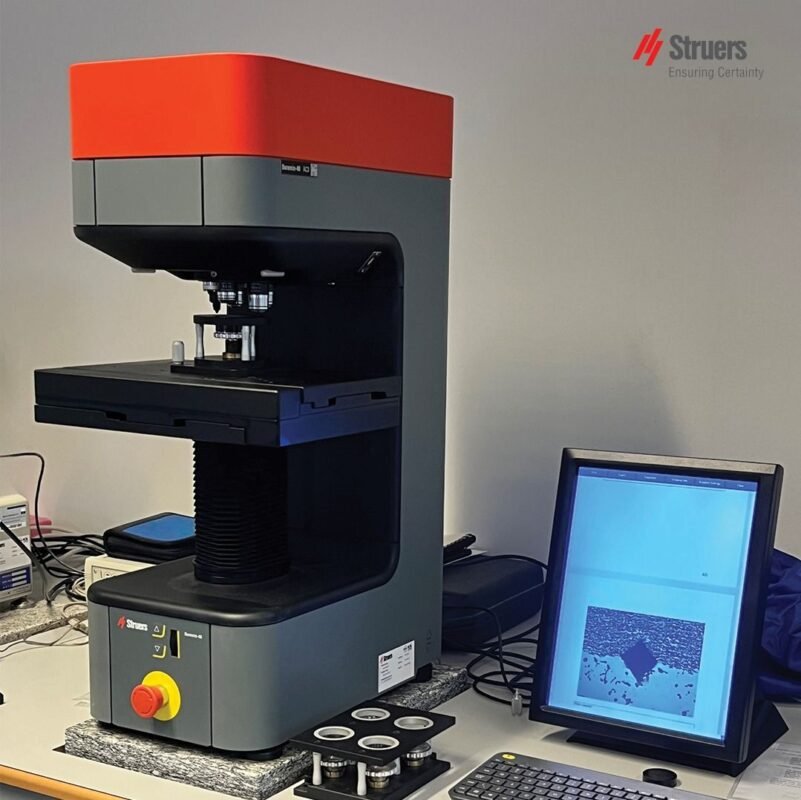
Modern Brinell hardness testers may incorporate digital imaging and automated indentation measurement.
These systems can offer:
- Automatic indentation detection
- Digital diameter measurement
- Automatic hardness calculation
- Veri depolama
- Test reports
- İstatistiksel analiz
Automation can improve efficiency, but reference standards remain important.
Even a highly automated hardness tester needs appropriate verification to ensure that its measurements remain reliable.
Sıkça Sorulan Sorular
1. What are Brinell test blocks used for?
Brinell test blocks are reference specimens used to verify the performance of Brinell hardness testing machines and compare measured results with an assigned hardness value.
2. Which materials can be tested with Brinell hardness testing?
Brinell testing is commonly used for suitable steels, cast iron, aluminum alloys, copper alloys, brass, and other metallic materials.
3. How do I choose the correct Brinell test block?
Choose a block that matches the Brinell testing method, hardness range, material requirements, test conditions, and applicable standard.
4. Are Brinell test blocks used for calibration?
They are commonly used for indirect verification of Brinell hardness machines. They should not automatically be considered a substitute for every required calibration procedure.
5. Why is certification important for Brinell test blocks?
Certification provides information about the assigned reference value and relevant traceability, which is particularly important for quality control, audits, and accredited testing.
6. Can Brinell test blocks be reused?
Yes. They can generally be used repeatedly within their usable test surface, provided they remain in suitable condition and indentation spacing requirements are followed.
7. How should Brinell test blocks be stored?
They should be kept clean, dry, protected against corrosion and mechanical damage, and stored with their identification and certification information.
8. Can Brinell test blocks be used with portable hardness testers?
Some portable Brinell systems can use suitable reference blocks, but compatibility must be confirmed with the specific instrument, test method, and applicable standard.
Sonuç
Brinell test blocks provide a practical and important reference for verifying Brinell hardness testing equipment. They help laboratories and manufacturers detect measurement problems, improve testing confidence, support traceability, and maintain consistent quality-control procedures.
Choosing the correct reference block requires more than simply selecting a hardness value. The block should match the Brinell testing method, hardness range, equipment, certification requirements, and applicable standard.
With proper surface preparation, correct test conditions, suitable indentation measurement, regular verification, and careful storage, Brinell test blocks can become a valuable part of a reliable hardness measurement system.
For manufacturers working with cast iron, steel, aluminum alloys, and other engineering metals, a well-controlled Brinell testing process can provide dependable information for material acceptance, heat-treatment inspection, production control, and product quality assurance.