mikro vickers sertlik testiMikro Vickers Sertlik Testi: Prensip, Prosedür ve Uygulamalarmikro vickers sertlik testi

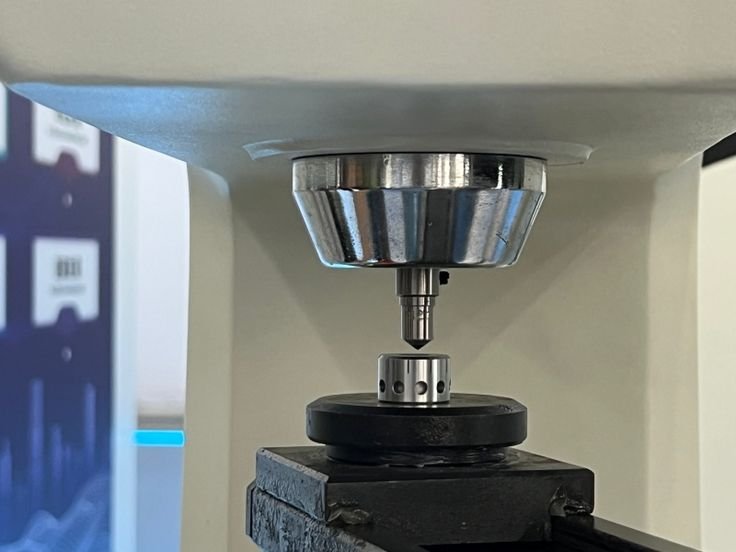
Bu micro Vickers hardness test is a highly precise method used to measure the hardness of very small or thin materials. It is a variation of the Vickers hardness test and is specifically designed for microscopic areas, thin coatings, and delicate materials where conventional hardness testing methods cannot be applied.
This testing technique is widely used in materials science, metallurgy, and microstructure analysis. It allows engineers and researchers to determine the hardness of individual phases within a material, surface treatments, or micro-scale components. The test uses a diamond indenter and very small loads to create a tiny indentation on the material surface, which is then measured using a microscope.
What Is the Micro Vickers Hardness Test?
The micro Vickers hardness test is a hardness measurement method that uses the same pyramid-shaped diamond indenter as the standard Vickers hardness test but applies much smaller test loads, typically ranging from 10 grams to 1000 grams.
Because of its precision and ability to measure extremely small indentations, the micro Vickers test is ideal for evaluating:
- Thin metal coatings
- Yüzey işlemleri
- Microstructural phases
- Small precision components
- Electronic materials
The hardness value obtained from the test is expressed in HV (Vickers Sertliği).
Principle of Micro Vickers Hardness Testing
The micro Vickers hardness test works on the principle of measuring the resistance of a material to deformation under a controlled load.
A diamond pyramid indenter with a square base and an angle of Karşılıklı yüzler arasında 136 derece is pressed into the surface of the material. After the load is removed, the diagonal lengths of the indentation are measured using an optical microscope.
The hardness value is then calculated using the formula: HV=1.854×Fd2HV = \frac{1.854 \times F}{d^2}HV=d21.854×F
Nerede?
- HV = Vickers sertlik sayısı
- F = Uygulanan yük (kgf)
- d = Average length of indentation diagonals (mm)
Since the indentation is extremely small, the measurement requires high magnification and precise optical systems.
Components of a Micro Vickers Hardness Tester
A micro Vickers hardness testing machine includes several essential components:
Elmas İndenter
A pyramid-shaped diamond indenter used to penetrate the material surface.
Precision Load System
Applies very small and controlled loads to ensure accurate micro-scale measurements.
Optik Mikroskop
Used to observe and measure the indentation diagonals with high accuracy.
Numune Aşaması
Holds and positions the test sample during measurement.
Dijital Ölçüm Sistemi
Modern micro Vickers testers include digital imaging systems and software that automatically calculate hardness values.
Test Procedure
The micro Vickers hardness test follows a systematic procedure to ensure accurate results.
Örnek Hazırlama
The surface of the specimen must be carefully polished to obtain a smooth and flat testing area.
Positioning the Sample
The sample is placed on the testing stage and positioned under the microscope.
Applying the Load
The diamond indenter is pressed into the material with a predetermined load for a specific dwell time, usually between 10 and 15 seconds.
Removing the Load
After the load is removed, a small square-shaped indentation remains on the surface.
Girintinin Ölçülmesi
The two diagonals of the indentation are measured using the microscope.
Calculating Hardness
The hardness value is calculated automatically by the testing machine or manually using the formula.
Advantages of Micro Vickers Hardness Testing
The micro Vickers hardness test offers several important benefits.
High Precision
It can measure extremely small areas with excellent accuracy.
Suitable for Thin Materials
The test is ideal for coatings, thin films, and small components.
Microstructure Analysis
It allows hardness measurement of individual phases within a material.
Wide Material Range
The test can be applied to metals, ceramics, and composite materials.
Non-destructive Testing
Girinti çok küçüktür ve numuneye verilen zararı en aza indirir.
Limitations of Micro Vickers Testing
Despite its advantages, the micro Vickers hardness test has some limitations.
- Requires careful sample preparation
- Sensitive to surface roughness and vibrations
- Requires high-quality optical measurement systems
- Testing process may be time-consuming
Proper laboratory conditions are necessary to ensure accurate measurements.
Applications of Micro Vickers Hardness Testing
Micro Vickers hardness testing is widely used in many industrial and research fields.
Metallurgy
Used to study the hardness of different phases in alloys and metals.
Coating and Surface Treatment
Evaluates the hardness of thin coatings, plating layers, and surface treatments.
Electronics Industry
Used for testing microelectronic components and semiconductor materials.

Heat Treatment Evaluation
Determines hardness variations after processes such as quenching and tempering.
Material Research
Researchers use micro Vickers testing to analyze new materials and microstructures.
Diğer Sertlik Testleri ile Karşılaştırma
The micro Vickers test differs from other common hardness testing methods.
Micro Vickers vs Rockwell
The Rockwell hardness test uses larger loads and provides faster results but cannot measure extremely small areas.
Micro Vickers vs Brinell
The Brinell hardness test uses a large ball indenter and is mainly suitable for bulk materials.
Micro Vickers vs Standard Vickers
The standard Vickers hardness test uses higher loads, while the micro Vickers test focuses on micro-scale measurements.
Importance in Modern Materials Engineering
In modern engineering and materials science, understanding the micro-scale mechanical properties of materials is crucial. The micro Vickers hardness test provides detailed insights into how materials behave at very small scales.
This information is essential for improving material performance, optimizing manufacturing processes, and ensuring product reliability in industries such as aerospace, automotive, electronics, and medical device manufacturing.
Sonuç
The micro Vickers hardness test is an advanced and highly precise method used to measure the hardness of very small areas, thin coatings, and microstructural components. By using a diamond indenter and microscopic measurement techniques, it allows accurate evaluation of material properties that cannot be assessed with traditional hardness testing methods.
Because of its accuracy and versatility, the micro Vickers hardness test has become an essential tool in materials research, quality control, and industrial testing laboratories. As materials continue to become more complex and miniaturized, the importance of micro-scale hardness testing will continue to grow.