




Portable Hardness Tester: 12 Powerful Benefits, Working Principles, and Industrial Applications


Úvod do prenosného tvrdomeru
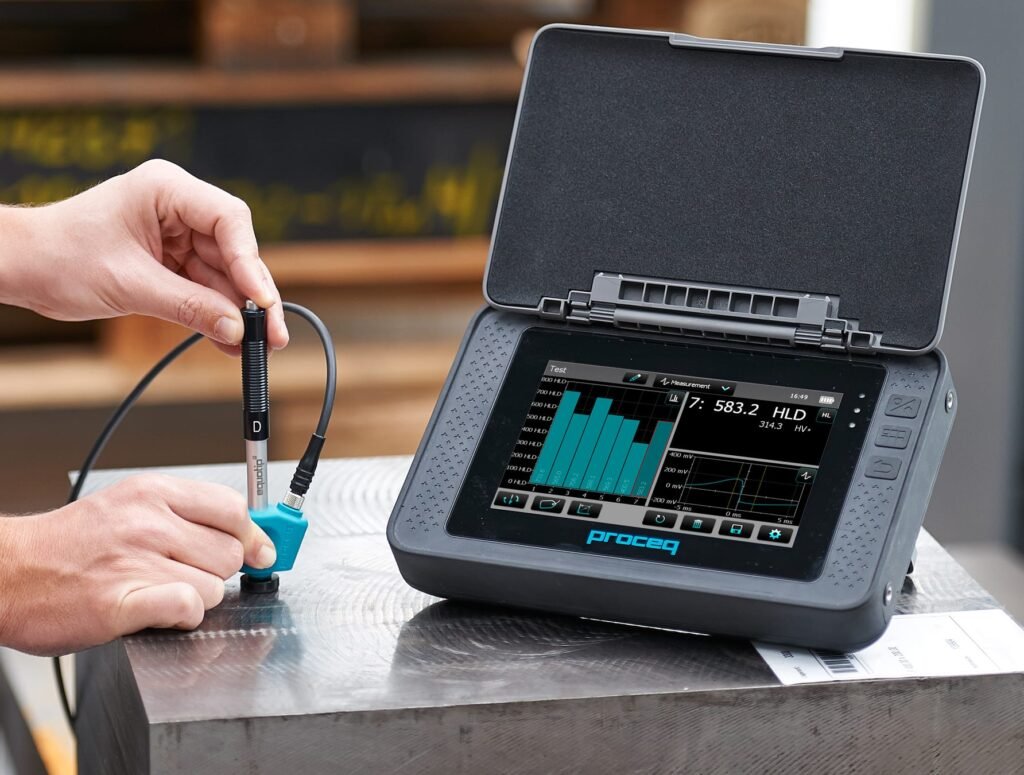
A portable hardness tester is a compact and easy-to-use instrument designed to measure the hardness of metals and other materials directly on-site. Unlike traditional laboratory hardness testers that require samples to be taken to a testing facility, portable devices allow technicians to perform hardness testing directly on large or installed components.
Hardness testing plays a crucial role in determining the strength, wear resistance, and durability of materials. With industries increasingly requiring quick and reliable testing methods, portable hardness testers have become essential tools in sectors such as manufacturing, construction, automotive, and aerospace.
The key advantage of a portable hardness tester is its mobility and convenience. Engineers can perform non-destructive hardness testing on pipelines, machinery parts, welded joints, and large metal structures without removing the components from service.
History and Evolution of Hardness Testing
Hardness testing has been used in material science for more than a century. Early hardness testing methods included Brinell, Rockwell, and Vickers tests, which required large laboratory machines and carefully prepared test samples.
As industrial equipment became larger and more complex, it became difficult to bring components into laboratories for testing. This led to the development of portable hardness testers in the late 20th century.
The introduction of Leeb rebound technology revolutionized portable hardness testing by allowing accurate hardness measurements using a small handheld device. Today, modern portable hardness testers incorporate digital displays, advanced sensors, and automated data processing for improved accuracy.

What Is a Portable Hardness Tester
A portable hardness tester is a handheld testing device used to measure the hardness of materials without damaging the tested object.
Definition and Key Features
Portable hardness testers are designed to measure hardness quickly and accurately in field environments. Key features typically include:
- Compact handheld design
- Digital display interface
- Multiple hardness scale conversion (HL, HB, HRC, HV)
- Built-in memory for test results
- Rechargeable battery operation
These features make portable hardness testers ideal for on-site inspection and quality control.
Importance in Modern Material Testing
Portable hardness testers help engineers ensure that materials meet design and safety requirements. They are widely used in:
- Quality control inspections
- Equipment maintenance
- Material verification
- Welding inspection
By providing immediate test results, portable hardness testers help prevent equipment failure and improve product reliability.
Pracovný princíp prenosného tvrdomeru
Portable hardness testers operate using different measurement principles depending on the testing technology used.
Impact Testing Method
One of the most common methods used in portable hardness testers is the impact testing method.
In this method, an impact body is propelled toward the surface of the test material. The device measures the velocity of the impact body before and after impact. The difference in velocity indicates the hardness of the material.
Rebound Measurement Technology
Rebound technology measures how much the impact body rebounds after hitting the surface. Harder materials cause a higher rebound velocity, while softer materials absorb more energy.
The hardness value is then calculated using a predefined mathematical relationship.
Types of Portable Hardness Tester
Portable hardness testers come in several types based on their testing principles.
Prenosný tester tvrdosti Leeb
The Leeb hardness tester is the most widely used portable hardness tester. It uses rebound technology to measure hardness and provides quick results for metals such as steel and aluminum.
Ultrazvukový prenosný tester tvrdosti
Ultrasonic hardness testers use ultrasonic vibrations to measure hardness. They are highly accurate and suitable for thin materials or small components.
Rebound Portable Hardness Tester
Rebound testers measure hardness by analyzing the rebound height or velocity of an impact hammer.
Key Components of a Portable Hardness Tester
Portable hardness testers consist of several components that work together to perform accurate measurements.
Impact Device
The impact device contains the impact body that strikes the material surface during testing.
Display and Control Unit
The control unit processes the test data and displays hardness values on the screen.
Data Processing System
Modern devices include microprocessors that convert raw measurements into standard hardness scales.
Probe and Sensors
Sensors measure velocity and rebound data, which are used to calculate hardness values.
Advantages of Portable Hardness Tester
Portable hardness testers provide several important benefits.
Mobility
Their lightweight design allows testing in remote locations or difficult-to-access areas.
Non-Destructive Testing
Portable hardness testers cause minimal damage to the test surface.
Quick Results
Measurements are obtained within seconds.
Multiple Hardness Scale Conversion
Many devices automatically convert results into various hardness scales.
Cost Efficiency
Portable hardness testers reduce the need for expensive laboratory testing.
Limitations of Portable Hardness Tester
Despite their advantages, portable hardness testers also have certain limitations.
- Surface preparation may be required for accurate results
- Accuracy may depend on operator skill
- Not ideal for very thin materials in some testing methods
- Environmental conditions may affect measurements
However, modern technology continues to improve the accuracy and reliability of portable hardness testers.
Applications of Portable Hardness Tester
Portable hardness testers are widely used in many industries.
Manufacturing Industry
Used to verify material hardness during production.
Automobilový priemysel
Ensures engine components and metal parts meet hardness specifications.
Letecký a kozmický priemysel
Used to inspect aircraft components and structural materials.
Oil and Gas Industry
Used to test pipelines, pressure vessels, and welded joints.
Construction Industry
Helps evaluate the hardness of structural materials used in buildings and bridges.
Portable Hardness Tester vs Bench Hardness Tester
| Funkcia | Prenosný tester tvrdosti | Bench Hardness Tester |
|---|---|---|
| Portability | Handheld | Stationary |
| Testing Location | On-site testing | Laboratory testing |
| Accuracy | High | Very high |
| Sample Requirement | No sample removal required | Requires prepared sample |
| Cost | Lower | Vyššie |
Kalibrácia a údržba
Regular calibration ensures accurate hardness measurements.
Key maintenance practices include:
- Calibration using standard hardness blocks
- Cleaning impact devices and probes
- Checking battery performance
- Updating device software if necessary
Proper maintenance extends the lifespan of the device and ensures reliable testing results.
Future Trends in Portable Hardness Tester Technology
Portable hardness tester technology continues to evolve with new innovations.
Emerging trends include:
- Wireless data transmission
- Integration with mobile applications
- AI-based analysis systems
- Cloud-based quality monitoring platforms
These technologies will improve testing efficiency and enable real-time quality control.
For further research on material testing standards, visit the ASTM International website:
https://www.astm.org
Často kladené otázky
1. What is a portable hardness tester used for?
It is used to measure the hardness of metals and materials directly on-site without removing samples.
2. What materials can be tested using a portable hardness tester?
Portable hardness testers are commonly used for steel, cast iron, aluminum, copper, and other metals.
3. Is portable hardness testing accurate?
Yes, modern portable hardness testers provide highly accurate measurements when properly calibrated.
4. What hardness scales can portable testers measure?
Many devices measure multiple scales such as HL, HB, HRC, HV, and HS.
5. Can portable hardness testers test welded joints?
Yes, they are commonly used for inspecting weld hardness in pipelines and structural components.
6. How often should a portable hardness tester be calibrated?
Calibration should typically be performed regularly using certified hardness test blocks.
Záver
Portable hardness testers have become indispensable tools in modern industrial quality control. Their compact design, fast testing capability, and ability to perform on-site inspections make them essential for engineers and technicians across many industries.
By enabling quick and reliable hardness measurements without removing components, portable hardness testers improve efficiency, reduce downtime, and enhance product safety. As technology continues to evolve, these devices will become even more advanced, offering smarter data analysis and improved testing accuracy.