




Bench Hardness Tester: A Comprehensive Guide


A bench hardness tester is a mechanical or electronic device used to measure the hardness of materials, particularly metals, plastics, and composites. Hardness is a key property in material science, reflecting a material’s resistance to deformation, wear, or penetration. Bench hardness testers are widely used in laboratories, quality control, manufacturing, and research due to their accuracy, repeatability, and ease of use.
1. Introduction to Hardness Testing
Hardness is an essential property of materials that influences strength, wear resistance, and durability. Measuring hardness helps engineers and scientists:
- Evaluate material suitability for specific applications
- Monitor manufacturing quality
- Investigate component failures
- Conduct research and development on new materials
While portable hardness testers exist, bench hardness testers offer higher precision and stability, making them ideal for laboratory environments.
2. Working Principle of Bench Hardness Testers
Bench hardness testers operate on the principle of indenting a material with a standardized indenter under a controlled force and then measuring the resulting impression. Depending on the tester type, the hardness value may be determined using:
- Depth of indentation
- Size of the impression
- Resistance to penetration
Common hardness scales include Rockwell (HR), Brinell (HB), en Vickers (HV).
3. Types of Bench Hardness Testers
Bench hardness testers are classified based on the testing method:
a) Rockwell Hardness Tester
- Measures hardness by the depth of penetration under a fixed load.
- Uses a diamond cone or steel ball indenter.
- Advantages: Quick, reliable, minimal sample preparation.
- Ideal for metals like steel, aluminum, and alloys.
b) Brinell Hardness Tester
- Uses a hard steel or tungsten carbide ball indenter.
- Hardness is calculated by measuring the diameter of the indentation.
- Suitable for materials with coarse or uneven grains, like cast iron.
c) Vickers Hardness Tester
- Uses a diamond pyramid-shaped indenter.
- Measures diagonal length of the indentation under a precise load.
- Applicable for thin materials, coatings, or very hard metals.
d) Microhardness Tester
- A variation of Vickers or Knoop testers for small-scale or thin samples.
- Used for coatings, thin films, and microstructures.
4. Main Components of a Bench Hardness Tester
A typical bench hardness tester consists of:
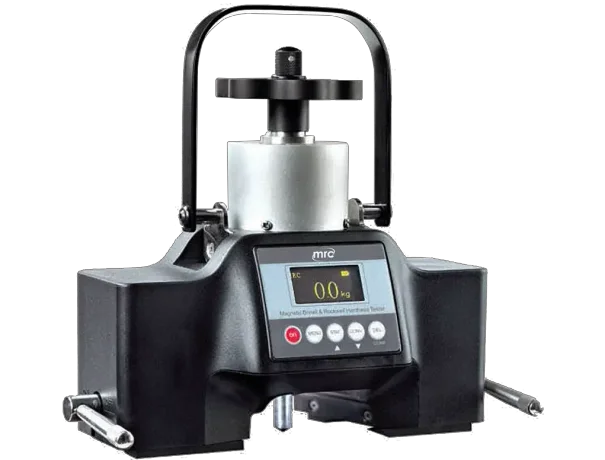
- Indenter: Diamond, steel ball, or tungsten carbide tip that penetrates the material.
- Load application system: Applies a standard force, either manually or electronically.
- Specimen stage: Holds the sample firmly in place; often adjustable for height.
- Dial or digital readout: Displays hardness value directly or via measurement of indentation size.
- Frame and base: Provides stability to minimize vibration and ensure accuracy.
Some modern bench testers are fully digital, integrating automated measurement, data logging, and software analysis.
5. Sample Preparation
Accurate hardness measurement depends on proper sample preparation:
- Surface smoothness: Rough surfaces can produce erroneous readings.
- Cleanliness: Remove dirt, grease, or oxidation.
- Flatness: The sample should be flat to ensure even contact with the indenter.
- Thickness: Generally, the sample should be at least 10 times the indentation depth to prevent back-side effects.
6. Operation Procedure
While specific procedures vary by tester type, general steps include:
- Place the sample on the stage and ensure stability.
- Select the indenter and load according to the material and hardness scale.
- Apply the load gradually until full force is reached.
- Measure the indentation (either automatically or manually).
- Record the hardness value in the appropriate scale.
- Repeat at multiple points for consistency and statistical accuracy.
Tips:
- Avoid testing near edges or irregular surfaces.
- Perform multiple measurements and calculate an average to improve reliability.
7. Applications of Bench Hardness Testers
Bench hardness testers are widely used across industries:
- Metallurgie: Evaluate hardness of steels, aluminum alloys, and castings.
- Automotive and Aerospace: Test engine components, gears, and structural parts.
- Manufacturing Quality Control: Ensure materials meet specifications before assembly.
- Research and Development: Develop new alloys or optimize heat treatment processes.
- Foutenanalyse: Investigate wear, deformation, or premature component failure.
8. Advantages of Bench Hardness Testers
- High precision and repeatability
- Ability to test larger or heavy samples
- Can measure various hardness scales (Rockwell, Brinell, Vickers)
- Stable and robust construction suitable for laboratory use
- Modern digital models allow automatic data logging
9. Limitations
- Typically limited to laboratory or workshop use (not portable)
- Sample size or shape may restrict certain measurements
- Surface preparation is critical for accurate results
- Brinell testers may leave permanent marks on softer materials
10. Conclusion
A bench hardness tester is a vital tool in materials science, engineering, and quality control. By accurately measuring a material’s resistance to deformation, it provides essential information about strength, wear resistance, and overall performance. With proper operation and sample preparation, bench hardness testers deliver reliable, reproducible, and standardized hardness values across a wide range of materials.