




De hardheidsmeter: Een diepgaande verkenning van een fundamenteel gereedschap in de materiaalkunde

Inleiding
In the world of materials science and quality control, the ability to quantify a material’s resistance to deformation is paramount. This property, known as hardness, is a critical indicator of a material’s strength, wear resistance, durability, and suitability for specific applications. At the heart of measuring this essential characteristic lies the hardheidsmeter, a sophisticated instrument that has evolved from simple manual devices to highly advanced automated systems. This article delves into the principles, types, applications, and technological advancements of hardness testers, highlighting their indispensable role in industry and research.
1. What is Hardness and Why Test It?
Hardness is not a fundamental physical property but a composite one, broadly defined as a material’s resistance to localized plastic deformation, typically induced by indentation, scratching, cutting, or abrasion. Testing hardness provides rapid, non-destructive (or minimally destructive) insights into:
- Material Strength and Wear Resistance: Harder materials generally resist wear and deformation better.
- Heat Treatment Verification: Confirms the success of processes like case hardening, tempering, and annealing.
- Quality Control: Ensures batch consistency and compliance with material specifications.
- Material Selection: Guides engineers in choosing the right material for gears, cutting tools, bearings, structural components, and more.
2. Core Principles of Hardness Testing
Most hardness testers operate on the inspringingsprincipe: a hard indenter of specific geometry and material (like diamond or hardened steel) is pressed into the test material under a controlled force. The hardness value is derived from either:
- The depth of the indentation (Rockwell, Instrumented Indentation).
- The size (area or diagonal) of the indentation (Brinell, Vickers, Knoop).
- The rebound of an indenter (Shore, Leeb).
The choice of method depends on the material type, scale of measurement, required precision, and sample condition.
3. Major Types of Hardness Testers
A. Rockwell Hardness Testers
The most widely used method due to its speed and simplicity.
- Principe: Measures the permanent depth of indentation under two loads (a minor preload and a major load).
- Indenters: Diamond cone (Brale) for hard materials, or hardened steel balls.
- Scales: Multiple scales (e.g., HRA, HRB, HRC) based on indenter and load combination. Results are read directly from a dial or display.
- Geschikt voor: Rapid production line testing of metals, from soft aluminum to hardened steel.

B. Brinell Hardness Testers
One of the oldest and most reliable for heterogeneous materials.
- Principe: Uses a relatively large (usually 10mm) tungsten carbide ball indenter under a high load. Hardness (BHN) is calculated from the diameter of the residual impression.
- Advantage: The large indent averages out variations in grain structure, ideal for cast irons, aluminum alloys, and other coarse-grained materials.
- Limitation: Leaves a relatively large impression.
C. Vickers Hardness Testers
Known for its versatility and use of a single, scalable hardness number.
- Principe: Uses a pyramidal diamond indenter with a square base. Hardness (HV) is calculated from the diagonal length of the impression after load removal.
- Voordelen:
- A single scale works for all materials, from soft to ultra-hard (like ceramics).
- The geometrically similar indentations allow for direct comparison of hardness values regardless of load.
- Ideaal voor microhardheid testen with very low loads.
- Toepassingen: Thin sections, surface coatings, heat-affected zones, and small components.
D. Microhardness Testers (Vickers & Knoop)
Specialized versions of Vickers testers designed for very small loads (grams to a few kilograms).
- Knoop Indenter: An elongated pyramidal diamond, producing a shallow, long indentation. Excellent for testing brittle materials (glass, ceramics) and thin plated layers, as it minimizes cracking.
- Principe: Requires a high-precision microscope to measure the tiny indent diagonals.
- Toepassingen: Material phases, individual grains, thin films, painted/coated surfaces, and electronic components.
E. Portable & Non-Destructive Testers
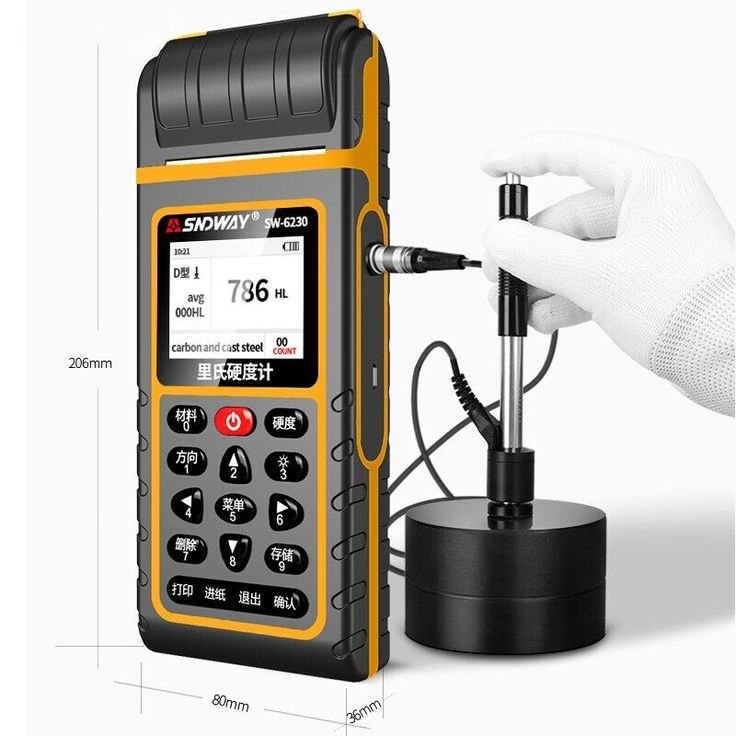
- Leeb (Terugslag) Testers: Measure the velocity change of a tungsten carbide impact body before and after striking the sample. The rebound hardness correlates to indentation hardness. Ideal for large, non-moveable components (pipelines, forgings, turbines).
- Ultrasone contactimpedantietesters (UCI): A vibrating rod with a Vickers diamond tip measures frequency shift upon indentation. Suitable for small, thin, or coated parts.
- Shore (Durometer) Testers: Used for polymers, elastomers, and rubbers, measuring resistance to indentation of a spring-loaded conical or spherical indenter.
4. Key Components of a Modern Hardness Tester
- Frame: A rigid, vibration-resistant structure.
- Indenter: Precision-made diamond or ball indenters.
- Force Application System: Can be weights (deadweight), closed-loop servo motors, or spring-based systems.
- Measurement System: Optical microscopes (for reading indent size), depth sensors (for Rockwell), or electronic transducers.
- Control & Display Unit: Modern testers feature digital touchscreens, programmable test cycles, and data logging.
- Motorized XYZ Stage (for microhardness): Enables precise positioning and automated traverses for creating hardness profiles.
5. Technological Advancements
- Automation: Robotic loading, auto-focus cameras, and image analysis software automatically locate, indent, measure, and classify hardness values, dramatically increasing throughput and eliminating operator bias.
- Software Integration: Advanced software enables mapping hardness across a surface (hardness mapping), creating line profiles, statistical analysis, and direct reporting to Quality Management Systems (QMS).
- Instrumented (Nano) Indentation: Goes beyond hardness to measure elastic modulus, creep, and fracture toughness by continuously monitoring force and displacement during the entire indentation cycle at nanometer scales.
6. Selection and Best Practices
Selecting the right tester involves considering:
- Material Type & Hardness Range
- Sample Size & Geometry
- Required Scale (Macro, Micro, Nano)
- Test Standards (ASTM, ISO, JIS)
- Production Volume vs. Lab Precision
Critical best practices include proper sample preparation (grinding, polishing), calibration with certified reference blocks, adherence to standard test procedures, and environmental control.
Conclusie
From ensuring the safety of automotive components and aircraft landing gear to developing next-generation biomedical implants and semiconductor materials, the hardness tester remains a cornerstone of material characterization. Its evolution from a simple mechanical gauge to a fully automated, data-rich analytical tool mirrors the progress of modern manufacturing. As materials themselves become more advanced—smaller, thinner, and more complex—hardness testing technology will continue to innovate, providing the essential data needed to push the boundaries of engineering and science. In essence, the humble hardness indentation is a profound fingerprint, revealing the inner strength and integrity of the material world around us.