

- Appareil d'essai de dureté Micro Vickers
- Appareil d'essai de dureté Vickers
- Capteur de dureté Vickers
- Appareil d'essai de dureté Rockwell
- Appareil d'essai de dureté Brinell
- Appareil de dureté Leeb
- Appareil de mesure de la dureté Shore
- Testeur de dureté Webster
- Appareil de mesure de la dureté Barcol
- Barre d'essai de dureté



How to Choose a Hardness Tester Smart Guide 21 Expert Tips for Accurate Results

Outline for the Article on How to Choose a Hardness Tester
| Domaine thématique | Couverture détaillée avec des mots-clés LSI |
|---|---|
| Introduction to How to Choose a Hardness Tester | selecting hardness tester |
| Why Choosing the Right Hardness Tester Matters | accuracy, reliability |
| Understanding Hardness Testing Basics | indentation principles |
| Types of Hardness Testers Available | Rockwell, Brinell, Vickers |
| Rockwell Hardness Tester Selection | essais de production |
| Brinell Hardness Tester Selection | cast and forged materials |
| Vickers Hardness Tester Selection | essais de précision |
| Knoop Hardness Tester Selection | microhardness analysis |
| Microhardness vs Macro Hardness Testers | application differences |
| Portable Hardness Testers | essais sur place |
| Bench and Laboratory Hardness Testers | environnements contrôlés |
| Digital vs Analog Hardness Testers | usability |
| Automatic Hardness Testers | essais en grand volume |
| Materials to Be Tested | steel, aluminum, alloys |
| Choosing a Tester for Steel | heat-treated materials |
| Choosing a Tester for Aluminum | métaux doux |
| Choosing a Tester for Cast Iron | coarse structures |
| Choosing a Tester for Non-Ferrous Metals | copper, brass |
| Testing Range and Load Selection | accuracy |
| Sample Size and Geometry Considerations | part shape |
| Surface Condition Requirements | preparation |
| Accuracy and Repeatability Needs | quality control |
| Production Volume Considerations | l'efficacité |
| Industry-Specific Requirements | automobile, aérospatiale |
| Normes et conformité | ASTM, ISO |
| Étalonnage et traçabilité | l'assurance qualité |
| Ease of Use and Training | operator efficiency |
| Gestion des données et rapports | digital integration |
| Maintenance and Support | fiabilité à long terme |
| Budget and Cost Considerations | ROI |
| Common Mistakes When Choosing a Tester | avoidance |
| Evaluating Suppliers and Brands | reliability |
| Expertise et solutions en matière de marques | Johoyd guidance |
| Future-Proofing Your Investment | scalability |
| FAQ | questions courantes |
| Conclusion | résumé |
Introduction
How to Choose a Hardness Tester is a question faced by manufacturers, laboratories, quality engineers, and research teams across industries. With many hardness testing methods, configurations, and technologies available, selecting the right tester can feel overwhelming. However, the right choice directly affects accuracy, efficiency, and long-term testing reliability.
A hardness tester is more than just an inspection tool. It is an investment in product quality, safety, and process control. Understanding how to choose a hardness tester ensures that testing results are meaningful, repeatable, and compliant with industry standards.

How to Choose a Hardness Tester
To understand how to choose a hardness tester, it is essential to start with your application requirements. The right tester depends on material type, testing environment, production volume, and accuracy expectations.
Rather than selecting based on popularity or price alone, a systematic evaluation ensures optimal performance and value.
Why Choosing the Right Hardness Tester Matters
Choosing the wrong hardness tester can lead to inaccurate measurements, rejected parts, and costly rework. Incorrect hardness data may hide processing issues or create false confidence in product quality.
By carefully selecting a suitable hardness tester, organizations ensure reliable data, regulatory compliance, and consistent decision-making.
Understanding Hardness Testing Basics
Hardness testing measures a material’s resistance to permanent deformation. This resistance is evaluated by pressing an indenter into the material under a controlled load.
Different hardness testing methods measure either indentation depth or indentation size. Understanding these fundamentals helps guide the selection process.
Types of Hardness Testers Available
There are several types of hardness testers available, each designed for specific applications.
The most common types include Rockwell, Brinell, Vickers, and Knoop hardness testers.
Rockwell Hardness Tester Selection
Rockwell hardness testers are widely used in production environments. They provide fast and direct readings.
This type is ideal when speed, simplicity, and repeatability are required, especially for steel and alloy components.
Brinell Hardness Tester Selection
Brinell testers use a large ball indenter and heavy load. They are suitable for softer materials and coarse-grain structures.
Brinell testing is often chosen for cast iron, forgings, and large components.
Vickers Hardness Tester Selection
Vickers testers use a diamond pyramid indenter. They cover a wide hardness range.
This type is ideal when high accuracy and versatility are required, especially in laboratories and quality control settings.
Knoop Hardness Tester Selection
Knoop hardness testers are used for microhardness testing. They are ideal for thin layers and brittle materials.
This method is commonly used in research and surface analysis.
Microhardness vs Macro Hardness Testers
Microhardness testers use very low loads and analyze small features. Macro hardness testers evaluate bulk material properties.
Understanding the scale of testing helps determine the appropriate tester type.
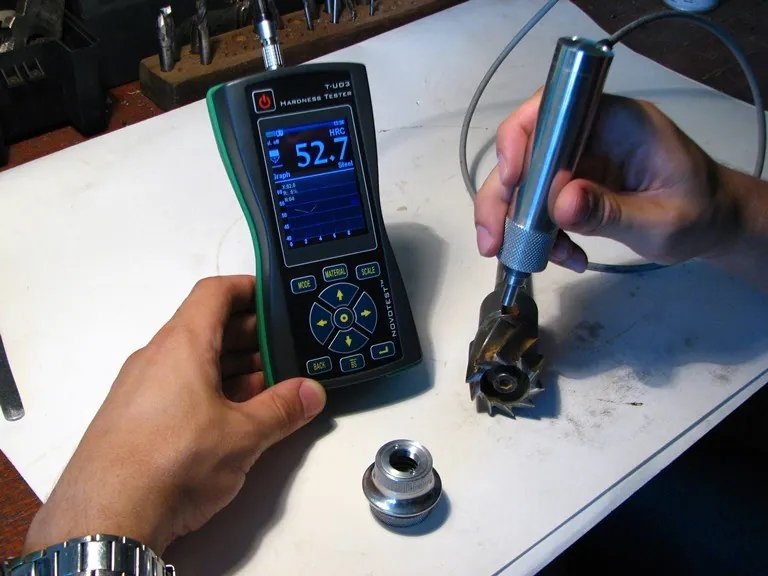
Portable Hardness Testers
Portable hardness testers allow testing on large or installed components. They are ideal for maintenance and field inspections.
These testers are chosen when laboratory testing is impractical.
Bench and Laboratory Hardness Testers
Bench-top and laboratory hardness testers offer controlled conditions and high accuracy.
They are ideal for research, certification, and reference testing.
Digital vs Analog Hardness Testers
Digital hardness testers offer automated measurement, data storage, and reporting.
Analog testers are simpler but require more operator experience.
Automatic Hardness Testers
Automatic hardness testers reduce operator influence and improve repeatability.
They are ideal for high-volume production and standardized testing.
Materials to Be Tested
Material type is a primary factor when learning how to choose a hardness tester.
Steel, aluminum, cast iron, and non-ferrous metals all respond differently to indentation.
Choosing a Tester for Steel
Steel hardness testing often requires Rockwell or Vickers testers.
The choice depends on hardness range and application.

Choosing a Tester for Aluminum
Aluminum is softer and requires careful load selection.
Vickers or Brinell testers are commonly used.
Choosing a Tester for Cast Iron
Cast iron has a coarse structure.
Brinell testing provides reliable average hardness values.
Choosing a Tester for Non-Ferrous Metals
Les métaux non ferreux nécessitent des méthodes d'essai flexibles.
Le test Vickers est souvent préféré pour des raisons de précision.
Testing Range and Load Selection
The tester must cover the required hardness range.
Incorrect load selection can lead to inaccurate results.
Sample Size and Geometry Considerations
Component size and shape affect tester selection.
Thin or irregular samples may require microhardness testing.
Surface Condition Requirements
Surface preparation influences hardness results.
Some testers tolerate rough surfaces better than others.
Accuracy and Repeatability Needs
Quality-critical applications demand high accuracy.
Automatic and digital testers improve repeatability.
Production Volume Considerations
High production volumes benefit from fast and automated testers.
Low-volume testing may prioritize versatility.
Industry-Specific Requirements
Industries such as automotive and aerospace have strict testing requirements.
Compliance often dictates tester selection.
Normes et conformité
Hardness testers should comply with ASTM and ISO standards.
La conformité garantit l'acceptation au niveau mondial.
Étalonnage et traçabilité
Regular calibration maintains accuracy.
Traceability supports audits and quality systems.
Ease of Use and Training
User-friendly testers reduce training time and errors.
Intuitive interfaces improve productivity.
Gestion des données et rapports
Modern testers offer digital data storage and reporting.
This supports quality documentation and analysis.
Maintenance and Support
Reliable support and maintenance services protect investment.
Long-term accuracy depends on proper upkeep.
Budget and Cost Considerations
Cost should be balanced against performance and durability.
The cheapest option may not deliver long-term value.

Common Mistakes When Choosing a Hardness Tester
Common mistakes include choosing based on price alone or ignoring standards.
Clear requirements prevent costly errors.
Evaluating Suppliers and Brands
Reputable suppliers offer technical support and training.
Experience matters when selecting testing equipment.
Expertise et solutions en matière de marques
Choosing the right hardness tester is easier with expert guidance. Brands like Johoyd, par le biais de https://hardnesstests.com, provide professional advice and a wide range of hardness testers tailored to industrial, laboratory, and research needs.
Their expertise helps users confidently understand how to choose a hardness tester that meets both current and future requirements.
Future-Proofing Your Investment
Future-proof testers support upgrades, automation, and digital integration.
Scalable solutions protect long-term value.
Questions fréquemment posées
Why is it important to know how to choose a hardness tester?
It ensures accurate and reliable testing.
Which hardness tester is best for beginners?
Rockwell testers are simple and widely used.
Are portable hardness testers accurate?
Yes, when properly calibrated.
Do all industries use the same hardness tester?
No, requirements vary by application.
How often should hardness testers be calibrated?
According to standards or usage.
Can one tester handle all materials?
Some testers are versatile, but specialization improves accuracy.
Conclusion
Understanding How to Choose a Hardness Tester is essential for achieving accurate, repeatable, and compliant material testing. The right choice depends on material type, application environment, accuracy requirements, and future needs.
With experienced manufacturers like Johoyd offering expert solutions through hardnesstests.com, users gain confidence in their selection process. By investing wisely, organizations ensure long-term quality, efficiency, and reliability in hardness testing.
Liens internes suggérés
- Types of Industrial Hardness Testers
- Hardness Testing Standards and Methods
Liens sortants suggérés
- Normes d'essai de dureté ASTM
- ISO Guidelines for Material Hardness Testing