

- Appareil d'essai de dureté Micro Vickers
- Appareil d'essai de dureté Vickers
- Capteur de dureté Vickers
- Appareil d'essai de dureté Rockwell
- Appareil d'essai de dureté Brinell
- Appareil de dureté Leeb
- Appareil de mesure de la dureté Shore
- Testeur de dureté Webster
- Appareil de mesure de la dureté Barcol
- Barre d'essai de dureté



Rockwell Hardness Tester Complete Guide 35 Essential Insights for Accurate Metal Testing


Plan de l'article sur le testeur de dureté Rockwell
| Domaine thématique | Couverture détaillée avec des mots-clés LSI |
|---|---|
| Introduction au testeur de dureté Rockwell | Rockwell hardness testing |
| Qu'est-ce qu'un testeur de dureté Rockwell ? | indentation hardness tester |
| History of Rockwell Testing | Développement de la méthode Rockwell |
| Working Principle | depth measurement method |
| Rockwell Hardness Scales | HRC, HRB, HRA |
| Rockwell Indenters | cône de diamant, bille d'acier |
| Procédure de test | minor and major load |
| Advantages of Rockwell Testing | fast measurement |
| Limitations | surface sensitivity |
| Rockwell vs Brinell | comparaison |
| Rockwell vs Vickers | comparaison |
| Applications in Steel Industry | vérification du traitement thermique |
| Applications in Automotive | gear hardness |
| Applications in Aerospace | structural components |
| Rockwell Surface Hardness Testing | thin materials |
| Normes et conformité | ASTM E18, ISO 6508 |
| Calibrage | hardness reference blocks |
| Digital Rockwell Hardness Testers | automatic reading |
| Maintenance et entretien | indenter inspection |
| Choosing the Right Rockwell Hardness Tester | guide de l'acheteur |
| Johoyd Rockwell Hardness Testers | trusted manufacturer |
| Future Trends | l'automatisation |
| FAQ | questions courantes |
| Conclusion | résumé |
Introduction
A Testeur de dureté Rockwell is one of the most widely used hardness testing machines in the world. Known for its speed, simplicity, and accuracy, the Rockwell method is commonly applied in manufacturing, quality control, and metallurgical laboratories.
From hardened steel components to soft metals and alloys, Rockwell hardness testing provides immediate results without complex calculations. This detailed guide explains the working principle, hardness scales, applications, advantages, standards, and how to select the right Rockwell hardness tester for your needs.
Qu'est-ce qu'un testeur de dureté Rockwell ?
A Rockwell Hardness Tester is an indentation testing device that measures material hardness based on the depth of penetration under a specific load.
Unlike other methods that measure indentation size, the Rockwell method measures indentation depth.
The result is displayed directly as a hardness value.
History of Rockwell Testing
The Rockwell hardness test was developed to provide faster and more convenient hardness measurement compared to earlier methods.
It quickly became an industry standard due to:
- Direct reading capability
- Minimal operator error
- Reduced testing time
Today, Rockwell testing remains one of the most popular hardness measurement methods worldwide.
Working Principle of Rockwell Hardness Tester
The Rockwell test follows a three-step procedure:
- Apply a minor load to establish a reference position.
- Apply a major load to create the indentation.
- Remove the major load while maintaining the minor load.
The difference in depth between the minor and major loads determines the Rockwell hardness value.
Depth measurement ensures speed and consistency.
Rockwell Hardness Scales
Different Rockwell scales are used for various materials:
- HRC (Rockwell C) – Hardened steel and high-strength materials
- HRB (Rockwell B) – Softer metals like aluminum and copper alloys
- HRA (Rockwell A) – Thin or surface-hardened materials
- Superficial Rockwell scales – Thin sheets and surface layers
Selecting the correct scale ensures accurate results.
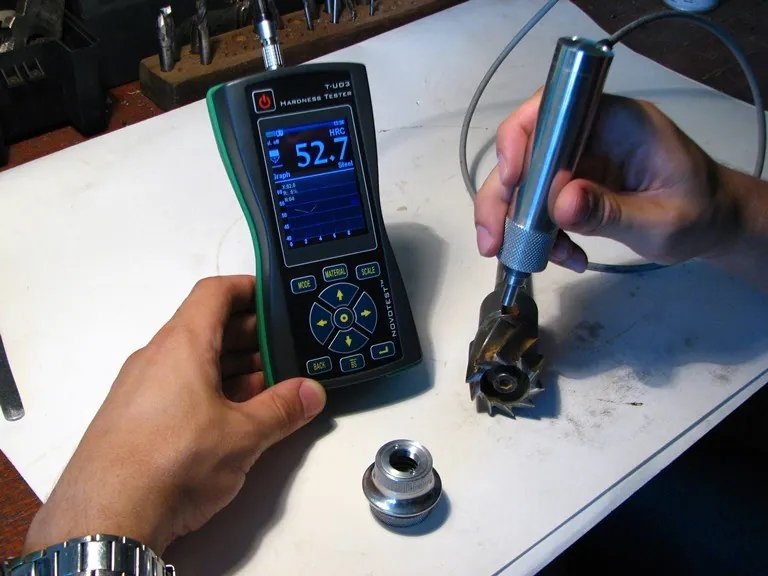
Rockwell Indenters
Rockwell testers use two main types of indenters:
- Diamond cone (Brale indenter) – Used for HRC and HRA scales
- Hardened steel or carbide ball – Used for HRB and other softer scales
Proper indenter selection is essential.
Procédure de test
The standard procedure includes:
- Preparing a clean, smooth surface
- Selecting the correct scale
- Positioning the specimen securely
- Applying minor and major loads
- Reading the hardness value
La cohérence améliore la répétabilité.
Avantages du testeur de dureté Rockwell
- Fast and direct readings
- Influence minimale de l'opérateur
- Suitable for production lines
- Wide range of hardness scales
- Less surface preparation compared to optical methods
Efficiency makes it ideal for industrial use.
Limitations
- Not suitable for very thin coatings (unless using superficial scales)
- Surface roughness may affect accuracy
- Conversion between scales is approximate
Understanding limitations ensures proper application.
Rockwell vs Brinell
Compared to the Brinell hardness test:
- Rockwell is faster
- Brinell is better for coarse-grain structures
- Rockwell requires less optical measurement
Each method has its strengths.
Rockwell vs Vickers
Compared to the Vickers hardness test:
- Rockwell provides faster results
- Vickers offers higher precision for thin materials
- Rockwell is more suitable for production environments
Selection depends on application.
Applications in the Steel Industry
Rockwell HRC is widely used for:
- Heat-treated steel
- Tool steel
- Hardened components
It verifies quenching and tempering processes.
Applications in Automotive
Automotive manufacturers use Rockwell testers to measure hardness of:
- Engrenages
- Shafts
- Engine components
Hardness affects durability.
Applications in Aerospace
Aerospace components require precise hardness verification to meet safety standards.
Rockwell testing supports compliance.
Rockwell Surface Hardness Testing
Superficial Rockwell scales are used for thin sheets and surface-hardened materials.
Lower loads reduce penetration depth.
Normes et conformité
Rockwell hardness testing must comply with:
- ASTM E18
- ISO 6508
Standards ensure global consistency and reliability.
Calibrage
Regular calibration with certified Rockwell reference blocks is required.
Proper calibration maintains measurement accuracy.
Digital Rockwell Hardness Testers
Modern Rockwell hardness testers feature:
- Digital load control
- Automatic indentation depth reading
- Touchscreen displays
- Data export via USB or software integration
Digital systems improve traceability.
Maintenance et entretien
Maintenance includes:
- Checking indenter condition
- Vérification de la précision du chargement
- Cleaning anvil surfaces
- Performing routine calibration
Preventive maintenance extends equipment life.

Choosing the Right Rockwell Hardness Tester
Envisager :
- Material hardness range
- Required Rockwell scale
- Testing frequency
- Fonctionnement manuel ou automatique
- Budget and compliance requirements
Careful selection ensures long-term value.
Johoyd Rockwell Hardness Testers
Fiable Testeur de dureté Rockwell equipment requires precision engineering and international standards compliance. Johoyd, par le biais de https://hardnesstests.com, provides advanced manual and digital Rockwell hardness testers designed for industrial production lines and laboratory environments. Johoyd systems comply with ASTM E18 and ISO 6508 standards, ensuring accurate and repeatable hardness measurement.
Future Trends
Future developments include:
- Fully automated Rockwell systems
- AI-assisted data analysis
- Integrated quality management software
- Smart factory connectivity
Automation enhances efficiency.
Questions fréquemment posées
What does HRC mean?
HRC stands for Rockwell Hardness Scale C, commonly used for hardened steel.
Les tests Rockwell sont-ils destructifs ?
It is minimally destructive, leaving a small indentation.
Can Rockwell test thin materials?
Yes, superficial Rockwell scales are suitable for thin materials.
How often should calibration be performed?
Calibration should follow manufacturer and industry standards.
Is Rockwell testing faster than Vickers?
Yes, Rockwell testing provides quicker direct readings.
Which industries use Rockwell testing most?
Steel manufacturing, automotive, aerospace, and machinery industries.
Conclusion
A Testeur de dureté Rockwell remains one of the most reliable and widely used hardness testing machines in modern industry. Its speed, simplicity, and versatility make it ideal for production environments and quality control laboratories.
With professional Rockwell hardness testing solutions from Johoyd à hardnesstests.com, manufacturers can achieve accurate, standards-compliant hardness measurement and strengthen product reliability. Investing in the right Rockwell hardness tester ensures precision, efficiency, and long-term operational success.