

- Appareil d'essai de dureté Micro Vickers
- Appareil d'essai de dureté Vickers
- Capteur de dureté Vickers
- Appareil d'essai de dureté Rockwell
- Appareil d'essai de dureté Brinell
- Appareil de dureté Leeb
- Appareil de mesure de la dureté Shore
- Testeur de dureté Webster
- Appareil de mesure de la dureté Barcol
- Barre d'essai de dureté



Micro Hardness Tester Complete Guide 38 Precision Insights for Accurate Microhardness Measurement (en anglais)

Outline for the Article on Micro Hardness Tester
| Domaine thématique | Couverture détaillée avec des mots-clés LSI |
|---|---|
| Introduction to Micro Hardness Tester | essais de microdureté |
| Definition of Micro Hardness Tester | low load hardness tester |
| Role of Micro Hardness Testing | microstructure evaluation |
| Importance of Micro Hardness Testers | mesure de précision |
| History of Micro Hardness Testing | Vickers and Knoop |
| Basic Principle of Micro Hardness Testing | small indentation |
| Difference Between Micro and Macro Hardness | load comparison |
| Types of Micro Hardness Testers | Vickers, Knoop |
| Vickers Micro Hardness Tester | pyramide de diamants |
| Knoop Micro Hardness Tester | elongated indentation |
| Manual Micro Hardness Tester | operator controlled |
| Digital Micro Hardness Tester | automated measurement |
| Automatic Micro Hardness Tester | high repeatability |
| Components of a Micro Hardness Tester | indenter, optics |
| Indenter Types and Loads | gram-force loads |
| Système de mesure optique | microscope accuracy |
| Test Procedure for Micro Hardness | step-by-step |
| Exigences en matière de préparation des échantillons | polished surface |
| Micro Hardness Testing Standards | ASTM, ISO |
| Materials Suitable for Micro Hardness Testing | metals and coatings |
| Micro Hardness Testing for Thin Coatings | surface layers |
| Micro Hardness Testing for Heat Treatment | case depth |
| Micro Hardness Testing for Welds | HAZ evaluation |
| Précision et répétabilité | precision control |
| Calibration of Micro Hardness Tester | blocs de référence |
| Advantages of Micro Hardness Tester | detailed analysis |
| Limitations of Micro Hardness Testing | surface sensitivity |
| Applications in Metallography | microstructure study |
| Applications dans le domaine du contrôle de la qualité | small parts |
| Applications dans les laboratoires de R&D | développement du matériel |
| Applications in Electronics Industry | micro components |
| Data Recording and Analysis | digital results |
| Integration with Laboratory Systems | data management |
| Erreurs de test courantes | indentation issues |
| Selecting the Right Micro Hardness Tester | guide d'achat |
| Maintenance et entretien | long-term accuracy |
| Expertise et solutions en matière de marques | Johoyd micro hardness tester |
| Future Trends in Micro Hardness Testing | l'automatisation |
| FAQ | questions courantes |
| Conclusion | résumé |
Introduction
A micro hardness tester is a specialized instrument designed to measure the hardness of materials using very low test loads. Unlike conventional hardness testing, micro hardness testing focuses on small areas, thin layers, and fine microstructures that require exceptional precision.
In metallurgical laboratories, quality control departments, and research environments, micro hardness testers play a critical role in understanding material behavior at a microscopic level.
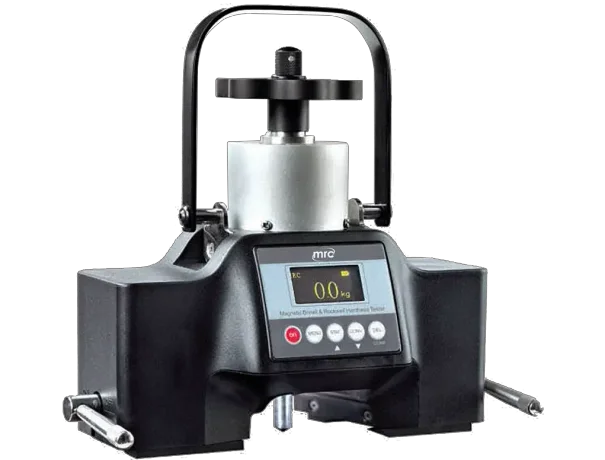
Micro Hardness Tester
A micro hardness tester applies a small, controlled force through a diamond indenter and measures the resulting indentation using optical systems. The hardness value reflects resistance to localized deformation.
This approach enables detailed material evaluation.
Definition of Micro Hardness Tester
A micro hardness tester is a hardness testing device that operates with test loads typically ranging from a few grams to several kilograms. It is used to evaluate micro-scale hardness variations.
This tester is essential for precision analysis.
Role of Micro Hardness Testing
Micro hardness testing reveals variations in hardness within small regions of a material. It supports microstructural analysis and process validation.
This insight is not achievable with macro testing.
Importance of Micro Hardness Testers
Micro hardness testers are important because they allow evaluation of thin coatings, surface treatments, and small components. They provide localized hardness data.
Precision drives reliability.
History of Micro Hardness Testing
Micro hardness testing evolved with the development of the Vickers and Knoop methods. These techniques enabled accurate measurement under low loads.
They remain industry standards.
Basic Principle of Micro Hardness Testing
The principle involves pressing a diamond indenter into the surface with a small force. The indentation size determines hardness.
Accurate measurement is critical.
Difference Between Micro and Macro Hardness
Micro hardness testing uses much lower loads than macro testing. It focuses on small features, while macro testing evaluates bulk properties.
Method selection depends on application.
Types of Micro Hardness Testers
Micro hardness testers are classified by indenter type and automation level. Common types include Vickers and Knoop testers.
Each serves specific needs.
Vickers Micro Hardness Tester
The Vickers micro hardness tester uses a square-based diamond pyramid. It provides versatile and precise results.
It is widely used in laboratories.
Knoop Micro Hardness Tester
The Knoop micro hardness tester uses an elongated diamond indenter. It is ideal for thin coatings and brittle materials.
It minimizes surface damage.
Manual Micro Hardness Tester
Manual micro hardness testers require operator control. They offer flexibility and cost efficiency.
Operator skill is important.
Digital Micro Hardness Tester
Digital micro hardness testers use electronic measurement and displays. They improve repeatability and data handling.
Les systèmes numériques améliorent la productivité.
Automatic Micro Hardness Tester
Automatic micro hardness testers control load application and measurement automatically. They reduce operator influence.
L'automatisation garantit la cohérence.
Components of a Micro Hardness Tester
Key components include the indenter, loading mechanism, optical microscope, and control system. Each component affects accuracy.
Precision engineering is essential.
Indenter Types and Loads
Diamond indenters are used for micro hardness testing. Loads are carefully selected to match material and application.
Correct selection prevents errors.
Système de mesure optique
High-magnification microscopes measure indentation size. Optical clarity and calibration are critical.
Measurement accuracy defines results.
Test Procedure for Micro Hardness
The test procedure includes positioning, load application, indentation measurement, and calculation. Controlled conditions ensure reliable results.
Consistency is key.
Exigences en matière de préparation des échantillons
Samples must be polished to a mirror finish. Surface defects distort indentation measurement.
Proper preparation is mandatory.
Micro Hardness Testing Standards
Micro hardness testing follows standards such as ASTM E384 and ISO 6507. Standards define loads and procedures.
Compliance ensures comparability.
Materials Suitable for Micro Hardness Testing
Micro hardness testers are used for metals, alloys, ceramics, and coatings. They are ideal for small or delicate samples.
Versatility is a strength.

Micro Hardness Testing for Thin Coatings
Thin coatings require low loads and precise measurement. Micro hardness testing evaluates coating quality.
This supports surface engineering.
Micro Hardness Testing for Heat Treatment
Micro hardness profiles verify case depth and heat treatment uniformity. This is critical for performance.
Accurate profiling improves confidence.
Micro Hardness Testing for Welds
Micro hardness testing evaluates hardness variation across weld zones. It identifies potential weak areas.
This supports welding quality.
Précision et répétabilité
Accuracy depends on calibration, optics, and operator technique. Repeatability improves with automation.
Des données fiables renforcent la confiance.
Calibration of Micro Hardness Tester
Regular calibration using reference blocks ensures traceability. Calibration maintains confidence in results.
It is essential for compliance.
Advantages of Micro Hardness Tester
Les principaux avantages sont les suivants :
- Haute précision
- Low test loads
- Localized measurement
- Detailed analysis
These benefits make micro hardness testing indispensable.
Limitations of Micro Hardness Testing
Micro hardness testing is sensitive to surface condition and preparation. It requires skilled operation.
Understanding limits prevents misinterpretation.
Applications in Metallography
Metallographic analysis relies on micro hardness testing to correlate hardness with microstructure.
It supports material understanding.
Applications dans le domaine du contrôle de la qualité
Quality control uses micro hardness testers for small components and coatings. Results ensure specification compliance.
Precision supports acceptance decisions.
Applications dans les laboratoires de R&D
R&D laboratories use micro hardness testing to study new materials and processes. Detailed data supports innovation.
La précision est essentielle.
Applications in Electronics Industry
Electronics components are small and delicate. Micro hardness testers evaluate material integrity without damage.
They support reliability.
Data Recording and Analysis
Modern micro hardness testers generate digital data and images. Software supports analysis and reporting.
Digital records improve traceability.
Integration with Laboratory Systems
Micro hardness testers integrate with laboratory information systems. Data sharing improves workflow.
Integration supports Industry standards.
Erreurs de test courantes
Errors include poor surface preparation and incorrect load selection. Training reduces mistakes.
Les procédures standardisées améliorent la cohérence.
Selecting the Right Micro Hardness Tester
Selection depends on material type, load range, and automation needs. Expert guidance ensures optimal choice.
The right tester improves results.
Maintenance et entretien
Routine maintenance preserves optical clarity and mechanical accuracy. Proper care extends equipment life.
Maintenance ensures long-term reliability.
Expertise et solutions en matière de marques
Fiable micro hardness tester nécessitent une ingénierie de précision et un soutien d'experts. Johoyd, par le biais de https://hardnesstests.com, provides advanced micro hardness testers and complete hardness testing solutions for laboratories, manufacturing, and quality control, delivering accuracy, durability, and international compliance.
Future Trends in Micro Hardness Testing
Future trends include enhanced automation, image analysis, and smart software integration. These developments will further improve efficiency and insight.
Questions fréquemment posées
What is a micro hardness tester used for?
It measures hardness of small areas and thin layers.
Which methods are used in micro hardness testing?
Vickers and Knoop methods.
Is micro hardness testing destructive?
Il est peu destructeur.
Do micro hardness testers require calibration?
Oui, un étalonnage régulier est nécessaire.
Quels matériaux peuvent être testés ?
Metals, alloys, coatings, and ceramics.
Are automatic micro hardness testers better?
They offer improved repeatability and efficiency.
Conclusion
A micro hardness tester is an essential instrument for precise hardness measurement at the microscopic level. Its ability to evaluate thin coatings, small components, and microstructural variations makes it indispensable in modern material analysis.
Avec les solutions professionnelles de Johoyd disponible à l'adresse suivante hardnesstests.com, laboratories and manufacturers can rely on micro hardness testers that deliver accuracy, consistency, and compliance. As technology advances, micro hardness testing will continue to support innovation and quality excellence.
Liens internes suggérés
- Machine d'essai de dureté
- Metallographic Sample Preparation
Liens sortants suggérés
- ASTM E384 Microhardness Standard
- ISO 6507 Vickers Hardness Testing