




Rockwell Hardness Test: Principles, Scales and Industrial Applications


Introduction to the Rockwell Hardness Test
En Rockwell hardness test is one of the most widely used methods for measuring the hardness of metals and engineering materials. Its popularity comes from its speed, simplicity, and ability to provide direct hardness readings without requiring complex calculations.
Manufacturers, quality control laboratories, and research institutions rely on the Rockwell hardness test to evaluate material properties, verify heat treatment processes, and ensure products meet required specifications. Because hardness is closely related to strength, wear resistance, and durability, accurate Rockwell testing is critical in many industrial applications.
Today, the Rockwell hardness test remains a standard procedure in industries ranging from automotive and aerospace to metalworking and machinery manufacturing.
¿Qué es el ensayo de dureza Rockwell?
Definición y finalidad
En Rockwell hardness test is an indentation hardness testing method that measures a material’s resistance to permanent deformation. Unlike some other hardness tests, the Rockwell method determines hardness by measuring the depth of penetration of an indenter under specific loads.
The test is commonly used to:
- Verify material quality
- Evaluate heat treatment effectiveness
- Monitor production consistency
- Support material selection
- Ensure compliance with industry standards
Importance in Material Testing
Hardness testing provides valuable information about a material’s mechanical behavior. Because the Rockwell method is fast and repeatable, it is frequently used for routine quality inspections and production control.
Historia y desarrollo del ensayo de dureza Rockwell
The Rockwell hardness test was developed in the early 20th century by Hugh Rockwell y Stanley Rockwell.
Their goal was to create a faster and more efficient hardness testing method than those available at the time. The resulting system became one of the most recognized hardness testing standards worldwide.
Today, modern digital Rockwell testers provide automated testing, data management, and advanced reporting capabilities.
How the Rockwell Hardness Test Works
Principio básico de las pruebas
The Rockwell test measures the depth of penetration caused by an indenter when subjected to two different loads.
Unlike optical hardness tests, Rockwell testing does not require measuring indentation dimensions under a microscope.
Major and Minor Loads
The testing process involves two stages:
- Minor Load
- Typically 10 kgf
- Establishes a reference position
- Carga principal
- Applied after the minor load
- Varies depending on the Rockwell scale used
The difference in penetration depth determines the hardness value.
Measuring Indentation Depth
The machine automatically measures indentation depth and converts it into a Rockwell hardness number.
This direct measurement approach makes testing fast and efficient.
Explicación de las escalas de dureza Rockwell
Rockwell C Scale (HRC)
The HRC scale is commonly used for:
- Hardened steels
- Tool steels
- Heat-treated components
Characteristics:
- Diamond cone indenter
- 150 kgf major load
Rockwell B Scale (HRB)
The HRB scale is typically used for:
- Aleaciones de cobre
- Aleaciones de aluminio
- Soft steels
Characteristics:
- 1/16-inch carbide ball indenter
- 100 kgf major load
Other Common Rockwell Scales
Additional Rockwell scales include:
- HRA
- HRF
- HRG
- HR15N
- HR30N
- HR45N
Each scale is designed for specific materials and applications.
Procedimiento de ensayo de dureza Rockwell
Preparación de la muestra
Proper preparation improves accuracy.
Requirements include:
- Clean surface
- Flat testing area
- Adequate specimen thickness
- Stable support

Test Setup
The specimen is placed on the testing anvil and positioned beneath the indenter.
Applying Loads
The machine applies:
- Minor load
- Major load
- Load removal sequence
The process is usually completed within seconds.
Reading and Recording Results
Modern testers automatically display hardness values and store test results electronically.
Equipment Used in Rockwell Hardness Testing
Durómetros Rockwell
Available options include:
- Manual testers
- Digital testers
- Automatic testers
- Integrated production-line systems
Indenters
Common indenters include:
- Cono de diamante (penetrador Brale)
- Tungsten carbide ball
Load Application Systems
Accurate load control ensures reliable and repeatable results.
Digital Measurement Technology
Advanced systems often feature:
- Interfaces táctiles
- Ciclos de pruebas automatizadas
- Statistical analysis software
- Data export functions
Ventajas del ensayo de dureza Rockwell
The Rockwell method offers numerous benefits:
- Proceso de prueba rápido
- Lecturas directas de la dureza
- Influencia mínima del operador
- No se requiere ninguna medición óptica
- Alta repetibilidad
- Adecuado para entornos de producción
- Broad industry acceptance
These advantages make it one of the most widely used hardness testing methods.
Limitations of the Rockwell Hardness Test
Despite its benefits, the Rockwell test has some limitations:
- Not ideal for very thin materials
- Surface finish can affect results
- Limited microhardness capabilities
- May not be suitable for some coatings
In such cases, Vickers or Knoop testing may be preferred.
Aplicaciones industriales
Fabricación de metales
Manufacturers use Rockwell testing to verify material quality and consistency.
Componentes de automoción
Las aplicaciones más comunes son:
- Engranajes
- Rodamientos
- Ejes
- Piezas del motor
Aerospace Materials
Rockwell testing helps ensure critical aerospace materials meet performance requirements.
Heat-Treated Parts
Hardness testing is widely used to verify:
- Hardening
- Templado
- Cementación
- Surface treatment processes
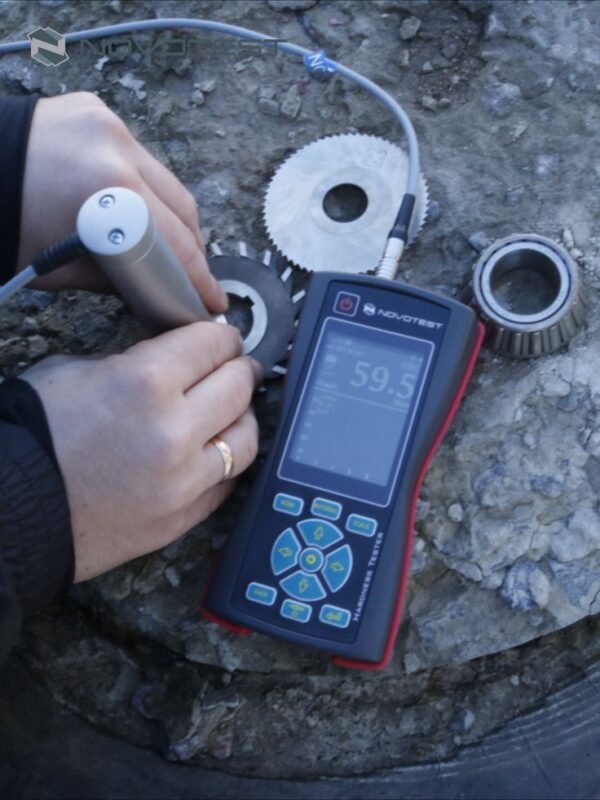
Laboratorios de control de calidad
Laboratories use Rockwell testers for routine inspections and certification testing.
Rockwell vs Other Hardness Testing Methods
Rockwell vs Brinell
| Característica | Rockwell | Brinell |
|---|---|---|
| Medición | Depth | Indentation Diameter |
| Velocidad | Rápido | Moderado |
| Tamaño de la muestra | Small to Medium | Large Components |
| Automatización | Alto | Moderado |
Rockwell vs Vickers
| Característica | Rockwell | Vickers |
|---|---|---|
| Método de medición | Depth-Based | Optical |
| Precisión | Alto | Very High |
| Thin Materials | Limited | Excelente |
| Facilidad de uso | Simple | More Complex |
Rockwell vs Leeb
| Característica | Rockwell | Leeb |
|---|---|---|
| Environment | Laboratory | Portable Field Testing |
| Precisión | Very High | Alto |
| Tamaño de la muestra | Small to Medium | Large Components |
Normas y cumplimiento de la industria
The Rockwell hardness test is governed by internationally recognized standards including:
- ASTM E18
- ISO 6508
For official standards information:
Compliance ensures consistent and globally accepted test results.
Preguntas frecuentes
1. What is the Rockwell hardness test used for?
It is used to measure a material’s resistance to indentation and verify material quality.
2. What does HRC mean?
HRC refers to the Rockwell C hardness scale, commonly used for hardened steel materials.
3. Is the Rockwell hardness test destructive?
The test creates a small indentation but is generally considered minimally destructive.
4. Which materials are commonly tested using Rockwell?
Steel, stainless steel, aluminum alloys, copper alloys, and heat-treated metals.
5. What is the difference between HRB and HRC?
HRB is used for softer materials, while HRC is designed for harder materials such as hardened steel.
6. Why is the Rockwell hardness test popular?
Because it is fast, easy to perform, highly repeatable, and provides direct hardness readings.
Conclusión
En Rockwell hardness test remains one of the most trusted and widely used hardness testing methods in modern industry. Its speed, simplicity, and accuracy make it an essential tool for quality control, material verification, and heat treatment inspection.
Whether used in manufacturing plants, research laboratories, or production environments, the Rockwell hardness test provides reliable hardness measurements that help ensure product quality, improve process consistency, and meet international standards.
.jpg)
