Vickers Hardness Test: Principles, Procedure and Applications

Introduction to the Vickers Hardness Test
Die Vickers hardness test is one of the most accurate and versatile methods used for measuring material hardness. It is widely applied in quality control, metallurgy, research laboratories, and manufacturing industries because it can test a broad range of materials, from soft metals to extremely hard alloys and surface coatings.
Unlike some hardness testing methods that are limited to specific materials or thicknesses, the Vickers method uses a single diamond indenter and a wide range of test loads. This flexibility makes it suitable for both macrohardness and microhardness testing applications.
Today, the Vickers hardness test is recognized worldwide as a reliable method for evaluating mechanical properties and ensuring material quality.
What Is the Vickers Hardness Test?
Definition und Zweck
Die Vickers hardness test is an indentation hardness testing method that determines a material’s resistance to deformation by pressing a diamond pyramid indenter into its surface under a controlled load.
The test is commonly used to:
- Evaluate material hardness
- Verify heat treatment results
- Analyze microstructures
- Test thin materials and coatings
- Support quality assurance programs
Importance in Material Testing
Hardness values provide valuable information about:
- Abriebfestigkeit
- Strength characteristics
- Material consistency
- Manufacturing quality
Because the Vickers method offers excellent precision, it is often selected when detailed hardness analysis is required.
History and Development of the Vickers Hardness Test
The Vickers hardness test was introduced in 1921 by engineers at Vickers Ltd. The goal was to create a universal hardness testing method that could be used across a wide variety of materials.
Its unique diamond pyramid indenter and flexible load range quickly made it one of the most respected hardness testing techniques in industrial and laboratory environments.
How the Vickers Hardness Test Works
Basic Testing Principle
The test involves pressing a diamond pyramid indenter into the specimen surface using a predetermined load.
After removing the load, the indentation left on the surface is measured and used to calculate the hardness value.
Diamant-Pyramide Eindringkörper
The Vickers indenter has:
- A square-based diamond pyramid shape
- Opposing face angles of 136°
This geometry provides consistent and accurate hardness measurements across different materials.
Messen der Vertiefung
Two diagonal lengths of the indentation are measured using:
- Optische Mikroskope
- Digital imaging systems
- Software für automatisierte Messungen
The average diagonal length is used to determine the hardness value.
Understanding Vickers Hardness Values (HV)
How HV Is Calculated
Vickers hardness values are expressed as HV.
The hardness value is calculated based on:
- Applied test force
- Surface area of the indentation
Modern digital hardness testers automatically perform these calculations.
Factors Affecting Test Results
Several factors can influence measurement accuracy:
- Surface finish
- Specimen thickness
- Test load selection
- Optical calibration
- Operator technique
Proper testing procedures help minimize variability.
Vickers-Härte-Testverfahren
Vorbereitung der Probe
Accurate testing requires:
- Clean surfaces
- Proper polishing when necessary
- Adequate specimen thickness
- Stable support during testing
Applying the Test Load
The selected load is applied through the diamond indenter for a specified dwell time.
Load ranges vary depending on the application.
Measuring Indentation Diagonals
After testing, the two diagonals of the indentation are measured and averaged.
Determining Hardness Values
Modern testers automatically calculate and display the HV value while storing results for future analysis.
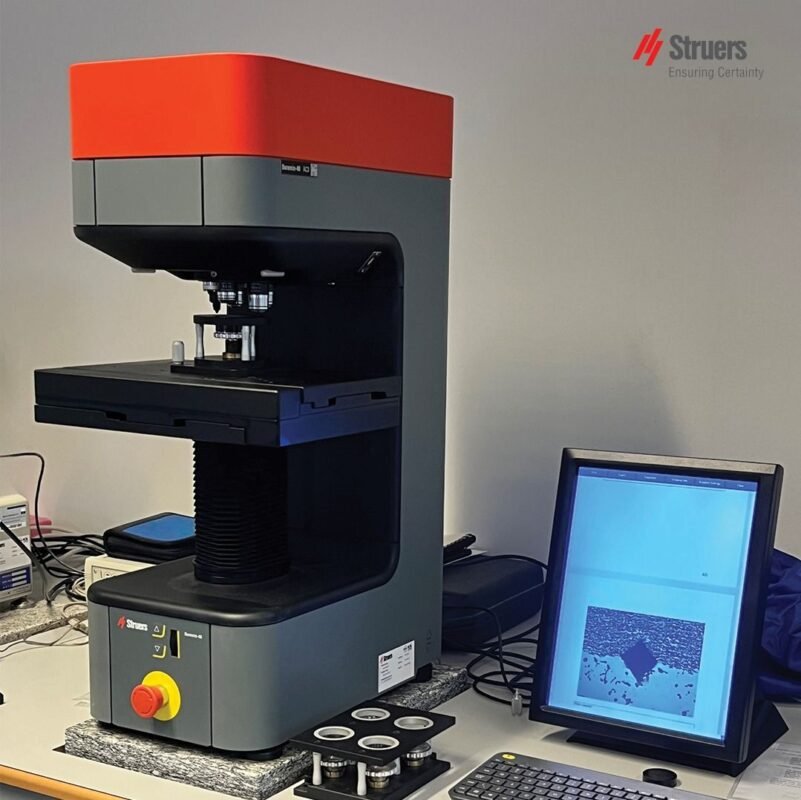
Equipment Used in Vickers Hardness Testing
Vickers-Härteprüfgeräte
Common systems include:
- Manual testers
- Digital testers
- Microhardness testers
- Fully automated systems
Optische Messsysteme
Optical components often include:
- Precision microscopes
- CCD cameras
- High-resolution imaging devices
Digital Imaging Technology
Advanced imaging systems improve:
- Measurement accuracy
- Repeatability
- Inspection speed
Automated Hardness Testing Systems
Modern automated systems provide:
- Automatic focusing
- Auto-indentation measurement
- Statistische Berichterstattung
- Data management integration
These features significantly improve productivity.
Advantages of the Vickers Hardness Test
The Vickers method offers several advantages:
- Hohe Messgenauigkeit
- Wide hardness testing range
- Geeignet für dünne Materialien
- Suitable for coatings and surface layers
- One indenter for many applications
- Ausgezeichnete Wiederholbarkeit
- Microhardness testing capability
These advantages make it one of the most versatile hardness testing methods available.
Limitations of the Vickers Hardness Test
Despite its strengths, there are some limitations:
- Erfordert optische Messung
- Longer testing time than Rockwell
- More sensitive to surface preparation
- Higher equipment complexity
However, these limitations are often outweighed by the method’s precision and flexibility.
Industrielle Anwendungen
Metallverarbeitung
Manufacturers use Vickers testing to verify material quality and production consistency.
Überprüfung der Wärmebehandlung
The method is widely used to evaluate:
Aerospace Components
Aerospace manufacturers rely on precise hardness measurements to ensure safety and performance.
Surface Coatings and Thin Films
The small indentation size makes Vickers testing ideal for:
- Protective coatings
- Thin films
- Surface engineering applications
Research and Metallurgical Laboratories
Researchers use the Vickers hardness test to study microstructures and material behavior.

Vickers vs Rockwell Hardness Test
| Merkmal | Vickers | Rockwell |
|---|---|---|
| Messverfahren | Optical | Depth-Based |
| Precision | Very High | Hoch |
| Thin Materials | Excellent | Limited |
| Testgeschwindigkeit | Mäßig | Schnell |
| Mikrohärteprüfung | Yes | No |
Rockwell testing is generally preferred for production environments, while Vickers testing excels in precision applications.
Vickers vs Brinell Hardness Test
| Merkmal | Vickers | Brinell |
|---|---|---|
| Eindringkörper | Diamond Pyramid | Carbide Ball |
| Thin Materials | Excellent | Limited |
| Precision | Very High | Hoch |
| Microhardness Capability | Yes | No |
| Large Castings | Mäßig | Excellent |
The Vickers method is more versatile across different material types and thicknesses.
Industriestandards und Compliance
The Vickers hardness test is governed by internationally recognized standards, including:
- ASTM E384
- ISO 6507
For official standards information:
Compliance ensures consistent and globally accepted hardness measurements.
Häufig gestellte Fragen
1. What is the Vickers hardness test used for?
It is used to measure material hardness, especially for thin materials, coatings, and precision engineering applications.
2. What does HV mean?
HV stands for Vickers Hardness Value.
3. Why is a diamond indenter used?
Diamond provides exceptional hardness and maintains its geometry during testing.
4. Can the Vickers test measure coatings?
Yes. It is one of the most commonly used methods for evaluating coatings and thin surface layers.
5. Is the Vickers hardness test destructive?
The test leaves a very small indentation and is generally considered minimally destructive.
6. What industries use Vickers hardness testing?
Manufacturing, aerospace, automotive, electronics, metallurgy, and research laboratories.
Fazit
Die Vickers hardness test is one of the most accurate and flexible hardness testing methods available today. Its ability to test a wide range of materials, including thin sections, coatings, and microstructures, makes it an essential tool for quality control, research, and advanced material analysis.
By understanding the principles, procedures, advantages, and applications of the Vickers hardness test, manufacturers and laboratories can select the most appropriate hardness testing solution and ensure reliable material performance.