




Wie man einen Härteprüfer auswählt Smart Guide 21 Expertentipps für genaue Ergebnisse

Gliederung für den Artikel zum Thema „So wählen Sie ein Härteprüfgerät aus“
| Themenbereich | Detaillierte Abdeckung mit LSI-Schlüsselwörtern |
|---|---|
| Einführung in die Auswahl eines Härteprüfers | selecting hardness tester |
| Warum die Wahl des richtigen Härteprüfers wichtig ist | accuracy, reliability |
| Grundlagen der Härteprüfung verstehen | indentation principles |
| Types of Hardness Testers Available | Rockwell, Brinell, Vickers |
| Auswahl eines Rockwell-Härteprüfers | Produktionsprüfung |
| Auswahl eines Brinell-Härteprüfgeräts | cast and forged materials |
| Auswahl eines Vickers-Härteprüfers | Präzisionsprüfung |
| Knoop Hardness Tester Selection | Analyse der Mikrohärte |
| Microhardness vs Macro Hardness Testers | application differences |
| Tragbare Härteprüfgeräte | Vor-Ort-Tests |
| Bench and Laboratory Hardness Testers | kontrollierte Umgebungen |
| Digital vs Analog Hardness Testers | usability |
| Automatic Hardness Testers | Großserientests |
| Materials to Be Tested | Stahl, Aluminium, Legierungen |
| Choosing a Tester for Steel | heat-treated materials |
| Choosing a Tester for Aluminum | weiche Metalle |
| Choosing a Tester for Cast Iron | grobe Strukturen |
| Choosing a Tester for Non-Ferrous Metals | copper, brass |
| Testing Range and Load Selection | Genauigkeit |
| Überlegungen zur Probengröße und Geometrie | part shape |
| Surface Condition Requirements | preparation |
| Anforderungen an Genauigkeit und Wiederholbarkeit | Qualitätskontrolle |
| Production Volume Considerations | Effizienz |
| Branchenspezifische Anforderungen | Automobil, Luft- und Raumfahrt |
| Standards und Einhaltung | ASTM, ISO |
| Kalibrierung und Rückverfolgbarkeit | qualitätssicherung |
| Ease of Use and Training | operator efficiency |
| Datenverwaltung und Berichterstattung | digital integration |
| Maintenance and Support | langfristige Zuverlässigkeit |
| Überlegungen zu Budget und Kosten | ROI |
| Common Mistakes When Choosing a Tester | avoidance |
| Evaluating Suppliers and Brands | Zuverlässigkeit |
| Markenkompetenz und Lösungen | Johoyd-Leitfaden |
| Ihre Investition zukunftssicher machen | scalability |
| FAQs | allgemeine Fragen |
| Fazit | Zusammenfassung |
Einführung
So wählen Sie ein Härteprüfgerät aus is a question faced by manufacturers, laboratories, quality engineers, and research teams across industries. With many hardness testing methods, configurations, and technologies available, selecting the right tester can feel overwhelming. However, the right choice directly affects accuracy, efficiency, and long-term testing reliability.
A hardness tester is more than just an inspection tool. It is an investment in product quality, safety, and process control. Understanding how to choose a hardness tester ensures that testing results are meaningful, repeatable, and compliant with industry standards.

So wählen Sie ein Härteprüfgerät aus
To understand So wählen Sie ein Härteprüfgerät aus, it is essential to start with your application requirements. The right tester depends on material type, testing environment, production volume, and accuracy expectations.
Rather than selecting based on popularity or price alone, a systematic evaluation ensures optimal performance and value.
Warum die Wahl des richtigen Härteprüfers wichtig ist
Choosing the wrong hardness tester can lead to inaccurate measurements, rejected parts, and costly rework. Incorrect hardness data may hide processing issues or create false confidence in product quality.
By carefully selecting a suitable hardness tester, organizations ensure reliable data, regulatory compliance, and consistent decision-making.
Grundlagen der Härteprüfung verstehen
Hardness testing measures a material’s resistance to permanent deformation. This resistance is evaluated by pressing an indenter into the material under a controlled load.
Different hardness testing methods measure either indentation depth or indentation size. Understanding these fundamentals helps guide the selection process.
Types of Hardness Testers Available
There are several types of hardness testers available, each designed for specific applications.
The most common types include Rockwell, Brinell, Vickers, and Knoop hardness testers.
Auswahl eines Rockwell-Härteprüfers
Rockwell hardness testers are widely used in production environments. They provide fast and direct readings.
This type is ideal when speed, simplicity, and repeatability are required, especially for steel and alloy components.
Auswahl eines Brinell-Härteprüfgeräts
Brinell testers use a large ball indenter and heavy load. They are suitable for softer materials and coarse-grain structures.
Brinell testing is often chosen for cast iron, forgings, and large components.
Auswahl eines Vickers-Härteprüfers
Vickers testers use a diamond pyramid indenter. They cover a wide hardness range.
This type is ideal when high accuracy and versatility are required, especially in laboratories and quality control settings.
Knoop Hardness Tester Selection
Knoop hardness testers are used for microhardness testing. They are ideal for thin layers and brittle materials.
This method is commonly used in research and surface analysis.
Microhardness vs Macro Hardness Testers
Microhardness testers use very low loads and analyze small features. Macro hardness testers evaluate bulk material properties.
Understanding the scale of testing helps determine the appropriate tester type.
Tragbare Härteprüfgeräte
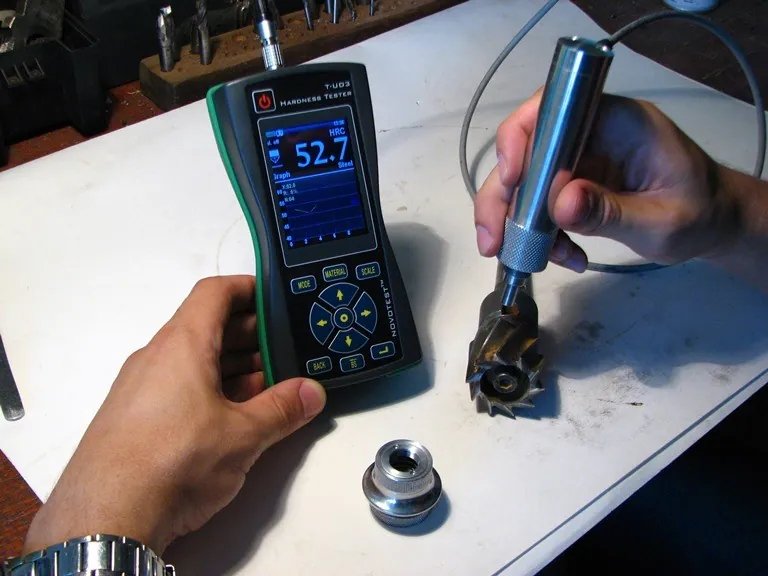
Portable hardness testers allow testing on large or installed components. They are ideal for maintenance and field inspections.
These testers are chosen when laboratory testing is impractical.
Bench and Laboratory Hardness Testers
Bench-top and laboratory hardness testers offer controlled conditions and high accuracy.
They are ideal for research, certification, and reference testing.
Digital vs Analog Hardness Testers
Digital hardness testers offer automated measurement, data storage, and reporting.
Analog testers are simpler but require more operator experience.
Automatic Hardness Testers
Automatic hardness testers reduce operator influence and improve repeatability.
They are ideal for high-volume production and standardized testing.
Materials to Be Tested
Material type is a primary factor when learning how to choose a hardness tester.
Steel, aluminum, cast iron, and non-ferrous metals all respond differently to indentation.
Choosing a Tester for Steel
Steel hardness testing often requires Rockwell or Vickers testers.
The choice depends on hardness range and application.

Choosing a Tester for Aluminum
Aluminum is softer and requires careful load selection.
Vickers or Brinell testers are commonly used.
Choosing a Tester for Cast Iron
Cast iron has a coarse structure.
Die Brinell-Prüfung liefert zuverlässige Durchschnittswerte für die Härte.
Choosing a Tester for Non-Ferrous Metals
Nichteisenmetalle erfordern flexible Testmethoden.
Die Vickers-Prüfung wird oft aus Gründen der Genauigkeit bevorzugt.
Testing Range and Load Selection
The tester must cover the required hardness range.
Incorrect load selection can lead to inaccurate results.
Überlegungen zur Probengröße und Geometrie
Component size and shape affect tester selection.
Thin or irregular samples may require microhardness testing.
Surface Condition Requirements
Surface preparation influences hardness results.
Some testers tolerate rough surfaces better than others.
Anforderungen an Genauigkeit und Wiederholbarkeit
Quality-critical applications demand high accuracy.
Automatic and digital testers improve repeatability.
Production Volume Considerations
High production volumes benefit from fast and automated testers.
Low-volume testing may prioritize versatility.
Branchenspezifische Anforderungen
Industries such as automotive and aerospace have strict testing requirements.
Compliance often dictates tester selection.
Standards und Einhaltung
Hardness testers should comply with ASTM and ISO standards.
Konformität sorgt für weltweite Akzeptanz.
Kalibrierung und Rückverfolgbarkeit
Durch regelmäßige Kalibrierung bleibt die Genauigkeit erhalten.
Die Rückverfolgbarkeit unterstützt Audits und Qualitätssysteme.
Ease of Use and Training
User-friendly testers reduce training time and errors.
Intuitive interfaces improve productivity.
Datenverwaltung und Berichterstattung
Modern testers offer digital data storage and reporting.
This supports quality documentation and analysis.
Maintenance and Support
Reliable support and maintenance services protect investment.
Long-term accuracy depends on proper upkeep.
Überlegungen zu Budget und Kosten
Cost should be balanced against performance and durability.
The cheapest option may not deliver long-term value.

Common Mistakes When Choosing a Hardness Tester
Common mistakes include choosing based on price alone or ignoring standards.
Clear requirements prevent costly errors.
Evaluating Suppliers and Brands
Reputable suppliers offer technical support and training.
Experience matters when selecting testing equipment.
Markenkompetenz und Lösungen
Choosing the right hardness tester is easier with expert guidance. Brands like Johoyd, durch https://hardnesstests.com, provide professional advice and a wide range of hardness testers tailored to industrial, laboratory, and research needs.
Their expertise helps users confidently understand So wählen Sie ein Härteprüfgerät aus that meets both current and future requirements.
Ihre Investition zukunftssicher machen
Future-proof testers support upgrades, automation, and digital integration.
Scalable solutions protect long-term value.
Häufig gestellte Fragen
Why is it important to know how to choose a hardness tester?
It ensures accurate and reliable testing.
Which hardness tester is best for beginners?
Rockwell testers are simple and widely used.
Sind tragbare Härteprüfgeräte genau?
Ja, sofern es ordnungsgemäß kalibriert ist.
Do all industries use the same hardness tester?
No, requirements vary by application.
Wie oft sollten Härteprüfgeräte kalibriert werden?
Gemäß den Standards oder dem Gebrauch.
Can one tester handle all materials?
Some testers are versatile, but specialization improves accuracy.
Fazit
Verständnis So wählen Sie ein Härteprüfgerät aus is essential for achieving accurate, repeatable, and compliant material testing. The right choice depends on material type, application environment, accuracy requirements, and future needs.
Mit erfahrenen Herstellern wie Johoyd offering expert solutions through hardnesstests.com, users gain confidence in their selection process. By investing wisely, organizations ensure long-term quality, efficiency, and reliability in hardness testing.
Vorgeschlagene interne Links
- Arten von industriellen Härteprüfern
- Hardness Testing Standards and Methods
Vorgeschlagene ausgehende Links
- ASTM-Härteprüfnormen
- ISO Guidelines for Material Hardness Testing