




Benchtop Hardness Tester: 12 Powerful Benefits for Precision Material Testing


Article Outline
| Heading Level | Section |
|---|---|
| H1 | Benchtop Hardness Tester: Complete Guide |
| H2 | Introduction to Benchtop Hardness Tester |
| H2 | What is a Benchtop Hardness Tester |
| H3 | Importance of Hardness Testing |
| H2 | Working Principle of a Benchtop Hardness Tester |
| H3 | Indentation Method |
| H3 | Hardness Measurement Process |
| H2 | Types of Benchtop Hardness Tester |
| H3 | Rockwell Benchtop Hardness Tester |
| H3 | Brinell Benchtop Hardness Tester |
| H3 | Vickers Benchtop Hardness Tester |
| H3 | Micro Hardness Benchtop Tester |
| H2 | Main Components of a Benchtop Hardness Tester |
| H3 | Indenter System |
| H3 | Load Application Mechanism |
| H3 | Measurement and Optical System |
| H3 | Digital Control Interface |
| H2 | Applications of Benchtop Hardness Tester |
| H2 | Advantages of Using Benchtop Hardness Tester |
| H2 | Hardness Testing Standards |
| H2 | How to Choose the Right Benchtop Hardness Tester |
| H2 | Maintenance and Calibration |
| H2 | Future Developments in Hardness Testing Technology |
| H2 | Häufig gestellte Fragen |
| H2 | Schlussfolgerung |
Benchtop Hardness Tester: Complete Guide
Introduction to Benchtop Hardness Tester
A benchtop hardness tester is a compact material testing instrument designed to measure the hardness of materials in laboratories, research centers, and industrial quality control departments. Hardness testing is a crucial process used to determine a material’s resistance to indentation, scratching, and deformation.
Unlike large floor-standing machines, benchtop hardness testers are designed to be placed on a laboratory workbench or testing table, making them ideal for laboratories with limited space while still delivering high levels of precision.
These devices are widely used for testing metals, alloys, plastics, ceramics, and composite materials. Engineers and technicians rely on benchtop hardness testers to evaluate material properties, verify manufacturing processes, and ensure product quality.
Because of their compact design, reliability, and ease of operation, benchtop hardness testers are commonly found in manufacturing industries, educational institutions, and material research laboratories.
What is a Benchtop Hardness Tester
A benchtop hardness tester is a laboratory instrument used to measure material hardness using standardized hardness testing methods such as Rockwell, Brinell, or Vickers.
The machine applies a controlled load through a specific indenter onto the surface of the material. The indentation created by the load is then measured to determine the hardness value.
Benchtop hardness testers are popular because they provide:
- Accurate hardness measurements
- Compact and space-saving design
- Easy operation and setup
- Reliable and repeatable results
They are ideal for environments where precision testing is required but space is limited.
Importance of Hardness Testing
Hardness testing plays an essential role in evaluating the mechanical properties of materials.
Key reasons for performing hardness testing include:
Material Strength Evaluation
Hardness helps determine the strength and durability of materials.
Quality Control
Manufacturers use hardness testing to ensure products meet specified engineering standards.
Überprüfung der Wärmebehandlung
After heat treatment processes such as quenching or tempering, hardness testing confirms whether the desired properties have been achieved.
Wear Resistance Assessment
Harder materials generally show better resistance to abrasion and wear.
Working Principle of a Benchtop Hardness Tester
A benchtop hardness tester operates based on the indentation testing principle. This method evaluates the hardness of a material by measuring how much it resists indentation from a specific indenter under a defined load.
Indentation Method
The testing process usually follows these steps:
- The material sample is placed on the testing stage.
- The operator selects the desired hardness testing method.
- The indenter is positioned on the material surface.
- A controlled load is applied for a specific duration.
- The indenter creates a small indentation on the material surface.
- The indentation is measured to determine hardness.
Each hardness testing method uses different indenters and load values.
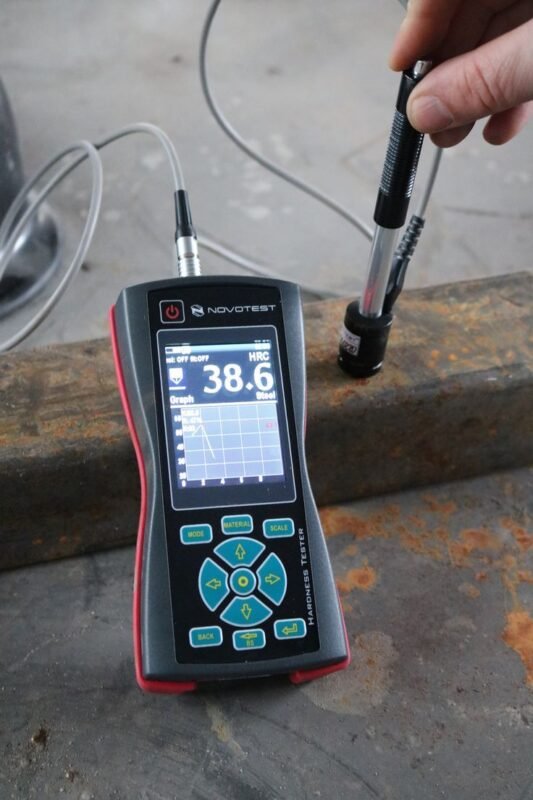
Hardness Measurement Process
There are two common ways to determine hardness values.
Tiefenmessung
Some hardness tests measure the depth of penetration created by the indenter.
Optical Measurement
Other methods measure the diameter or diagonal length of the indentation using microscopes or digital imaging systems.
Modern benchtop hardness testers often include automatic measurement systems that calculate hardness values instantly.
Types of Benchtop Hardness Tester
Several hardness testing methods are commonly used with benchtop hardness testers.
Rockwell Benchtop Hardness Tester
The Rockwell hardness tester determines hardness based on indentation depth.
Advantages
- Schnelle Prüfgeschwindigkeit
- Direkte Härtemessung
- Minimal sample preparation
Rockwell testers are widely used in manufacturing quality control.
Brinell Benchtop Hardness Tester
The Brinell hardness tester uses a steel or tungsten carbide ball indenter.
Merkmale
- Large indentation area
- Suitable for softer metals
- Good for cast materials
Brinell testing is commonly used in heavy metal industries.
Vickers Benchtop Hardness Tester
The Vickers hardness tester uses a Diamant-Pyramiden-Eindringkörper.
Benefits
- High measurement accuracy
- Suitable for thin materials
- Works for both soft and hard materials
Vickers testing is widely used in metallurgical research laboratories.
Micro Hardness Benchtop Tester
Micro hardness testers measure hardness using very small loads and high magnification systems.
Anwendungen
- Dünne Schichten
- Kleine Komponenten
- Analyse der Mikrostruktur
These testers are essential in electronics and materials research.
Main Components of a Benchtop Hardness Tester
A benchtop hardness tester contains several key components that enable precise hardness measurement.
Indenter System
The indenter is the tool used to apply pressure to the material surface.
Common indenter types include:
- Diamond pyramid indenters
- Steel ball indenters
- Tungsten carbide balls
Load Application Mechanism
The load system applies a controlled force to the indenter.
Load systems may include:
- Dead weight mechanisms
- Hydraulic systems
- Motorized load application
Accurate load control ensures reliable test results.
Measurement and Optical System
Many benchtop hardness testers include optical microscopes or digital cameras to measure indentation dimensions.
Advanced systems can automatically calculate hardness values.
Digital Control Interface
Modern testers feature digital displays or touchscreen control panels.
These systems allow operators to:
- Select testing methods
- Adjust load parameters
- Store test results
- Generate reports
Applications of Benchtop Hardness Tester
Benchtop hardness testers are used in a wide range of industries.
Manufacturing Industry
Used to verify the hardness of machined components and metal parts.
Metallurgical Laboratories
Engineers analyze metal microstructures and heat treatment results.
Autoindustrie
Used to test engine parts, gears, and mechanical components.
Luft- und Raumfahrtindustrie
Evaluates high-performance alloys used in aircraft structures.
Academic Research
Universities use benchtop hardness testers to study material properties and engineering behavior.
Advantages of Using Benchtop Hardness Tester
Benchtop hardness testers offer several advantages.
Compact Design
Fits easily on laboratory workbenches.
High Precision
Provides accurate hardness measurements.
Cost-Effective
More affordable than large floor-standing testers.
Versatile Testing
Supports multiple hardness testing methods.
Easy Operation
User-friendly controls simplify testing procedures.
Hardness Testing Standards
Hardness testing procedures follow international standards developed by organizations such as:
- ASTM International
- International Organization for Standardization
These standards ensure consistent and reliable hardness testing across industries.

How to Choose the Right Benchtop Hardness Tester
Selecting the right benchtop hardness tester depends on several factors.
Material Typ
Different materials require different hardness testing methods.
Lastbereich
Ensure the tester supports the required load levels.
Measurement Accuracy
High-quality optical systems improve precision.
Automation Features
Automated testers reduce operator errors.
Data Management
Modern testers provide software for storing and analyzing test results.
Maintenance and Calibration
Regular maintenance ensures accurate hardness testing.
Important practices include:
- Cleaning indenters and testing surfaces
- Checking load calibration
- Inspecting optical measurement systems
- Updating testing software
Routine calibration ensures long-term reliability.
Future Developments in Hardness Testing Technology
Hardness testing technology continues to advance.
Automated Hardness Testing Systems
Automation increases efficiency and consistency.
Digital Imaging Technology
Advanced imaging improves measurement accuracy.
AI-Based Data Analysis
Artificial intelligence helps analyze material properties.
Smart Laboratory Integration
Hardness testers can integrate with laboratory information management systems (LIMS).
Häufig gestellte Fragen
1. What is a benchtop hardness tester used for?
It measures the hardness of materials by evaluating their resistance to indentation.
2. What materials can be tested?
Materials such as metals, plastics, ceramics, and composites can be tested.
3. What hardness testing methods can benchtop testers perform?
Common methods include Rockwell, Brinell, and Vickers hardness testing.
4. Why is hardness testing important?
It helps determine material strength, durability, and wear resistance.
5. How accurate are benchtop hardness testers?
High-quality testers provide precise and repeatable hardness measurements.
6. How often should a hardness tester be calibrated?
Calibration should be performed regularly according to industry standards and manufacturer recommendations.
Schlussfolgerung
A benchtop hardness tester is a compact yet powerful instrument used for precise hardness measurement in laboratories and industrial quality control environments. By applying standardized hardness testing methods such as Rockwell, Brinell, and Vickers, these machines provide reliable insights into material strength and durability.
Their compact size, versatility, and accuracy make benchtop hardness testers essential tools for engineers, researchers, and manufacturers who need consistent and reliable material testing results.
As technology continues to evolve, modern benchtop hardness testers are becoming more automated, digitally integrated, and capable of delivering even higher precision, making them indispensable tools in modern material science and engineering laboratories.